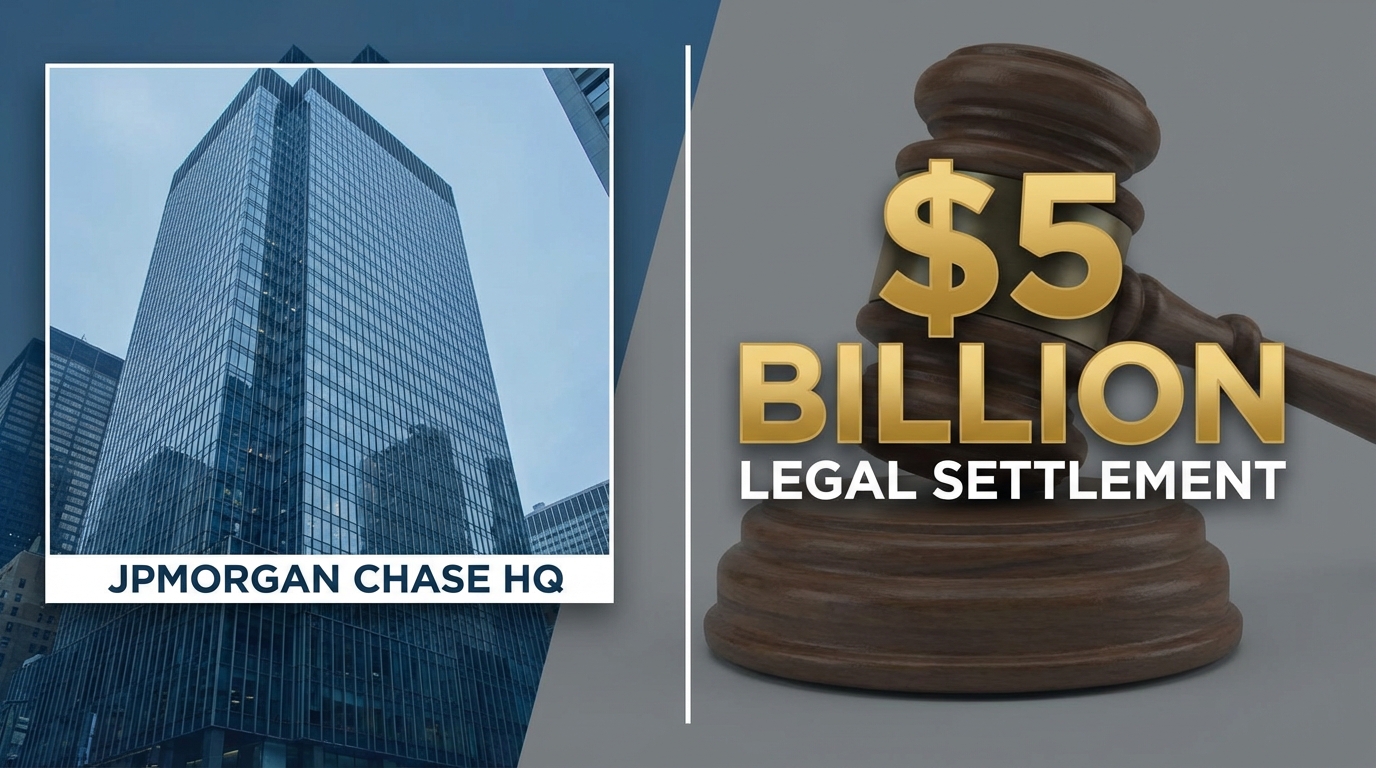
In a move that has sent shockwaves through Wall Street and the global financial sector, President Trump sues JPMorgan Chase and its CEO Jamie Dimon for $5 billion. Filed on Thursday, January 22, 2026, in a Miami-Dade County court, the lawsuit alleges that the nation’s largest bank engaged in politically motivated “debanking” by abruptly closing multiple accounts belonging to the President and his hospitality businesses in early 2021. This high-stakes legal battle marks a significant escalation in the ongoing debate over financial censorship and the regulatory responsibilities of “too-big-to-fail” institutions.
For investors and market analysts, the news that Trump sues JPMorgan represents a major shift in the risk landscape for banking stocks. As the 2026 economic environment remains sensitive to regulatory changes and high-profile litigation, understanding the implications of this case is essential for long-term wealth building. This guide breaks down the core legal concepts, the potential impact on the banking industry, and the practical strategies investors can use to protect their portfolios during this period of heightened volatility.
Political Debanking and the $5 Billion Claim
At its heart, the lawsuit filed by President Trump is about the concept of “debanking”—the practice where a financial institution terminates a customer’s relationship, often without a detailed explanation, due to perceived risks. While banks typically cite “regulatory” or “reputational” risks as the cause, the current legal complaint argues that these decisions were driven by ideological motivations rather than objective financial metrics.
The Allegations: Why Trump Sues JPMorgan
The lawsuit contends that JPMorgan Chase abruptly closed several long-standing accounts on February 19, 2021, providing only a 60-day notice period. These accounts, which had facilitated hundreds of millions of dollars in transactions over several decades, were allegedly shuttered to distance the bank from the political fallout following the events of January 6, 2021.
The legal team representing the President argues that this move constituted “trade libel” and a breach of the implied covenant of good faith and fair dealing. Furthermore, the suit alleges that the bank’s actions violated Florida’s specific laws regarding unfair and deceptive trade practices, which prohibit financial institutions from discriminating against customers based on their political or religious beliefs.
The Bank’s Defense: Regulatory Risk vs. Political Bias
In response to the $5 billion filing, JPMorgan Chase has issued a statement claiming the suit is “without merit.” The bank maintains that it does not close accounts for political or religious reasons. Instead, it argues that accounts are terminated only when they “create legal or regulatory risk for the company.”
This defense touches on a fundamental tension in modern banking: the requirement to perform “Know Your Customer” (KYC) and Anti-Money Laundering (AML) checks, which sometimes forces banks to exit relationships with “Politically Exposed Persons” (PEPs). However, the lawsuit alleges that JPM used “woke” social motivations to justify an industry practice of blacklisting conservative figures.
Managing Financial Exposure in High-Stakes Litigation
As an investor, when a major headline like Trump sues JPMorgan breaks, your first priority is to assess how this litigation affects the bank’s valuation and the broader financial sector. The 2026 market is characterized by a “litigation premium,” where legal risks can impact a bank’s ability to return capital to shareholders through dividends or buybacks.
Assessing Litigation Risk for Financial Giants
While $5 billion is a staggering sum, it must be viewed in the context of JPMorgan’s balance sheet. With quarterly earnings often exceeding $10 billion, the bank has a massive “capital buffer.” However, the risk is not just the potential payout, but the “discovery phase” of the trial.
- Review Operational Integrity: Investors should look for any evidence in quarterly reports of increased legal reserves. If the bank begins setting aside billions for “legal contingencies,” it signals that the risk is moving from “theoretical” to “probable.”
- Monitor Institutional Sentiment: Watch the actions of major pension funds and ETFs. If large-scale holders begin to trim their positions in JPM due to reputational concerns or potential regulatory blowback, it can create sustained downward pressure on the stock price.
Portfolio Protection Strategies
In a world where Trump sues JPMorgan, you need a framework to hedge your financial sector exposure.
- Diversify Across Tiers: Do not concentrate all your banking exposure in a single “Global Systemically Important Bank” (G-SIB). Consider diversifying into regional banks or fintech companies that may benefit from a shift in deposits.
- Utilize Tail-Risk Hedges: Given the political nature of this case, use out-of-the-money put options on the Financial Select Sector SPDR Fund (XLF) to protect against a broader industry sell-off.
- Watch for Regulatory Contagion: is a must-read, as the current administration’s moves to stop debanking could fundamentally change how all banks manage risk.
- Monitor the 10-Year Treasury Yield: Large banks are sensitive to interest rate spreads. If litigation causes a “risk-off” mood that drives investors into bonds, falling yields could compress JPM’s net interest margins.
Actionable Steps for the Proactive Investor:
- Review FDIC and OCC filings: Check for any new guidelines regarding “reputational risk” assessments.
- Audit your dividend income: Ensure your portfolio is not overly reliant on a single bank that might be forced to freeze its dividend due to legal stressors.
- Stay informed via authoritative sources: The Bank for International Settlements (BIS) often provides high-level insights into how geopolitical lawsuits affect global systemic stability.
The Cost of Legal Battles
To put the current $5 billion lawsuit into perspective, it is helpful to compare it with previous legal challenges faced by major U.S. financial institutions.
Comparative Analysis: JPM vs. Industry Norms
The following table illustrates the potential financial impact of various legal outcomes.
| Outcome Scenario | Estimated Financial Impact | Potential Market Reaction |
| Complete Dismissal | Minimal (Legal Fees Only) | Strong relief rally for JPM stock; reinforces bank autonomy. |
| Negotiated Settlement | $250 Million – $750 Million | Modest dip; viewed as “cost of doing business.” |
| **Jury Award ($5 Billion)** | $5 Billion + Punitive Damages | Major sell-off; potential impact on dividend and buyback programs. |
| Regulatory Reform | Long-term operational costs | Structural shift in how banks perform risk-based account closures. |
This scenario analysis suggests that the real “danger zone” for JPM is not just the $5 billion check, but the potential for a court-mandated change in business practices. If the court rules that banks must provide “public utility” levels of access regardless of political risk, it would revolutionize the profit models of the entire sector.
Central PA Retail Closures 2026
Common Mistakes and Risks to Avoid
- Trading on Emotion: News that Trump sues JPMorgan is inherently political. Successful wealth building requires you to separate your personal political views from your objective financial analysis.
- Underestimating the “Discovery Phase”: The biggest risk for any large corporation in a lawsuit is the release of internal emails and documents. These can reveal “reputational” landmines that damage the brand far beyond the courtroom.
- Ignoring the “Capital One” Precedent: shows a pattern of legal aggression. Investors should look at how those previous cases evolved to predict the trajectory of the JPM suit.
- Forgetting about “Fiduciary Duty”: Remember that Jamie Dimon’s primary legal obligation is to JPM shareholders. Any settlement or trial strategy will be designed to protect the bank’s long-term earnings power.
Conclusion – Key Takeaways & Next Steps
The lawsuit filed on January 22, 2026, where Trump sues JPMorgan and CEO Jamie Dimon, is a watershed moment for the financial services industry. It brings the opaque practice of debanking into the harsh light of a courtroom and challenges the definition of “risk” in the 21st century. Whether this results in a $5 billion payout or a fundamental shift in banking regulation, the 2026 investor must remain vigilant.
Ultimately, your goal is to build a resilient portfolio that can weather these high-profile storms. By diversifying your banking holdings, monitoring legal reserves, and understanding the regulatory environment, you can ensure that your long-term growth remains on track, regardless of the headlines.
Are you concerned about your exposure to banking stocks?
Start by reviewing the “Legal and Regulatory Risk” section of your brokerage’s latest 10-K filing. Would you like me to create a “Litigation Exposure Checklist” to help you identify which of your financial holdings are most vulnerable to upcoming political lawsuits?