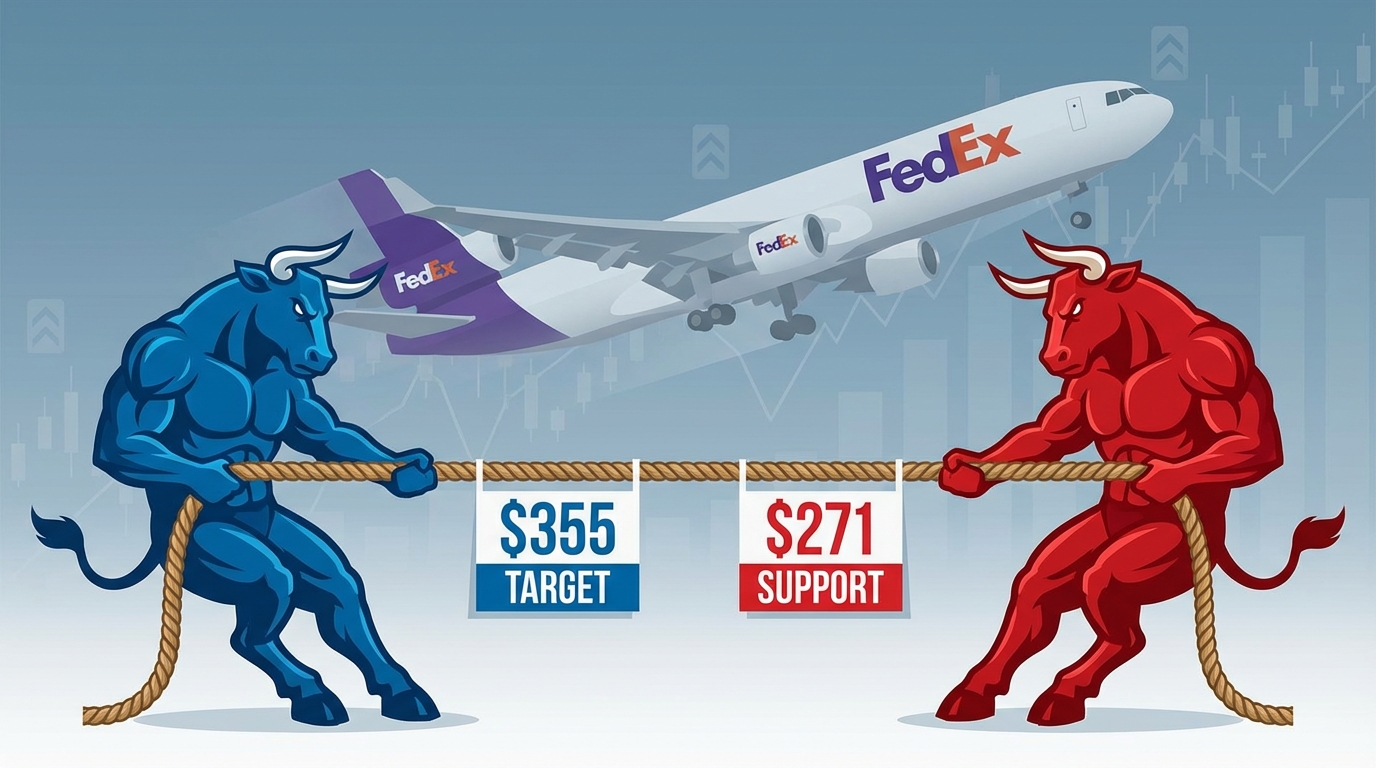
The logistics sector has officially entered a state of high-stakes volatility as FedEx stock gets a tug-of-war between cautious analysts and bullish price targets. On one side of the rope, institutional heavyweights like Rothschild Redburn have issued high-profile downgrades, citing a rally that has “priced in” the good news. On the other, firms like Argus and Wolfe Research have catapulted their price targets to the $350–$355 range, betting on the transformative power of the upcoming FedEx Freight spin-off.
As of late January 2026, FedEx (FDX) is trading near its 52-week highs, driven by a 38% surge over the last six months. However, for investors, this momentum is a double-edged sword. Is the current valuation a peak before a correction, or the launchpad for a new era of capital efficiency? In this guide, we will break down the mechanics of the “Freight spin-off,” analyze the conflicting analyst targets, and provide a framework for navigating this logistics giant in the 2026 economic environment.
Central PA Retail Closures 2026
The Core Concept: Why FedEx is in a Tug-of-War
The central driver of the FedEx stock gets a tug-of-war sentiment is the planned separation of its Less-Than-Truckload (LTL) business. Announced as a key value-creation milestone, the spin-off of FedEx Freight—scheduled for June 1, 2026—aims to unlock the latent value of North America’s largest LTL carrier.
The Spin-Off Thesis: Unlocking the “LTL Premium”
Historically, FedEx has traded at a “conglomerate discount” compared to pure-play LTL competitors like Old Dominion Freight Line. By spinning off FedEx Freight into a standalone public company (to be listed under the ticker FDXF), management hopes to achieve a higher valuation multiple for the freight business while streamlining the core parcel operations under “Network 2.0.”
The Bear Case: Overbought and Overpriced
The recent downgrade from Rothschild Redburn to “Neutral” stems from the belief that the stock’s 31% gain over the last 90 days has already captured the upside of the spin-off. Bears argue that with an RSI (Relative Strength Index) near 65, the stock is approaching overbought territory. Furthermore, the “Network 2.0” transformation—merging Express and Ground operations—carries significant execution risk that could weigh on margins if volumes stagnate in a cooling 2026 economy.
Practical Strategies: Navigating the $350–$355 Targets
For the proactive investor, the FedEx stock gets a tug-of-war provides a clear roadmap for entry and exit points. While some analysts are cooling, others see the $350 mark as just the beginning.
Strategy 1: The “Event-Driven” Entry
With the FedEx Freight Investor Day set for April 8, 2026, the market is likely to experience a “buy the rumor, sell the news” dynamic.
- Step-by-Step Guidance:
- Monitor the 50-day SMA: The stock currently finds support near $287. If a pullback occurs due to broader market profit-taking, this is a technical entry point for long-term bulls.
- Watch the Freight Investor Day: Look for specific guidance on FDXF’s starting debt levels and dividend policy.
- Set Limit Orders: With targets hitting $355, a 15% upside remains. Use limit orders at the $300 psychological level to catch volatility dips.
Strategy 2: Hedging with Logistics Peers
The logistics market in 2026 is seeing “episodic tightness.” While FedEx is restructuring, you can hedge your position by looking at competitors with less “transformation risk.”
Actionable Steps for the FedEx Investor:
- Review your cost basis: If you bought below $220, taking “partial profits” while the tug-of-war rages is a prudent way to lock in gains.
- Analyze Capex trends: Management has reaffirmed a $4.5 billion capital spending target for FY2026, focused on automation. Ensure these investments are actually translating into lower “cost per package” in quarterly reports.
- Monitor the “Amazon Effect”: FedEx has recently onboarded Amazon as a customer. Track the “Mix Shift” in earnings calls to see if this high-volume business is diluting or enhancing margins.
Scenarios: The Financial Math of the Spin-Off
To understand why FedEx stock gets a tug-of-war, we must look at the projected earnings power of the split entities.
| Segment | FY2026 Est. Revenue | Projected Margin | Strategic Focus |
| FedEx (Parcel) | ~$75 Billion | 6.5% – 8.0% | Network 2.0 / Cost Cuts |
| FedEx Freight (LTL) | ~$15 Billion | 20% – 22% | Pricing Power / High Yield |
Scenario: The “Sum-of-the-Parts” Valuation
If the independent FedEx Freight achieves a P/E multiple of 20x (typical for high-margin LTL) and the remaining Parcel business trades at 14x, the combined value could indeed push the stock past the $355 mark. However, if the separation costs—estimated at $0.72 per diluted share—balloon beyond expectations, the Downgrade camp’s “Hold” rating will be vindicated.
Macro Insight: According to theInternational Monetary Fund (IMF), “supply chain resilience” is the primary theme of 2026. Companies that can self-fund their transformation without relying on volatile debt markets are the safest bets for long-term wealth building.
Common Mistakes and Risks to Avoid
- Ignoring the MD-11 Grounding: FedEx is temporarily grounding parts of its MD-11 fleet, a move that creates a $175 million profit headwind. Don’t mistake this for a fundamental business decline.
- Chasing High Targets Blindly: A $365 target from BofA Securities is exciting, but it assumes “perfect execution” of the Freight spin-off. Always factor in a 10% “execution discount.”
- Underestimating Tariff Volatility: In 2026, trade policy remains a “wild card.” FedEx’s international export volumes are highly sensitive to sudden tariff announcements.
Conclusion – Key Takeaways & Next Steps
The FedEx stock gets a tug-of-war because it is at a historic crossroads. On June 1, 2026, the company as we know it will cease to exist, replaced by two specialized giants. For the bulls, the $350–$355 targets represent a fair valuation for a streamlined, high-margin logistics leader. For the bears, the current 17x P/E ratio is “full,” leaving little room for error.
Ultimately, your strategy should depend on your time horizon. If you are a long-term wealth builder, the spin-off is a “thesis-altering” catalyst that warrants holding through the noise. If you are a tactical trader, the tug-of-war is an opportunity to scalp volatility between the $290 support and $320 resistance levels.
Are you ready to position your portfolio for the spin-off?
Start by setting price alerts at $318 (the 52-week high) and $285 (key analyst support). Would you like me to create a “FedEx Spin-Off Survival Checklist” to help you track the critical SEC filings leading up to June 1st?