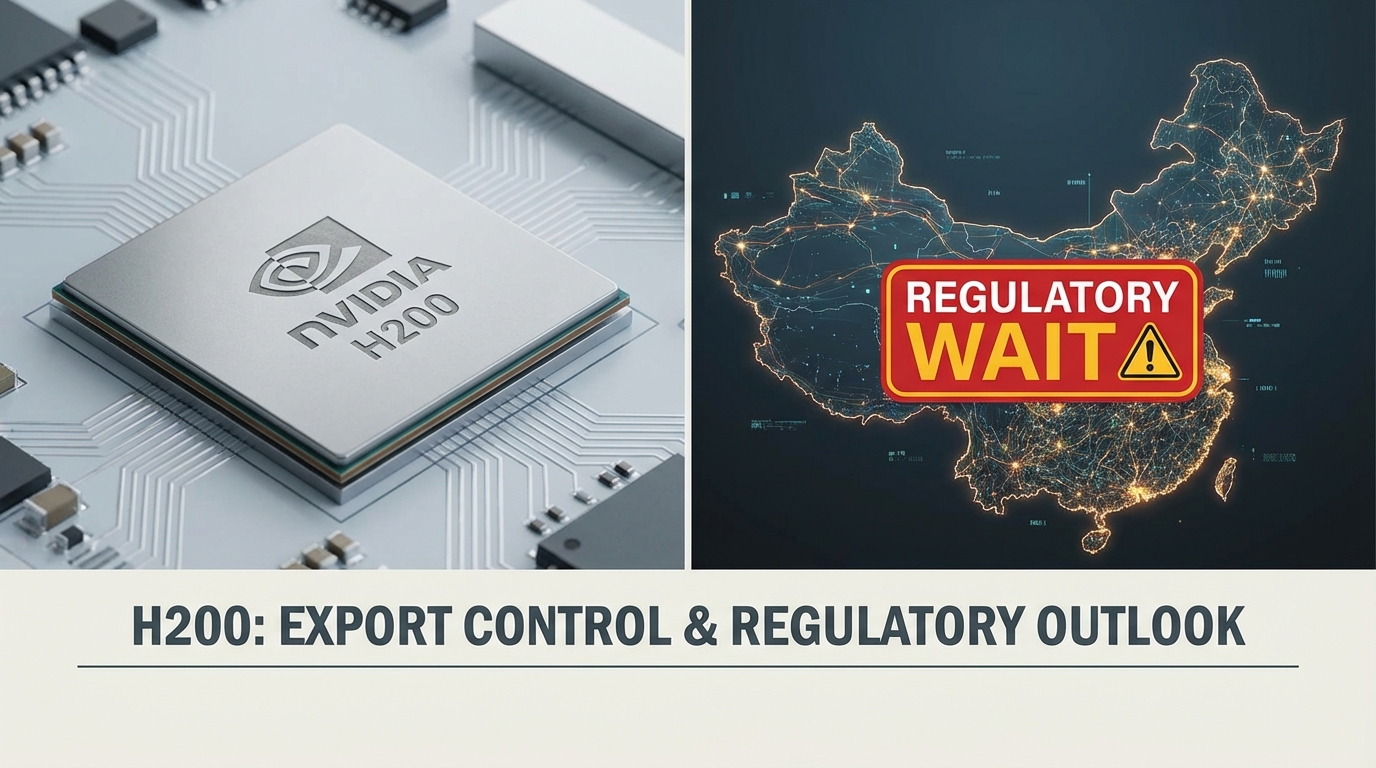
The global semiconductor race just hit a massive geopolitical roadblock that every tech investor needs to monitor. Recently, Taiwan’s Inventec made headlines by revealing that the deployment of the highly anticipated Nvidia H200 chip stuck in China is currently stalled. While the United States has theoretically cleared the path for these advanced AI processors under specific tariff conditions, the “ball” is now firmly in Beijing’s court. As of late January 2026, the uncertainty surrounding these shipments is causing ripples across the entire AI supply chain, from server manufacturers in Taipei to data center operators in Shanghai.
For those navigating the 2026 investment landscape, this development is more than just a supply chain hiccup. It represents a fundamental shift in how the world’s two largest economies manage high-end technology. In this article, we will break down why the Nvidia H200 chip stuck in China status is a critical signal for your portfolio and how you can strategically position your investments amid this escalating tech standoff.
The Geopolitical Standoff Over AI Hardware
To understand why the Nvidia H200 chip stuck in China situation is so significant, one must first grasp the technical and political weight of the H200 itself. The H200 is Nvidia’s second-most powerful AI processor, a cornerstone for training large language models and running complex generative AI applications.
The Shift from US Bans to Chinese Resistance
Throughout 2024 and 2025, the primary narrative was the U.S. government blocking exports to China. However, in early 2026, the dynamic changed. The Trump administration approved the sale of H200 chips to China, provided a 25% “export fee” was paid to the U.S. Treasury. This was seen as a way to allow American companies to maintain market share while generating federal revenue.
Surprisingly, the friction has now moved to the Chinese side. Reports from Inventec President Jack Tsai suggest that Chinese customs are withholding approval for these shipments. Whether this is a formal ban or a tactical delay remains unclear, but the result is a massive backlog of hardware that cannot reach its end users.
The Strategic Value for Inventec and Suppliers
Inventec is a vital link in this chain. As a major contract manufacturer for AI servers, they produce the “boxes” that house these Nvidia chips for clients like Alibaba, Tencent, and ByteDance. When the Nvidia H200 chip stuck in China news broke, it signaled that billions of dollars in planned infrastructure spending could be on hold. This uncertainty forces manufacturers to pause production lines to avoid building inventory that they cannot legally deliver.
Practical Strategies for the AI Investor
Investing in the semiconductor sector in 2026 requires more than just looking at earnings per share (EPS). You must account for “geopolitical beta”—the risk that political decisions will override market demand. With the Nvidia H200 chip stuck in China, here is a framework to protect and grow your wealth.
1. Diversifying Away from China-Dependent Tech
If your portfolio is heavily weighted in companies that rely on the Chinese market for more than 20% of their revenue, the current H200 stalemate is a warning sign.
- Focus on Sovereign AI: Look for companies benefiting from the “Sovereign AI” trend—nations like Saudi Arabia, the UAE, and Japan that are building their own data centers using Western tech without the same regulatory hurdles as China.
- The “Taiwan Hedge”: While Taiwanese firms like Inventec are caught in the middle, they are also rapidly expanding manufacturing in Mexico and Southeast Asia. Prioritize firms with successful “China Plus One” strategies.
2. Monitoring the “Domestic Substitution” Play
Beijing is reportedly urging its domestic tech giants to prioritize local alternatives, such as Huawei’s Ascend series chips.
- Strategic Move: Keep an eye on the performance gap between Nvidia’s H200 and Chinese domestic chips. If the H200 remains stuck, Chinese firms will be forced to optimize their software for local hardware, potentially creating a long-term “walled garden” that excludes U.S. tech.
Actionable Steps for Investors:
- Set “Policy Alerts”: Follow news from the U.S. Department of Commerce and China’s Ministry of Commerce (MOFCOM) rather than just stock price alerts.
- Increase exposure to “pick and shovel” plays: Companies that provide the cooling systems or power management for data centers often benefit regardless of which chip is inside the server.
Professional Note: According to theBank for International Settlements (BIS), global value chains are becoming increasingly fragmented, making geographical diversification a non-negotiable part of modern wealth building.
Market Scenarios and Economic Insights
The Nvidia H200 chip stuck in China situation creates several potential paths for the market. By understanding these scenarios, you can react with logic rather than emotion.
Scenario: The Prolonged Stalemate
In this scenario, China continues to “slow-walk” approvals for the H200 to encourage its own industry. This could lead to a short-term revenue miss for Nvidia but might be offset by explosive demand in other regions.
| Metric | Impact of H200 Blockade | Potential Market Reaction |
| Nvidia (NVDA) Revenue | Possible 5-10% quarterly drag | Short-term price correction; buying opportunity for long-termers. |
| Server Makers (Inventec) | Production delays & margin pressure | Stock volatility in the Taipei market. |
| Chinese Cloud Stocks | Slower AI development vs. US peers | Valuation discount due to “compute disadvantage.” |
Portfolio Allocation Example
Consider a hypothetical $100,000 “Growth & Tech” portfolio in the current environment:
- 40% Diversified US Big Tech: (Microsoft, Alphabet) – These firms are less reliant on selling hardware to China.
- 20% Specialized Semi-Equipment: (ASML, Applied Materials) – Essential for the next generation of chips, regardless of current shipping delays.
- 10% Emerging Markets (Ex-China): Focusing on India or Southeast Asia.
- 30% Cash or Cash Equivalents: Providing the liquidity to “buy the dip” when the Nvidia H200 chip stuck in China news causes a temporary market panic.
How to Use ChatGPT to Analyze Risk Tolerance and Build a Diversified Portfolio
Common Mistakes and Risks to Avoid
- Chasing “Bargains” in China-heavy Stocks: Just because a stock is down 20% due to the H200 news doesn’t mean it’s cheap. If the regulatory environment stays hostile, the “floor” may be much lower than you think.
- Ignoring the “25% Fee” Impact: Even if the chips start moving, the 25% fee imposed by the U.S. administration could squeeze margins for the buyers, leading to fewer orders overall.
- Underestimating Chinese Domestic Progress: Do not assume Chinese chips will never catch up. Historical data shows that “necessity is the mother of invention,” and a long-term block on Nvidia could accelerate China’s self-sufficiency.
- Overreacting to Headlines: Remember that Taiwan’s Inventec is just one voice in a complex ecosystem. Always look for confirmation from multiple industry sources before making major portfolio shifts.
Conclusion – Key Takeaways & Next Steps
The saga of the Nvidia H200 chip stuck in China is a defining moment for the 2026 tech market. It highlights the shift from “Globalism” to “Economic Nationalism,” where access to compute power is treated as a strategic weapon. For Inventec and other manufacturers, the “political direction” is now the most important variable in their business models.
As an investor, your goal is to stay agile. Diversify your geographic risk, focus on companies with high-margin software components, and never let a single geopolitical headline dictate your entire strategy. The Nvidia H200 chip stuck in China may be a hurdle today, but for those with a long-term vision, it is simply another data point in the ongoing evolution of the AI economy.
Are you ready to audit your portfolio for geopolitical risk?