
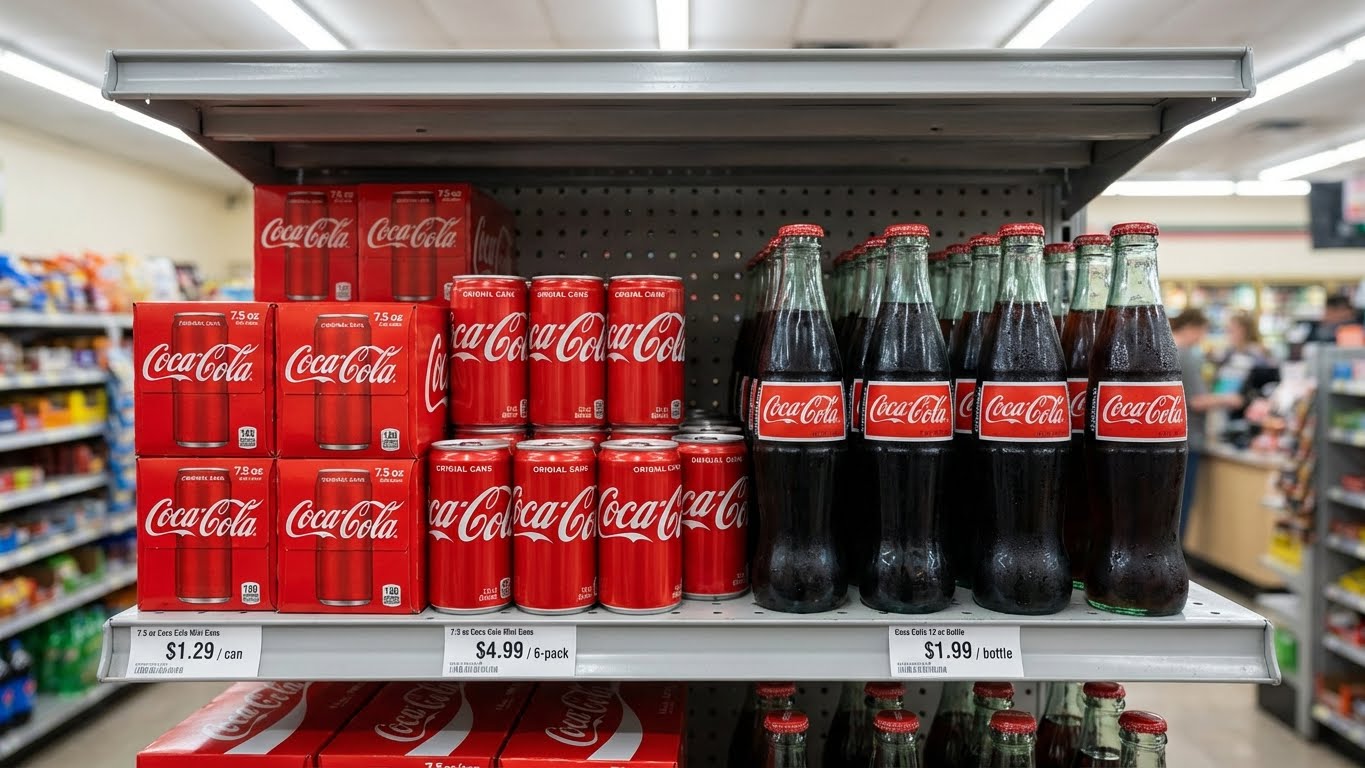
Coca-Cola testing major change in its core U.S. soft-drink business isn’t just a marketing story—it’s a signal to investors. By rolling out smaller 7.5-ounce mini cans as standalone items in convenience stores and introducing cane-sugar glass bottles in select markets, Coca-Cola is quietly stress-testing the future of its pricing, health positioning, and brand strategy. Reuters
In a world where inflation, shifting consumer habits, and health concerns are reshaping the beverage market, Coca-Cola testing major change is a case study in how a legacy consumer staple tries to protect margins while staying relevant. For investors, the key question is simple: Does this experiment strengthen Coca-Cola’s long-term investment case—or add new risks?
Section 1 – Core Concept/Overview
Coca-Cola is one of the most widely held “defensive” stocks in the world. Its business model is built on:
- Enormous global brand power
- A franchised bottler system
- High margins on syrup and concentrates
- Relatively stable demand through economic cycles
When you see Coca-Cola testing major change in packaging, portion size, or recipe, you’re really seeing management adjust three levers that matter directly for shareholders:
- Pricing power
- Volume trends
- Brand and regulatory risk
What Coca-Cola Is Actually Testing
Recent reports show Coca-Cola:
- Selling 7.5-ounce mini cans individually in U.S. convenience stores rather than only in multi-packs. These cans are priced below full-size 20-ounce bottles, but at a higher price per ounce, improving revenue mix while offering a smaller, more “permissible” serving. Reuters
- Rolling out cane-sugar glass bottles in select markets to gauge demand from consumers who prefer “real sugar” over high-fructose corn syrup and associate glass bottles with premium quality. Reuters
Effectively, Coca-Cola testing major change means the company is experimenting with:
- A premium-per-ounce strategy via mini cans
- A premium-perception strategy via glass bottles and cane sugar
For investors, both moves are about defending margins while addressing health and value perceptions.
The Message This Sends to Investors
Coca-Cola testing major change sends several clear messages to the market:
- Pricing power is still central.
By pushing smaller formats at relatively high prices per ounce, Coca-Cola is betting that brand strength allows it to earn more per unit of product without alienating customers. - Management is sensitive to health and regulatory pressures.
Smaller portions and cane-sugar variants align with global trends around sugar consumption, obesity, and soda taxes—pressures highlighted in recent macro and health discussions. - The company is willing to experiment before going all-in.
Using test markets for mini cans and cane-sugar glass bottles reduces execution risk. Coca-Cola testing major change in a controlled way gives investors time to observe results before the strategy scales. - Investor narrative is shifting from “just dividends” to “active adaptation.”
KO has long been perceived mainly as a dividend and income play. These moves remind the market that active product strategy still matters.
Section 2 – Practical Strategies / Framework
As an investor, you’ll see headlines about Coca-Cola testing major change long before the full financial impact appears in earnings reports. You need a simple framework to analyze what’s noise and what’s signal.
Step-by-Step Framework to Interpret Coca-Cola Testing Major Change
- Clarify what is actually changing.
- Is it price, package size, recipe, channel, or marketing?
- Here, Coca-Cola is tweaking package size and sweetener in select products.
- Estimate if it’s a margin play, a volume play, or both.
- Mini cans: smaller volume, higher price per ounce → margin-friendly if volumes hold.
- Glass bottles: premium perception → potentially higher margin but niche volume.
- Check the scale and scope.
- Is Coca-Cola testing major change in one region, or rolling it out nationally?
- Test markets mean limited immediate impact but important forward guidance.
- Tie it to macro conditions.
- The IMF’s 2025 outlook suggests global growth remains modest, with inflation easing but not fully resolved.
- In such an environment, consumer staples rely heavily on pricing discipline to protect earnings.
- Listen to management commentary.
- Monitor earnings calls and investor presentations for comments on:
- Unit case volume trends
- Price/mix contribution to revenue
- Consumer response to mini cans and glass bottles
- Monitor earnings calls and investor presentations for comments on:
- Compare to peers.
- How does Coca-Cola’s experiment stack up against PepsiCo or other beverage players?
- If Coca-Cola testing major change leads and peers follow, KO may gain a relative advantage.
How to Integrate Coca-Cola Testing Major Change Into Your Portfolio Decisions
If you already hold KO or are considering it, here’s how to think strategically:
- Define your role for KO.
- Income stock?
- Defensive core holding?
- Short-term trade?
- Map news to your time horizon.
- Coca-Cola testing major change in packaging will affect results over years, not days.
- Short-term volatility around headlines is rarely aligned with long-term dividend income goals.
- Track three key metrics over 4–8 quarters:
- Organic revenue growth (price + mix + volume)
- Unit case volume (are smaller formats hurting or helping total volume?)
- Operating margin (are these changes protecting profitability?)
- Keep valuation in view.
- Even if Coca-Cola testing major change succeeds, a stretched valuation reduces upside.
- Compare KO’s P/E, dividend yield, and free cash flow yield to its own history and peers.
- Avoid binary thinking.
- You don’t need to go “all-in” or “all-out.”
- Adjust position sizing gradually as data emerges on the impact of these tests.
Section 3 – Examples, Scenarios, or Case Insights
Let’s walk through simplified numbers to see why Coca-Cola testing major change in mini cans and glass bottles matters.
Example 1: Mini Cans and Price-Per-Ounce Economics
Imagine two products sitting side by side in a U.S. convenience store:
| Product | Size (oz) | Shelf Price | Price per Ounce | Comment |
|---|---|---|---|---|
| Standard Coke Bottle | 20 oz | $1.60 | $0.08 | Traditional single-serve |
| New Mini Coke Can (test) | 7.5 oz | $1.29 | $0.17 | Much higher price per ounce |
Numbers are illustrative, not actual Coca-Cola pricing.
What happens if a portion of buyers shift to mini cans?
- Suppose 100 customers previously bought 1 bottle each → 2,000 oz sold, revenue $160.
- Now 40 of those customers buy mini cans instead:
- 60 bottles → 1,200 oz, revenue $96
- 40 mini cans → 300 oz, revenue $51.60
- Total: 1,500 oz, revenue $147.60
In this simplified example:
- Volume (ounces) falls by 25%, but
- Revenue falls by only ~7.8%
- If mini cans have higher margin per ounce (less product, similar fixed costs per unit), profit may hold steady or even rise.
This is the core logic behind Coca-Cola testing major change with mini cans: optimize revenue and profit per ounce rather than just chasing volume.
Example 2: Glass Bottles and Premium Perception
Now imagine Coca-Cola introduces a cane-sugar glass bottle variant at a premium price:
- 12-ounce regular plastic bottle: $1.40
- 12-ounce cane-sugar glass bottle: $1.90
If even 10% of loyal buyers upgrade to the premium option in test markets, Coca-Cola:
- Increases average revenue per unit
- Strengthens brand perception with “heritage” and “quality” cues
- Gains valuable data on how much consumers will pay for less processed image, without committing globally
From an investment lens, this is why Coca-Cola testing major change in glass bottles is important—it informs future pricing strategies, product tiers, and brand equity decisions. Reuters
Example 3: Portfolio Impact for a Retail Investor
Assume you have a $50,000 portfolio and you hold KO at 5% ($2,500).
You’re watching news about Coca-Cola testing major change and wondering if you should change your position:
- If Q1 and Q2 results show stable or rising margins with only modest volume volatility, you might:
- Keep KO at 5% as a stable, dividend-paying core holding
- If several quarters show sharp volume declines with only limited margin benefit, you might:
- Trim KO from 5% to 3% and reallocate the difference into a more diversified consumer staples ETF
The point: let data—not headlines—drive your position sizing.
Common Mistakes and Risks
When headlines about Coca-Cola testing major change hit, investors often fall into predictable traps. Avoid these:
- Overreacting to a single news story
Treating one test market change as if the entire business model has shifted. - Ignoring scale and timing
Forgetting that these tests may only affect a small slice of sales for several quarters. - Confusing brand risk with guaranteed damage
Smaller portions and recipe tweaks may trigger short-term online backlash, but long-term behavior often follows price, convenience, and habit. - Not connecting the dots to macro conditions
In an environment where global growth is projected to slow and inflation is still normalizing, consumer companies must constantly recalibrate pricing and formats. - Focusing only on yield
KO’s dividend is important, but if you ignore shifts in volume, price mix, and brand health, you miss key drivers of future payout sustainability. - Assuming success is guaranteed
Coca-Cola testing major change doesn’t mean every initiative will work. Some formats or recipes may quietly disappear if consumers reject them.
Conclusion – Key Takeaways & Next Steps
Coca-Cola testing major change is more than a quirky packaging story. It’s a live demonstration of how a global consumer giant responds to:
- Health trends and sugar concerns
- Inflation and consumer budget pressure
- Competitive dynamics in beverages
For investors, the core takeaways are:
- Watch price/mix and margins, not just unit volume.
- Treat test markets as optionality, not certainty.
- Integrate news about Coca-Cola testing major change into a broader view of valuation, dividend strength, and long-term brand positioning.
As you refine your portfolio, ask yourself:
- Does Coca-Cola still deserve a place as a “sleep-well-at-night” defensive holding?
- How does this strategy compare with peers in your consumer staples allocation?
If you want to go deeper, consider:
- Reviewing Coca-Cola’s last few annual and quarterly reports, focusing on price/mix commentary
- Comparing KO’s dividend growth and payout ratio with other dividend aristocrats
- Building your own watchlist of companies that, like Coca-Cola testing major change, are actively adapting to new consumer realities
How to Use ChatGPT for Financial Planning and Investing
Taking these steps will help you move from reacting to headlines to using them as a structured input in your long-term investment process.






2 Comments