
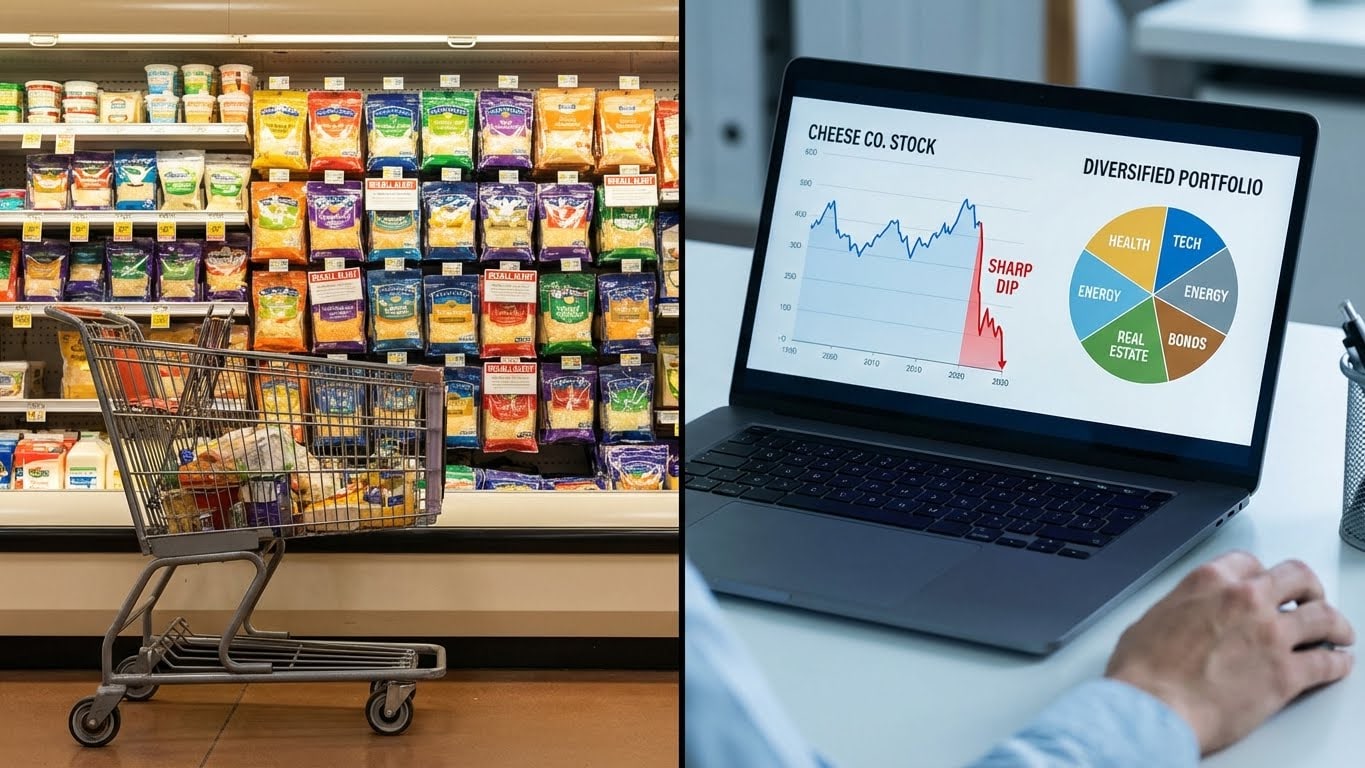
Headlines about “metal fragments in shredded cheese” sound like a food story, not an investing one. But if you look closer, there are powerful investing lessons from the shredded cheese recall that apply directly to your portfolio—especially in a world where supply chains are complex and product risks travel fast.
In late 2025, more than 1.5 million bags of shredded cheese sold under major store brands at retailers like Walmart, Target, Aldi and others were voluntarily recalled due to possible metal contamination, in an FDA-classified Class II recall.
This incident is exactly the kind of “everyday life” event you can use to upgrade your risk management, diversification, and stock-picking process.
Section 1 – Core Concept: Investing Lessons from the Shredded Cheese Recall
Key Component 1: What Happened in the Shredded Cheese Recall?
In the investing lessons from the shredded cheese recall, step one is understanding the basic facts:
- A large manufacturer supplied shredded cheese under numerous private-label brands at major retailers.
- Routine checks identified potential contamination with metal fragments in certain batches.
- The company voluntarily initiated a recall, which the U.S. Food and Drug Administration (FDA) later classified as Class II (meaning the product may cause temporary or medically reversible health effects, with a low chance of serious outcomes).
For consumers, the advice was straightforward: check lot numbers, stop eating the affected cheese, and return or discard it.
For investors, though, the shredded cheese recall is a live case study in operational risk, reputational risk, and idiosyncratic stock risk—all the things you claim to care about but often ignore until something breaks.
Key Component 2: How Product Recalls Hit Stock Prices
Academic research on product recalls shows that these events often trigger negative abnormal returns (i.e., stock price drops that can’t be explained by overall market moves):
- Studies across industries find that recall announcements typically lead to statistically significant short-term share price declines.
- Some research also finds spillover effects—competitors can suffer, too, as investors reassess risk across an entire sector or supply chain.
However, the magnitude and duration of the impact depend on:
- Severity of the recall (Class I vs. II vs. III; life-threatening vs. temporary risk).
- Company size and reputation.
- Management’s response (fast, transparent, accountable vs. slow and defensive).
The key investing lessons from the shredded cheese recall are not “never invest in food companies” but:
- Operational failures can show up suddenly as headline risk.
- Single-company and single-supplier exposure is far riskier than it looks in a calm year.
- Diversification and process matter more than your favorite “story stock.”
Top 10 Free Tools for Smarter Investing in 2025
Section 2 – Practical Strategies / Framework
Now let’s translate the investing lessons from the shredded cheese recall into a step-by-step framework you can use for any product crisis—food, autos, tech devices, or pharmaceuticals.
Strategy Type 1: Use Recalls as Risk-Management Signals
Rather than just reading recall news and moving on, you can deliberately use these events to stress-test your portfolio.
Step-by-step Checklist
- Map the recall to listed companies
- Which public manufacturer, brand owner, or key supplier is involved?
- Are they a direct holding in your portfolio or via an ETF?
- Check your concentration risk
- What percentage of your total portfolio is exposed to that company or sector?
- Do you also hold its major suppliers or customers, stacking correlated risk?
- Assess management’s response
- Is the recall voluntary and transparent?
- Does management provide clear information, timelines, and corrective actions?
- Re-underwrite your thesis
- Ask: “If I didn’t own this stock today, would I buy it after this recall, knowing what I now know?”
- If the answer is no, it might be time to trim or exit.
- Record the case in an “incident log”
- Maintain a simple file of product recalls and corporate crises that affected your holdings.
- Over time, you’ll see patterns in how companies handle risk.
Using this approach, every recall becomes a live drill in your risk-management process instead of random bad news.
Strategy Type 2: Diversify So Recalls Don’t Break You
One of the core investing lessons from the shredded cheese recall is that even a well-run company can get hit by contamination, defective parts, or supplier failures. The only durable defense is diversification.
Regulators and investor-education bodies like the SEC consistently emphasize diversification as one of the most important tools for reducing investment risk—“don’t put all your eggs in one basket.”
Building a Diversified Portfolio Around Recall Risk
Here’s a simple, practical framework:
- Limit single-stock exposure
- As a rule of thumb, avoid having any single stock represent more than 5% of your total portfolio.
- Use broad funds as a core
- Make diversified index funds or ETFs your main holdings.
- You can add a small “satellite” sleeve for individual stock ideas.
- Spread across sectors and geographies
- Don’t have all consumer-staples, all tech, or all domestic names.
- Diversify across sectors and regions so a food-safety or supply-chain shock in one country doesn’t dominate your results.
- Stress-test your portfolio
- Ask ChatGPT (or your own spreadsheet): “If one of my top 5 holdings dropped 40% due to a product recall or scandal, how much would my total portfolio fall?”
- Rebalance periodically
- Over time, winners can become too large.
- Set a schedule (e.g., annually) to bring weights back in line with your risk tolerance.
Table: From Shredded Cheese Recall to Portfolio Lessons
| Real-World Event Element | Investing Lesson |
|---|---|
| Contaminated ingredient from a supplier | Supply-chain risk can hit even “boring” companies. |
| Recall across many store brands | Hidden concentration: one manufacturer behind multiple labels. |
| FDA Class II recall classification | Severity of bad news influences stock impact, but any recall is a risk signal. |
| Short-term reputation damage and possible lawsuits | Expect event-driven volatility and potential long-run cost pressures. |
| Consumers can switch brands easily | Weak brand loyalty can magnify financial damage from product failures. |
| Recall covered heavily in national media | High visibility can amplify stock price reactions vs. quiet, minor incidents. |
These patterns show why investing lessons from the shredded cheese recall are really about identifying hidden risks before they find you.
Section 3 – Examples, Scenarios, or Case Insights
To make the investing lessons from the shredded cheese recall concrete, let’s look at simple numerical scenarios. Numbers here are illustrative, not predictions.
Scenario 1: Concentrated Position in a Food Stock
Suppose:
- Your portfolio is worth $100,000.
- You hold $25,000 (25%) in a single packaged-food manufacturer heavily exposed to shredded cheese and similar products.
- A large recall hits, triggering a 25% stock price drop over a few weeks due to projected costs, legal risks, and reputation damage.
Impact on your portfolio:
- Stock value: $25,000 → $18,750 (loss of $6,250).
- Portfolio total: $100,000 → $93,750 (-6.25%).
Even though the broader market might be flat, your net worth takes a heavy hit because of concentration risk.
Scenario 2: Diversified Portfolio Across Sectors
Now imagine a more diversified setup:
- Same $100,000 portfolio.
- Food manufacturer is 5% of the portfolio ($5,000), held within a diversified fund or as one of many stocks.
- Same 25% drop in the food stock due to the shredded cheese recall.
Impact:
- Food stock value: $5,000 → $3,750 (loss of $1,250).
- Portfolio total: $100,000 → $98,750 (-1.25%).
This still hurts, but it’s very manageable—and you may even be able to buy more at lower prices if your long-term thesis remains intact.
Scenario 3: Sector-wide Shock and Spillover
Research suggests recalls can sometimes trigger spillover effects across competitors, especially when they raise questions about industry-wide safety or compliance.
Assume:
- You own an ETF that tracks a broad consumer-staples index.
- The shredded cheese recall hits one major component, but sentiment drags down other packaged-food names by 5–10%.
- Overall, the ETF falls 4% for the month.
However:
- Another sector ETF you hold (e.g., technology or healthcare) is up 3% on unrelated news.
- Your bond holdings are flat or slightly positive.
Net result: The event is absorbed by the portfolio, not amplified.
The takeaway: the investing lessons from the shredded cheese recall are not about predicting every crisis, but about building a structure where no single crisis can dominate your returns.
Common Mistakes and Risks
When applying the investing lessons from the shredded cheese recall, watch out for these pitfalls:
- Overreacting to headlines
- Panic-selling every time a company faces a recall can lock in losses, especially if the issue is minor and management responds well.
- Ignoring recalls altogether
- The opposite mistake: treating product recalls as “noise” and never reassessing your thesis, governance views, or position sizing.
- Underestimating supply-chain concentration
- Thinking you’re diversified because you hold many brands, when they all rely on the same manufacturer or ingredient supplier.
- Confusing temporary event risk with structural risk
- A one-off contamination issue is different from a pattern of poor quality control or weak compliance.
- Failing to diversify beyond a favorite sector
- Food, autos, tech, pharmaceuticals—all face recall risk. Sector concentration magnifies that risk.
- Ignoring regulatory and legal overhangs
- Following large recalls, regulators may tighten standards or launch investigations, adding medium-term earnings pressure.
- No written risk limits
- Without explicit limits on single-stock or single-sector exposure, it’s easy to drift back into concentration.
Conclusion – Key Takeaways & Next Steps
The investing lessons from the shredded cheese recall go far beyond the dairy aisle. They illustrate, in a very tangible way, why:
- Operational and product-safety risks can appear suddenly and hit valuations hard.
- Diversification across companies, sectors, and regions is non-negotiable.
- You need a simple process for responding to product-recall headlines instead of reacting emotionally.
Your next steps:
- Audit your portfolio for single-stock and single-sector concentrations, especially in industries with heavy product-safety or regulatory risk.
- Write a one-page risk policy that sets max weights for a single stock and sector.
- Next time you see a headline like the shredded cheese recall, walk through the checklist in this article instead of just scrolling past.
If you consistently apply the investing lessons from the shredded cheese recall, you’ll gradually build a portfolio that is robust to the inevitable surprises that come with real-world businesses—and that’s how long-term investors survive and thrive.


One Comment