
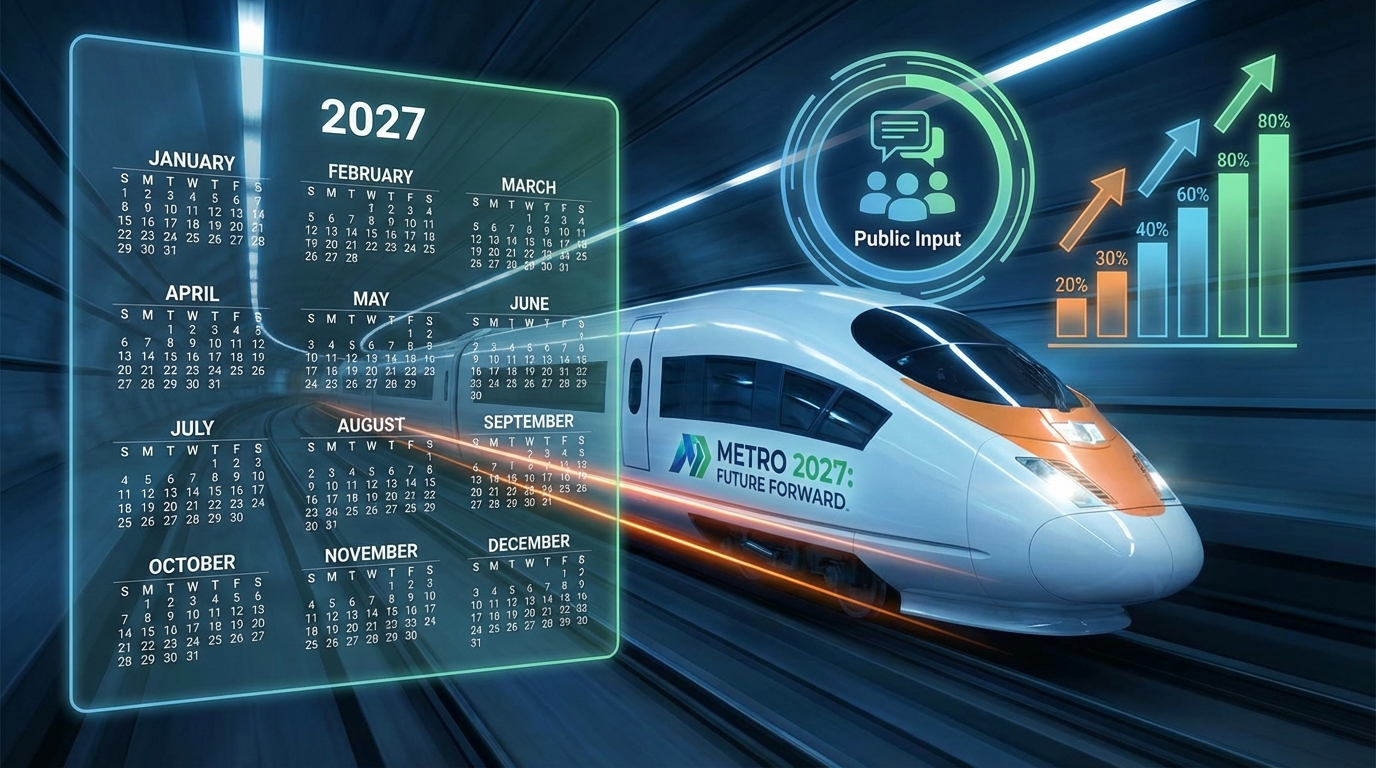
The regional economic landscape of the Washington D.C. metropolitan area is facing a critical juncture as the WMATA FY2027 Budget Proposal enters the public eye. As we navigate early 2026, the Washington Metropolitan Area Transit Authority (WMATA) has officially invited residents, business owners, and regional investors to provide feedback on a spending plan that will define the efficiency of the capital’s “circulatory system” for years to come. In an environment defined by shifting urban migration patterns and the integration of smart-city technologies, understanding the WMATA FY2027 Budget Proposal is no longer just for local commuters—it is a mandatory exercise for real estate investors, urban planners, and fiscal analysts tracking the health of the Atlantic coast’s economic corridor.
Securing the long-term solvency of public transit is a foundational element of regional wealth building. For those with significant interests in D.C., Maryland, or Virginia, the budget dictates property valuations, labor market accessibility, and the velocity of local commerce. As the transit authority grapples with the sunsetting of federal relief funds and the rising costs of infrastructure hardening, the WMATA FY2027 Budget Proposal serves as a blueprint for how a major metropolitan hub survives and thrives in the post-pandemic “New Normal.” In this guide, we will analyze the core financial pillars of the proposal and provide actionable insights for those whose portfolios are tied to the region’s stability.
the best AI crypto projects to watch in 2026
The Fiscal Architecture of FY2027
To truly grasp the significance of the WMATA FY2027 Budget Proposal, one must look beneath the service schedules and into the complex world of municipal finance. WMATA operates on a unique funding model that relies on a delicate balance of passenger fares, state contributions, and federal grants. As we move into 2026, the “fiscal cliff” that many feared in previous years has transformed into a “structural rebalancing.”
The Move Toward “Dedicated Funding” Stability
One of the primary themes of the WMATA FY2027 Budget Proposal is the transition toward more predictable revenue streams. For decades, WMATA suffered from the lack of a “dedicated funding” source, unlike transit systems in New York or Chicago. The current proposal highlights how recent legislative wins in the Maryland and Virginia assemblies are finally being utilized to stabilize the “capital improvement” pipeline. This is vital for investors, as it ensures that the multi-billion-dollar backlog of state-of-good-repair projects can proceed without constant political brinkmanship.
Modernization and the “Digital Twin” Infrastructure
The FY2027 plan isn’t just about repairing old tracks; it is about the “Intelligence Layer” of the city. A key component of the budget is the continued rollout of the “Digital Twin” project—a virtual replica of the entire Metrorail system. By utilizing real-time sensor data, WMATA can now perform predictive maintenance, identifying a fault in a rail car or an escalator before it fails. This shift from “reactive” to “proactive” maintenance is expected to lower long-term operational expenditures (OpEx), a metric that fiscal conservatives and large-scale regional investors watch closely.
best financial planning tools for long-term growth
Analyzing Regional Investment Impact
The WMATA FY2027 Budget Proposal is effectively a heat map for regional real estate and business growth. If you are looking to build or protect wealth in the D.C. area, your strategy must align with where the “Transit Dollars” are flowing.
Tracking Transit-Oriented Development (TOD) Hubs
The budget allocation for “Station Area Improvements” provides a clear signal for property investors. In 2026, the “15-minute city” concept has become a primary driver of apartment and retail valuations.
- Identify High-Growth Corridors: Look for stations receiving significant funding for entrance expansions or pedestrian bridges. These “micro-investments” often lead to a 5–10% premium in surrounding residential rents.
- Leverage Public-Private Partnerships: The WMATA FY2027 Budget Proposal encourages joint development projects. Small to mid-sized firms can often find opportunities in the “ancillary services” around these hubs, from automated lockers to boutique coworking spaces.
Hedging Against “Service Elasticity” Risks
Not every part of the budget is purely growth-oriented. Some sections of the WMATA FY2027 Budget Proposal discuss service frequency adjustments for lower-traffic bus routes.
- Evaluate Labor Connectivity: If you own a business reliant on a physical workforce, check the “Bus Network Redesign” maps within the proposal. A reduction in frequency for a specific route can increase employee turnover or “commuter friction,” indirectly impacting your bottom line.
- Capitalize on Sustainability Credits: In early 2026, the transition to zero-emission bus fleets is a major budget line item. Companies providing charging infrastructure or grid-stabilization technology in the North Wales or D.C. corridors are seeing a “green premium” in their valuations.
Actionable Steps for Participating in the Budget Cycle:
- Download the Executive Summary: Visit the official WMATA website to access the full FY2027 document.
- Attend Virtual Public Hearings: WMATA has scheduled several interactive sessions throughout February 2026. This is your chance to ask about the “debt-to-revenue” ratios directly to the board.
- Audit Your Real Estate Portfolio: Compare your current holdings against the “Capital Improvement Plan” (CIP) list. Are your properties in zones slated for modernization, or are they on the “maintenance only” list?
- Monitor Regional Bond Ratings: The International Monetary Fund (IMF) often notes that the fiscal health of regional transit authorities is a leading indicator for the creditworthiness of the associated municipalities.
Economic Scenarios for FY2027
To quantify the impact of the WMATA FY2027 Budget Proposal, let’s examine how a “Fully Funded” scenario compares to a “Budget Shortfall” scenario for a regional business owner in early 2027.
| Metric | Scenario A: Balanced FY2027 Budget | Scenario B: Funding Stalemate |
| Metrorail Reliability | 94% On-Time Performance | <85% due to maintenance delays |
| Regional Productivity | +1.2% GDP growth from commute efficiency | -0.5% drag due to traffic congestion |
| Retail Footfall (Urban Centers) | Stable/Increasing | Declining as people avoid “unreliable” transit |
| Property Tax Revenue | Strong growth in TOD zones | Stagnant due to lower demand |
Case Insight: The “Safety Dividend”
The current WMATA FY2027 Budget Proposal includes a significant increase in funding for the Metro Transit Police Department and the “Crisis Intervention” team. In the 2026 social climate, “perceived safety” is a primary economic driver. When passengers feel safe, ridership rises, farebox recovery improves, and the need for taxpayer subsidies decreases. This creates a “virtuous cycle” that stabilizes the entire regional economy. For investors, a safer Metro is a more valuable Metro, directly correlating to the “stability premium” of D.C. real estate.
Expert Insight: According to theWorld Bank, “high-capacity urban transport is the single most effective investment for long-term urban economic resilience.” The WMATA FY2027 Budget Proposal is effectively a resilience bond for the U.S. capital.
Common Mistakes and Risks to Avoid
- Ignoring the “Sunset” of Federal Funds: Do not assume that the federal government will always be there to bail out WMATA. The WMATA FY2027 Budget Proposal is designed to prove that the system can stand on its own feet through regional cooperation.
- Underestimating “Construction Drag”: While a “Capital Improvement” is good for long-term value, the 2-year construction phase can kill small retail businesses at the station entrance. If you are a business owner, ensure you have a “liquidity buffer” to survive the construction dust.
- Over-reliance on Historical Ridership: The “Tuesday-Wednesday-Thursday” office week is the new reality in 2026. reminds us that the “rush hour” profit model is dead.
- Failing to Provide Input: Public feedback does change the budget. If a specific bus route is vital for your company’s 200 employees, you must advocate for it during the public input period for the WMATA FY2027 Budget Proposal.
Conclusion – Key Takeaways & Next Steps
The WMATA FY2027 Budget Proposal is more than just a list of expenses; it is a declaration of the Washington region’s economic priorities for 2027. By focusing on dedicated funding, digital modernization, and transit-oriented development, the authority is attempting to build a system that is as fiscally resilient as it is operationally efficient. For the wealth builder, this budget is an “Early Warning System” that tells you where the next wave of urban growth will occur.
Ultimately, the success of the capital region depends on the reliability of its infrastructure. By engaging with the WMATA FY2027 Budget Proposal today, you are not just being a good citizen—you are performing essential due diligence on your own financial future.
Are you ready to safeguard your regional investments? Start by identifying the Metrorail or Metrobus lines closest to your business or home. Would you like me to create a “Transit Risk Scorecard” to help you evaluate how the




One Comment