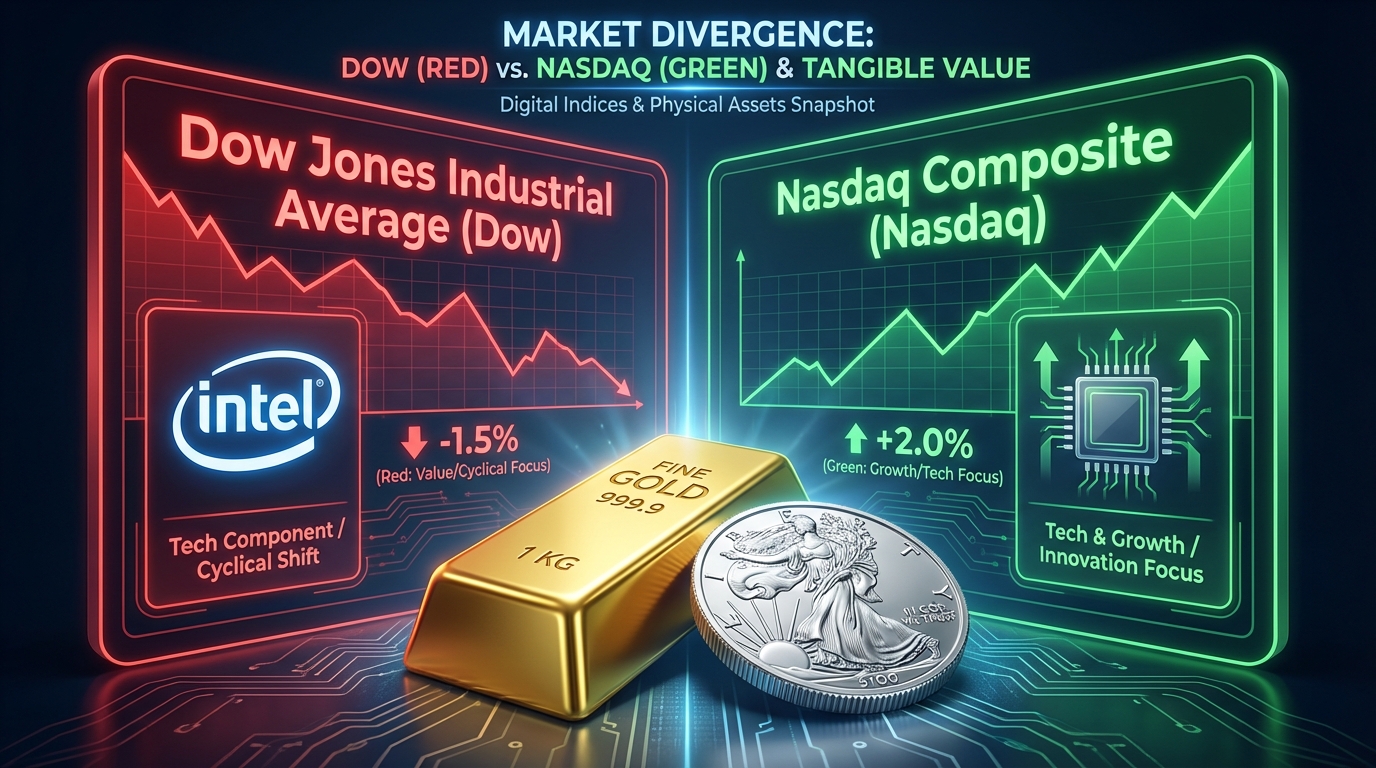
The third week of January 2026 proved to be a volatile “rollercoaster” for global investors as geopolitical tensions met the harsh reality of corporate earnings. While the Weekly Stock Market Summary (Jan 2026): Dow Weakens, Intel Drops, Nasdaq Holds Firm highlight a divided market, the overarching theme was one of “cautious resilience.” The week began with a sharp “Sell America” sentiment following President Trump’s surprise tariff threats against European allies over a Greenland acquisition bid. However, by Friday, a diplomatic de-escalation in Davos helped the Nasdaq and S&P 500 claw back some losses, even as the blue-chip Dow was dragged down by a catastrophic plunge in Intel shares.
Navigating the 2026 landscape requires an understanding of how quickly “policy shocks” can be absorbed by a market still fueled by an AI investment supercycle. Despite the mid-week rebound, all three major indices posted their second consecutive weekly loss—the first time the S&P 500 has seen such a streak since June. In this summary, we break down the critical events that defined the week, from the historic surge in precious metals to the semiconductor “tug-of-war” that continues to reshape the tech sector.
The “Man-Made” Volatility of January
The primary driver of market action this week was not just economic data, but “geopolitical brinkmanship.” The Weekly Stock Market Summary (Jan 2026): Dow Weakens, Intel Drops, Nasdaq Holds Firm underscores a market that is highly sensitive to trade policy. On Tuesday, January 20, the major indices suffered their worst single-day performance since October after threats of 10% to 25% tariffs were issued against eight NATO allies, including Germany, the UK, and France.
The Greenland “Kerfuffle” and Market Relief
By Thursday and Friday, the tone shifted. News from the World Economic Forum (WEF) in Davos suggested that a “framework deal” regarding Arctic security and the deployment of “The Golden Dome” missile defense system had replaced the immediate threat of a trade war. This de-escalation acted as a “circuit breaker” for the sell-off, allowing tech-heavy benchmarks to stabilize.
The Historic Commodities Breakout
While equities struggled, the commodities desk witnessed a once-in-a-generation event.
- Silver Surges Past $100: For the first time in history, silver broke past the $100 per ounce milestone, fueled by a deepening supply deficit and its critical role in AI hardware.
- Gold Nears $5,000: Gold prices hit a record high of $4,980, coming within striking distance of the psychological $5,000 barrier as investors sought a “chaos hedge” against global uncertainty.
Practical Strategies: Positioning for a Selective Tech Rally
The Weekly Stock Market Summary (Jan 2026): Dow Weakens, Intel Drops, Nasdaq Holds Firm reveals a “two-tier” tech market. Success in 2026 is no longer about buying the entire sector, but identifying the “AI-haves” versus the legacy “have-nots.”
Managing the Semiconductor “Execution Risk”
The week’s most alarming stock-specific move was the 15% to 17% plunge in Intel (INTC). Despite beating quarterly profit estimates, the company issued a dismal first-quarter 2026 outlook. Executives admitted that they were “caught off guard” by the surging demand for AI server processors, leading to significant supply constraints.
- The Lesson: In 2026, being in the “AI sector” isn’t enough. You must monitor a company’s “manufacturing readiness.”
- The Opportunity: As Intel dropped, rivals like Nvidia (NVDA) and AMD held firm or gained, proving that the market is rewarding companies with superior execution and specialized AI pipelines.
Utilizing “Safe Haven” Resilience
With the VIX (Volatility Index) rising to 15.83 from 14.48, “tail-risk” protection has become a core strategy for wealth building this month.
- Monitor the Gold-Silver Ratio: With silver at $100 and gold at nearly $5,000, the ratio has compressed to nearly 50:1.
- Verify Dividend Safety: High-yield financials like Capital One (COF) saw sharp declines this week (-7.2%) after missing earnings, proving that “yield” is only valuable if it is backed by solid earnings.
- Actionable Checklist:
- Audit your tech concentration: If your portfolio is 100% legacy hardware, consider rotating into AI-native software and semi-cap equipment firms like Lam Research (LRCX), which saw 25% gains earlier this month.
Long-Term Investing Mindset: Why Most People Never Build Real Wealth
The “January Effect” Reversal
To quantify the week’s impact, let’s look at a comparative performance of the major benchmarks as of the Friday close.
Weekly Performance Summary (Jan 19–23, 2026)
| Index / Asset | Friday Change | Weekly Performance | Key Driver |
| Dow Jones (DJI) | -0.6% | -0.5% | Intel plunge and financial sector weakness. |
| S&P 500 (SPX) | +0.1% | -0.4% | Mixed; second straight losing week. |
| Nasdaq (IXIC) | +0.3% | -0.1% | Resilience in “Magnificent Seven” (MSFT, AMZN, NVDA). |
| Silver Spot | +6.5% | +31.0% | Historic breakout past $100/oz. |
| Gold Spot | +1.4% | +8.2% | Safe-haven demand amid Greenland tensions. |
Case Insight: The “Magnificent Seven” Resilience
In the Weekly Stock Market Summary (Jan 2026): Dow Weakens, Intel Drops, Nasdaq Holds Firm, it is clear that Microsoft, Amazon, and Nvidia are the bedrock of the 2026 market. On Friday, these three led the Dow’s few gainers with advances of 1.5% to 3.5%. This suggests that while “policy shocks” can rattle the broad market, the structural demand for AI cloud services and hardware remains an unstoppable force for long-term growth.
the best financial planning tools for long-term growth
Common Mistakes and Risks to Avoid
- Panic-Selling on Political Headlines: The Greenland “tariff shock” on Tuesday was mostly erased by Friday’s “Davos Framework.” Investors who sold during the 800-point Dow drop missed the partial recovery.
- Underestimating Earnings Guidance: Intel’s beat-but-warn scenario is the “new normal.” In 2026, the market cares more about the next quarter than the last one.
- Ignoring the “Hidden” Inflation: shows that while inflation is “cooling” at 2.6%–2.8%, it is still above the Fed’s target, which could keep interest rates “higher for longer.”
- Over-leveraging Commodities: With silver at $100, the “FOMO” risk is extreme. Parabolic moves are often followed by 15% to 20% “shake-outs.”
Professional Note: As highlighted by theInternational Monetary Fund (IMF), “trade tensions constitute a major source of instability.” The volatility seen in the Weekly Stock Market Summary (Jan 2026): Dow Weakens, Intel Drops, Nasdaq Holds Firm is likely to persist as global alliances are redefined.
Key Takeaways & Next Steps
The Weekly Stock Market Summary (Jan 2026): Dow Weakens, Intel Drops, Nasdaq Holds Firm paints a picture of a market that is fundamentally strong but operationally stressed. The Dow’s 0.5% weekly decline and Intel’s 17% plunge are warnings for the “old guard” of tech and finance. Conversely, the Nasdaq’s ability to hold firm near its highs—and silver’s record-breaking run—proves that the “Innovation Supercycle” remains the primary engine of wealth building in 2026.
As we head into February, the “Greenland Deal” and the sustainability of $100 silver will be the primary themes to watch. The era of “blind index investing” is over; the 2026 economy demands a tactical, research-driven approach to every asset class.
Are you ready to optimize your portfolio for the February cycle?
Start by identifying your exposure to “legacy hardware” versus “AI infrastructure.” Would you like me to create a “2026 Semiconductor Risk Scorecard” to help you compare your tech holdings against leaders like Nvidia and AMD?