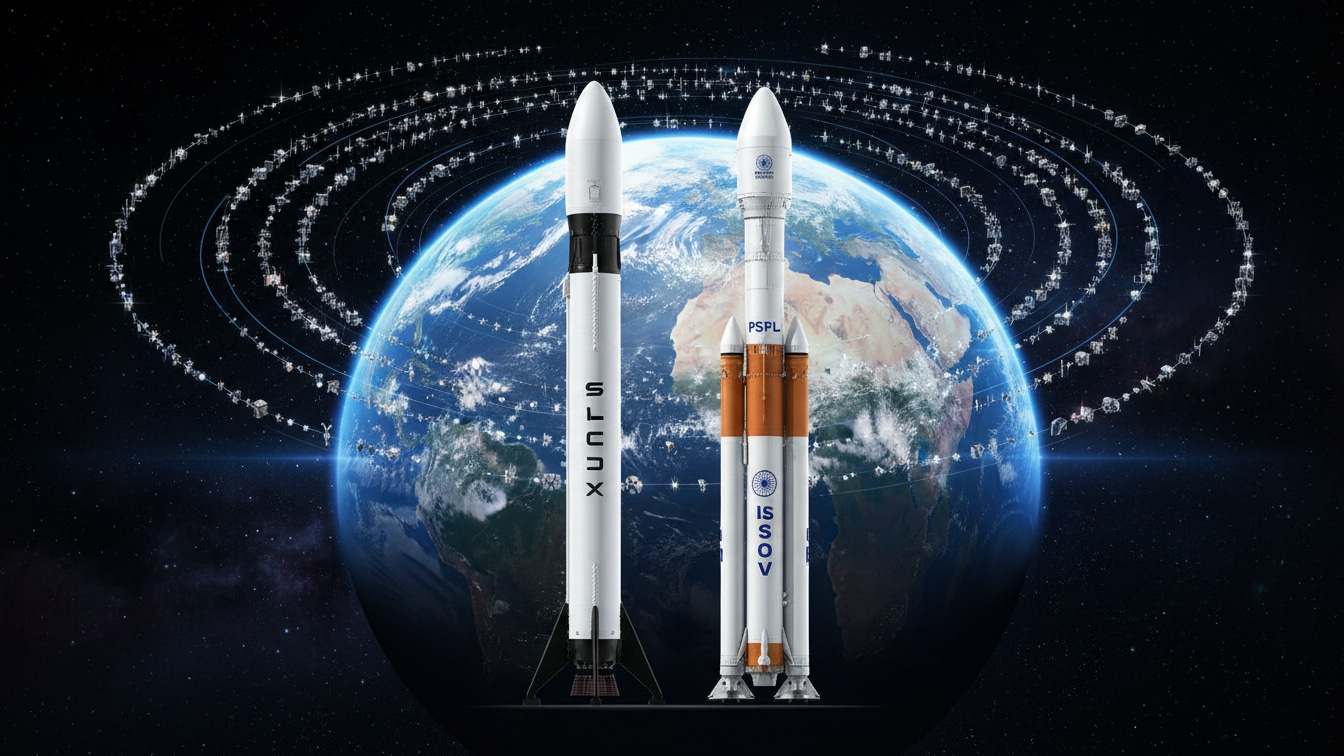
The dawn of 2026 has brought a seismic shift to the commercial space sector, primarily driven by the increasing frequency of SpaceX and ISRO rideshare missions into SSO. Just this week, a monumental collaboration between these two space giants showcased the power of international cooperation in reducing the barriers to entry for satellite deployment. By utilizing Sun-Synchronous Orbit (SSO), these missions are providing unprecedented access for Earth observation and climate monitoring startups. For investors, this represents a unique “convergence trade” where falling launch costs meet the rising demand for real-time orbital data.
Understanding the financial implications of these SpaceX and ISRO rideshare missions into SSO is essential for any portfolio focused on frontier technologies. We are no longer in the era of billion-dollar government satellites; we are in the era of the $325,000 “rideshare” ticket. In this guide, we will break down the mechanics of the 2026 space economy and how you can position your wealth to benefit from this orbital gold rush.
Core Concept: The Rideshare Revolution
A rideshare mission is essentially the “Uber” of the cosmos. Instead of a single entity paying for a dedicated rocket, dozens of small satellites (smallsats) and CubeSats share the cost of a single launch. The focus on Sun-Synchronous Orbit (SSO) is a strategic choice that maximizes the value of the data collected by these passengers.
The Strategic Value of Sun-Synchronous Orbit (SSO)
SSO is a nearly polar orbit where a satellite passes over any given point of the Earth’s surface at the same local mean solar time. This consistency is vital because it ensures that the surface illumination angle is nearly identical every time the satellite passes overhead. For companies in agriculture, urban planning, or disaster response, this constant lighting is the “holy grail” for comparing images over time and detecting subtle changes on the ground.
Collaborative Competition: SpaceX and ISRO
While SpaceX’s Falcon 9 has dominated the headlines with its “Transporter” and “Twilight” series, India’s ISRO (Indian Space Research Organisation) has long been the “reliable workhorse” of the industry. Using its Polar Satellite Launch Vehicle (PSLV), ISRO offers high-precision placement into SSO that often rivals or exceeds western commercial providers in cost-efficiency. In 2026, the collaboration between these two—sometimes sharing manifests to ensure schedule certainty—has created a “floor” for launch prices that is stabilizing the entire space investment sector.
How to Use ChatGPT to Analyze Risk Tolerance and Build a Diversified Portfolio
Practical Strategies for the 2026 Space Economy
Investing in the wake of SpaceX and ISRO rideshare missions into SSO requires a shift from speculative “moondance” bets to infrastructure-focused allocations. The current economic environment of 2025–2026 is characterized by “Orbital Compute”—treating space as a secondary data center for AI processing.
Diversifying via Launch Providers and “Satellite-as-a-Service”
To profit from this sector, you don’t necessarily need to pick the “winning” satellite company. Instead, you can invest in the infrastructure that makes these missions possible.
- Launch Aggregators: Companies that act as brokers, buying “plates” on SpaceX and ISRO missions and reselling them to smaller startups. They handle the complex logistics of integration and deployment.
- Ground Station Networks: Every satellite launched into SSO needs to beam data back to Earth. The 2026 market is seeing a massive uptick in “Ground-Station-as-a-Service” (GSaaS) providers that allow satellite operators to rent antenna time.
- Orbital Compute Plays: Look for companies that provide the hardware for AI processing in space. As data volumes from Earth observation increase, processing that data in orbit rather than sending it all down is becoming the standard.
Actionable Investment Steps for 2026
- Monitor the “Transporter” Manifests: Track the companies launching on SpaceX’s quarterly rideshare missions. A company with “flight heritage” (a successful launch) is far more investable than one with only a prototype.
- Assess Revenue Recurring Models: Focus on “Data-as-a-Service” firms that sell insights from their SSO constellations rather than the hardware itself.
- Watch for the SpaceX IPO: As market analysts predict a potential 2026 IPO, use it as a “re-rating” event that could pull generalist capital into the space niche.
- Evaluate Geopolitical Risks: While SpaceX and ISRO rideshare missions into SSO represent cooperation, trade policies in 2026 can shift rapidly. Ensure your picks have diverse launch partners.
Case Insights: The Economics of the $325,000 Ticket
The “rideshare” model has fundamentally changed the ROI (Return on Investment) calculations for space startups. In 2021, a dedicated launch could cost upward of $60 million. Today, a 50kg payload on a SpaceX Transhare mission starts at roughly $325,000.
Scenario: The Agricultural Data Startup
Consider a startup in 2026 that wants to provide daily crop health reports to farmers in the Midwest.
- Hardware Cost: $500,000 (CubeSat)
- Launch Cost (Rideshare to SSO): $325,000
- Operational Costs: $200,000/year
- Total Initial Capital: ~$1.025 Million
By utilizing SpaceX and ISRO rideshare missions into SSO, this startup can be operational for less than the cost of a high-end franchise on Earth. If they can secure 100 enterprise clients at $20,000/year, they achieve profitability in less than 12 months. This “lean space” model is exactly why generalist investors are flocking to the sector in 2026.
According to the World Bank’s report on the global space economy, the democratization of space access is a primary driver for developing nations to leapfrog traditional infrastructure. This global demand ensures that the manifest for ISRO and SpaceX missions remains booked years in advance.
Wealth Building Success Story: How a Young Professional Turned $7,000 into $85,000
Common Mistakes and Risks to Avoid
- Ignoring “Launch Fatigue”: Just because a company has a launch date doesn’t mean they will meet it. Launch delays can burn through a startup’s cash reserves quickly.
- The Debris Dilemma: With so many SpaceX and ISRO rideshare missions into SSO, the orbit is becoming crowded. Investors must consider “Space Traffic Management” as a potential regulatory hurdle.
- Over-reliance on Government Contracts: In 2026, the most successful firms are those with a 70/30 split between commercial and government revenue.
- Underestimating Ground Infrastructure: A satellite is a “brick” in space if you cannot retrieve and process the data it collects.
Conclusion – Key Takeaways & Next Steps
The proliferation of SpaceX and ISRO rideshare missions into SSO marks the definitive end of the “Old Space” era. For the first time, small businesses and private investors have a predictable, affordable, and high-frequency path to the stars. By focusing on the consistent lighting of Sun-Synchronous Orbits and the infrastructure of orbital compute, you can capitalize on the most exciting wealth-building opportunity of the decade.
As we move further into 2026, the question is no longer if a company can reach space, but what it will do once it gets there. Stay focused on the data-rich opportunities provided by these collaborative missions to ensure your portfolio stays in high gear.
Would you like me to analyze the latest Q4 2025 filings for major launch aggregators to see which are currently undervalued? Start by exploring our other guides on frontier tech to stay ahead of the curve!