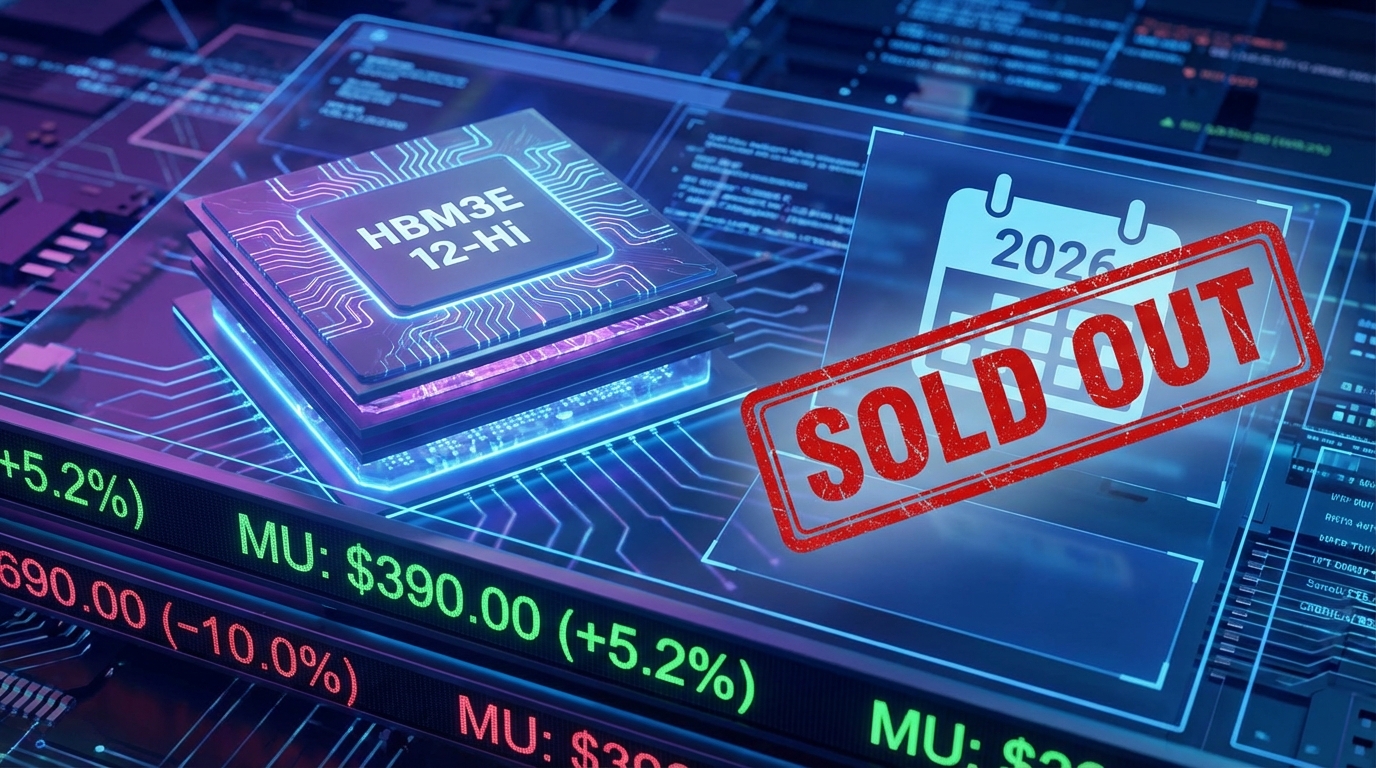
The semiconductor landscape has undergone a seismic shift as we move deeper into January 2026. While the “Magnificent Seven” often dominate headlines, it is the specialized memory makers that are quietly driving the next leg of the intelligence revolution. Micron stock is up over 260% in the past twelve months, a staggering rally that has propelled the Idaho-based chipmaker into the elite $400 billion market cap club. In the 2026 economic environment, where AI data centers are the primary engine of global GDP, memory is no longer a commodity; it is the fundamental bottleneck to human and machine productivity.
Despite this parabolic move, many institutional analysts believe the “memory supercycle” is still in its early innings. As of Monday, January 26, 2026, Micron Technology (MU) is trading at a level that suggests the market is only just beginning to price in the structural shift from cyclical hardware to essential AI infrastructure. In this guide, we will analyze why Micron stock is up over 260%, explore the practical frameworks for investing in the current chip rally, and highlight the catalysts that could drive shares toward new record highs.
Rich or Hungry? The 2026 Pyramid Reveals All
The Memory Supercycle and AI Infrastructure
To understand why Micron stock is up over 260%, one must move beyond traditional valuation metrics and look at the “Bill of Materials” (BoM) for 2026-era AI servers. Historically, the memory industry was notoriously cyclical, defined by brutal boom-and-bust cycles driven by oversupply in the PC and smartphone markets. However, the rise of Large Action Models (LAMs) and real-time inference has fundamentally changed the demand profile for Dynamic Random-Access Memory (DRAM).
High-Bandwidth Memory (HBM): The Critical Bottleneck
The primary engine behind Micron’s outperformance is High-Bandwidth Memory (HBM3E and HBM4). These specialized silicon stacks provide the massive data throughput required for Nvidia’s Blackwell and Rubin GPUs. In late 2025, Micron confirmed that its entire HBM capacity for 2026 is already fully pre-sold under multi-year contracts. Because HBM production consumes three times the wafer capacity of standard DRAM, it has created a structural supply deficit that keeps prices—and margins—at record levels.
The Shift from Cyclical to Structural Growth
In the 2025–2026 cycle, memory has transitioned from a volatile commodity to a strategic pillar of the global economy. According to the Bank for International Settlements (BIS), the “fragmentation of global semiconductor supply chains” has incentivized Western firms to prioritize secure, high-performance domestic suppliers like Micron. This structural shift has allowed Micron to exit its lower-margin consumer “Crucial” brand to focus almost exclusively on high-margin enterprise and data center segments.
WMATA FY2027 Budget Proposal: Navigating Infrastructure Investment in 2026
Navigating the 2026 Chip Rally
Navigating a stock that has already tripled requires a disciplined financial framework. While Micron stock is up over 260%, the “easy money” has likely been made, but the “smart money” is focused on the massive earnings expansion projected for the next 18 months.
Analyzing the Forward P/E Discount
Interestingly, even though Micron stock is up over 260%, its valuation remains attractive compared to other AI high-flyers. Micron currently trades at a forward Price-to-Earnings (P/E) ratio of approximately 11.5x. This is a significant discount to the Nasdaq-100 average of 25.6x. For a company projected to grow earnings by nearly 300% this fiscal year, this suggests that the market is still skeptical about the longevity of the cycle—creating an opportunity for those who believe the AI build-out is permanent.
The “Wait and See” on HBM4 Certification
A key tactical point for January 2026 is the competition with Samsung and SK Hynix. On Monday, reports surfaced that Samsung is nearing certification for Nvidia’s HBM4 chips. While this caused a temporary 2% dip in Micron’s share price today, analysts like Mizuho have noted that this is not a “zero-sum game.” The total addressable market (TAM) for memory is expected to hit $100 billion by 2028, and there is simply not enough capacity across all three suppliers to meet the “insatiable” demand.
Actionable Steps for the 2026 Investor:
- Monitor sequential margin expansion: Watch for the Q2 2026 earnings report; Micron expects gross margins to jump from 57% to a record 68%.
- Audit your tech concentration: If you own both Nvidia and Micron, you are highly correlated to the AI data center build-out. Ensure you have defensive anchors.
- Utilize stop-losses: Given Micron’s high beta (1.50), use trailing stop-losses of 10-15% to protect your gains in the event of a broad market correction.
- Track CapEx spending: Micron has raised its 2026 capital expenditure to $20 billion to accelerate HBM4 production. This is a vote of confidence in multi-year demand.
The Path to $450
To visualize the growth potential, let’s look at the financial “Monster Numbers” reported in Micron’s latest fiscal first-quarter update. The transition from a “cyclical” to a “growth” valuation is visible in the margin profile.
FQ1 2026 Financial Snapshot
| Metric | FQ1 2025 (Last Year) | FQ1 2026 (Current) | Growth % |
| Total Revenue | $8.71 Billion | $13.64 Billion | +57% |
| Gross Margin | 25.0% | 56.8% | +31.8 pts |
| Adj. EPS | $1.67 | $4.78 | +186% |
| Free Cash Flow | $1.2 Billion | $3.9 Billion | +225% |
Scenario: The Trillion-Dollar Club Ambition
As of Jan 26, 2026, Micron’s market cap has crossed the $400 billion threshold. If Micron achieves its projected annual EPS of $32.67 and the market awards it a “tech-average” P/E multiple of 14x, the stock price would target $457.38. This scenario would place Micron in the “Trillion-Dollar Club” alongside Nvidia and TSMC within the next 24 months. For those noting that Micron stock is up over 260%, the math shows that even a “fair” valuation based on forward earnings offers another 15-20% upside from today’s $390 level.
Common Mistakes and Risks to Avoid
- Chasing the “FOMO” Spike: Never “market buy” after a 10% daily jump. Wait for a “pull-back to the 50-day moving average” ($281.71) for a more favorable entry.
- Ignoring the “Memory Wall”: The biggest risk is a plateau in AI model scaling. If the next generation of LLMs doesn’t require exponentially more memory, the supply crunch could turn into a glut by 2027.
- The “Samsung Certification” Scare: Don’t panic-sell on news of a competitor qualifying a chip. The market needs all suppliers to succeed just to meet baseline demand.
- Cyclical Blindness: Remember that even though this cycle feels structural, the semiconductor industry is historically volatile. reminds us that MU’s dividend is small (~0.1%) for a reason—they need that cash for CapEx.
Conclusion – Key Takeaways & Next Steps
The fact that Micron stock is up over 260% is a validation of memory’s new status as the “Gold of the AI Era.” With its HBM3E supply fully booked through the end of 2026 and margins expanding at an unprecedented rate, Micron is no longer a speculative play—it is a critical infrastructure investment. While the stock’s parabolic run may invite short-term volatility, the underlying fundamentals of the “Memory Supercycle” suggest that the peak is not yet in sight.
Ultimately, your strategy should be one of “disciplined participation.” Celebrate the rally, but keep a close eye on the HBM4 certification milestones and sequential margin growth.
Are you ready to optimize your tech allocation for the 2026 supercycle?
Start by reviewing your portfolio for “Memory-to-GPU” weighting. Would you like me to create a “Chip Sector Risk Audit” to see how your current holdings compare to Micron’s record-breaking margin profile?