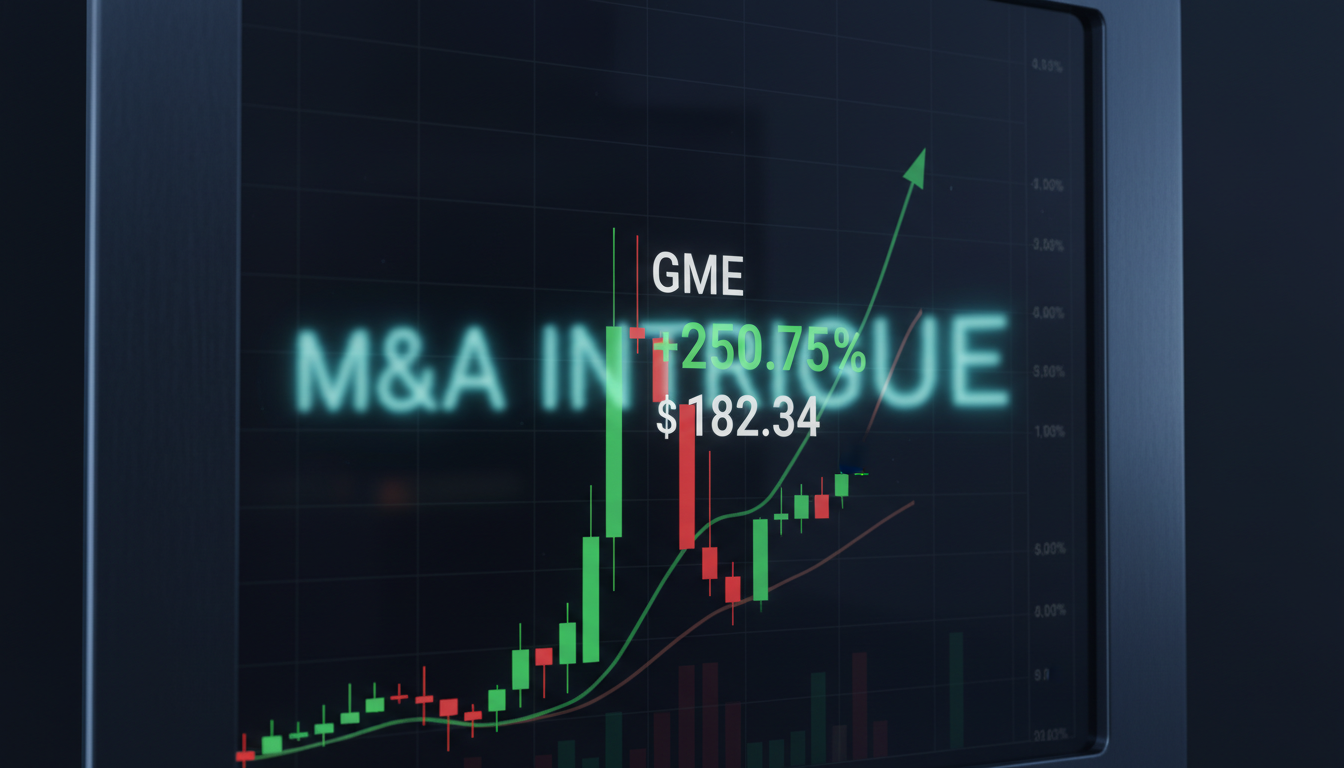
The financial world is once again transfixed as a familiar name surges to the forefront of market activity. As of early February 2026, we are witnessing a significant GameStop M&A speculative rally that has caught both institutional and retail traders by surprise. This price action, fueled by cryptic social media posts and circulating rumors of a major acquisition or merger, highlights a shift in market dynamics. While the 2021 saga was defined by a battle over short interest, today’s movement is driven by “M&A intrigue”—the possibility that GameStop is finally deploying its multi-billion dollar cash pile to transform its business model fundamentally.
Navigating a GameStop M&A speculative rally requires a blend of cold-blooded technical analysis and a deep understanding of corporate finance. For the retail investor, the allure of triple-digit percentage gains is intoxicating; however, the risks are equally profound. In the current economic environment of 2026, where interest rates have stabilized but market liquidity remains sensitive to headlines, understanding how to differentiate between a “head-fake” and a legitimate structural shift is the difference between building generational wealth and being left “holding the bag.”
The Anatomy of a Speculative M&A Rally
In finance, an M&A (Mergers and Acquisitions) rally occurs when the market begins to price in a premium based on the expectation that a company will either buy a competitor or be bought out. The GameStop M&A speculative rally is unique because of the company’s massive cash reserves and its vocal, dedicated shareholder base. Unlike a traditional rally based on earnings growth, a speculative rally is built on anticipation. Investors are not buying current revenue; they are buying the “optionality” of what that cash could become.
Understanding the “Cash-Heavy” Valuation Model
GameStop has spent the last year strengthening its balance sheet, resulting in a “fortress” of liquidity. When a company holds significant cash during a period of moderate inflation, the market begins to demand a plan. If rumors emerge that the company is looking at a tech-centric acquisition or a pivot into fintech, speculative buyers rush in to get ahead of the official announcement. This creates a feedback loop: higher prices attract more attention, which leads to more speculative buying, often independent of the underlying business’s current performance.
The Role of Sentiment and “Meme” Momentum
We cannot discuss the GameStop M&A speculative rally without acknowledging the power of retail sentiment. In 2026, social media remains a leading indicator for stock volatility. When M&A rumors begin to trend on decentralized social platforms, it triggers algorithmic trading bots that hunt for momentum. This synergy between human speculation and machine execution can push a stock far beyond its traditional fundamental value in a matter of hours.
AI Leverage in Business Scaling
Practical Strategies for Trading Speculative Rallies
If you are considering participating in the GameStop M&A speculative rally, you need a framework that prioritizes capital preservation. Speculative markets are “asymmetric”—meaning you can make a lot, but you can also lose your entire stake if you don’t use proper risk management. Here is a step-by-step guidance strategy for navigating this specific type of market event.
Step 1: Analyze the “Buy the Rumor, Sell the News” Cycle
Speculative rallies often peak the moment the official news is actually released. This is because the “smart money” has already priced in the move during the rumor phase. To trade this effectively, you must monitor volume. If the stock is rallying on declining volume, the move may be losing steam. Conversely, a breakout on massive volume often indicates institutional participation.
Step 2: Use Options to Define Risk
Rather than buying the stock outright at a peak, many seasoned investors use “defined risk” strategies like long calls or bull call spreads. This allows you to participate in the upside of the GameStop M&A speculative rally while knowing exactly how much you stand to lose (the premium paid). In a high-volatility environment, “Implied Volatility” (IV) will be expensive, so it is crucial to understand how “Theta” (time decay) will affect your position if the M&A news takes longer than expected to materialize.
Actionable Steps for Speculative Investors:
- Set Hard Stop-Losses: Never enter a speculative trade without a predetermined exit point.
- Check the SEC Filings: Look for U.S. Securities and Exchange Commission (SEC) filings such as Form 8-K, which companies must use to announce material events like mergers.
- Avoid “FOMO” (Fear Of Missing Out): If the stock has already doubled in two days, the best entry point has passed. Wait for a consolidation period.
- Size Your Position Correctly: Speculative trades should typically represent no more than 1% to 5% of your total portfolio.
Identifying Technical Breakouts
During the GameStop M&A speculative rally, technical indicators like the Relative Strength Index (RSI) and Moving Average Convergence Divergence (MACD) become vital. In 2026, many traders look for the “Golden Cross” on the 4-hour chart as a signal that the speculative momentum has institutional backing. However, be wary of “overbought” signals (RSI above 70), which suggest a temporary pullback is imminent.
Comparing 2021 to the 2026 Rally
To understand the potential returns and risks of the current GameStop M&A speculative rally, let’s look at a hypothetical scenario involving portfolio allocation and the “Gamma” effect.
Scenario: The $10,000 Speculative Allocation
Imagine an investor allocates $10,000 to GameStop during the early stages of the M&A rumor at $20 per share.
- Phase 1 (The Rumor): The stock climbs to $40 as M&A intrigue goes viral. The position is now worth $20,000.
- Phase 2 (The Gamma Squeeze): As call options go “In-the-Money,” market makers must buy shares to hedge, pushing the price to $60. The position is now worth $30,000.
- Phase 3 (The Reality Check): The company announces a smaller-than-expected acquisition. The stock drops 30% in post-market trading as speculators take profits.
| Metric | Start of Rally | Peak Speculation | Post-Announcement |
| Stock Price | $20.00 | $60.00 | $42.00 |
| Position Value | $10,000 | $30,000 | $21,000 |
| Psychological State | Curious | Euphoric | Frustrated |
| Total Gain/Loss | 0% | +200% | +110% |
As shown in this table, even if the “news” is positive, the stock price can drop because the expectation was even higher. This is a classic characteristic of the GameStop M&A speculative rally. Successful wealth building isn’t about catching the absolute top; it’s about having a “take-profit” strategy that secures gains while the rest of the market is still dreaming of higher numbers.
Applying Lessons to Real Life
In the real world, you can apply this by “scaling out” of your position. For example, if your position doubles, sell half. This way, you have recovered your initial $10,000 investment and are playing with “house money.” This reduces the emotional stress of the extreme volatility that defines these market events.
The road to financial freedom is littered with investors who tried to time a speculative rally perfectly and failed. When dealing with the GameStop M&A speculative rally, keep these risks in mind:
- Emotional Trading: Letting your heart rate dictate your “Buy” button.
- Neglecting Liquidity: In a massive sell-off, bid-ask spreads can widen significantly, making it difficult to exit your position at a fair price.
- Ignoring the Macro Picture: If the broader market is in a downturn due to rising 10-year Treasury yields, even the strongest M&A rumor might not be enough to sustain a rally.
- Falling for “Fake-Out” Rumors: Always verify news through multiple reputable sources or official corporate press releases before committing significant capital.
The current GameStop M&A speculative rally is a masterclass in modern market psychology. While the intrigue surrounding a potential merger or acquisition is a powerful catalyst for price action, it is also a double-edged sword. Investors who succeed in this environment are those who combine an understanding of the company’s “fortress” balance sheet with a disciplined, technical approach to entry and exit points.
In summary, the key takeaways are:
- Speculation is driven by the possibility of transformation, not just current earnings.
- Defined risk strategies, such as options or strict stop-losses, are essential to survive the volatility of the GameStop M&A speculative rally.
- “Selling the news” is a common outcome; always have a plan to secure profits during the ascent.
Would you like me to analyze the latest SEC filings for GameStop to see if there are any formal hints of an acquisition? Staying ahead of the data is the only way to turn speculation into a calculated investment. Keep learning, stay grounded, and remember that in the world of high-stakes finance, discipline always beats hype.