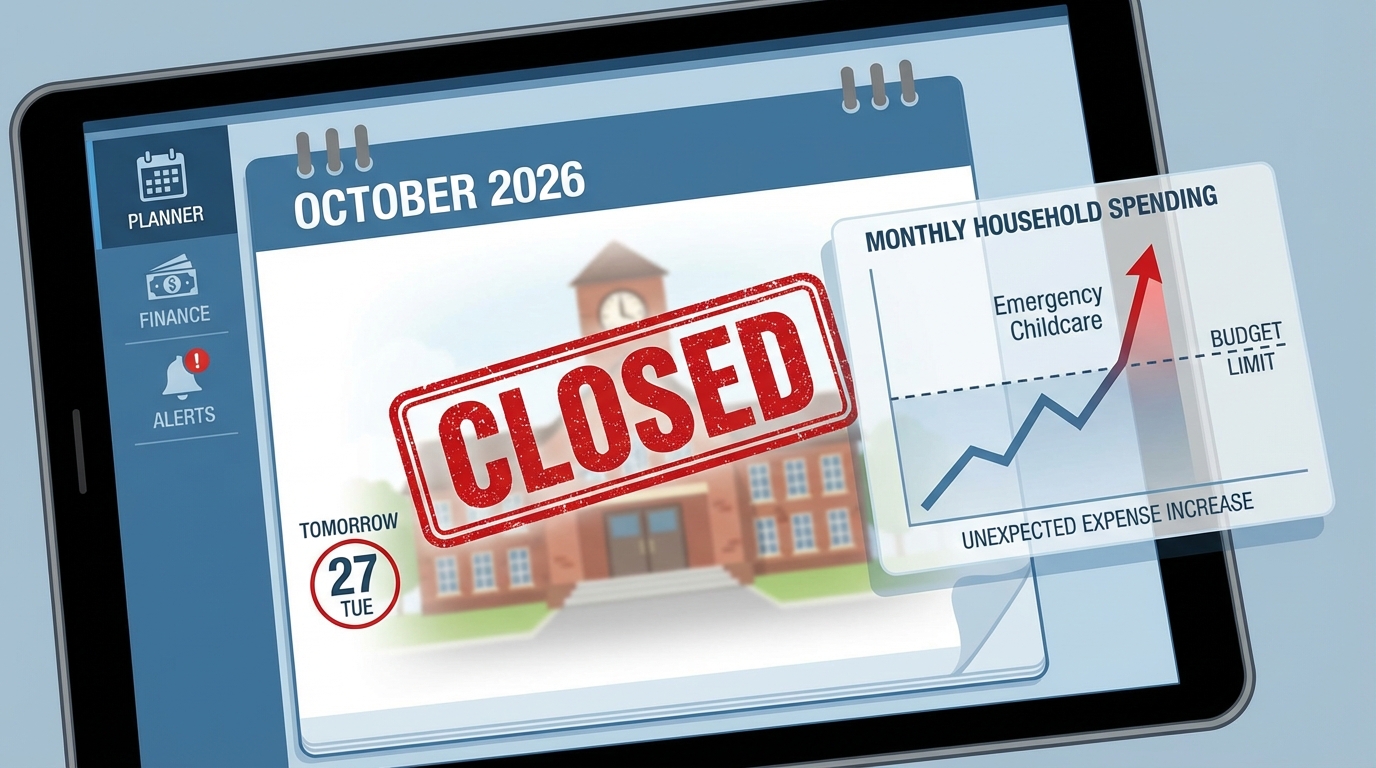
Predicting school closures tomorrow isn’t just about checking the weather forecast or monitoring local news; for the modern working professional, it is a significant financial event. Whether due to extreme weather, infrastructure failure, or sudden administrative pivots, an unplanned closure creates an immediate ripple effect through a family’s budget and a professional’s productivity. In the high-stakes economic environment of 2026, where “just-in-time” logistics apply to our homes as much as our businesses, losing a day of school means losing a day of operational stability.
For many, the first thought is “How will I finish my work?” while the second is “How much is this going to cost me?” Between emergency childcare, lost billable hours, and the invisible “productivity tax,” the financial toll can reach hundreds of dollars in a single day. This guide explores the core economic concepts of unplanned closures and provides a tactical framework to protect your wealth and your career when the school bells stop ringing.
AlgosOne AIAO: The Future of AI-Driven Wealth Building in 2026
The “Parental Labor Supply” Friction
To understand why school closures tomorrow matter to the macroeconomy, we must look at the concept of the “Parental Labor Supply.” In 2026, over 60% of households are dual-income, meaning school is not just an educational institution; it is the primary infrastructure for labor participation. When schools close unexpectedly, that infrastructure collapses, forcing an immediate and often expensive reallocation of human capital.
The Immediate Productivity Tax
An unplanned closure typically forces one parent to stay home, leading to “worker absenteeism.” For those in the service or healthcare sectors, this often results in direct wage loss. However, for white-collar professionals, the cost is often seen in “presenteeism”—being physically at home but mentally divided. Studies from the International Monetary Fund (IMF) suggest that unexpected shifts in childcare can reduce a worker’s daily output by up to 40%, potentially delaying critical projects and impacting long-term career growth.
Emergency Childcare Inflation
In early 2026, the demand for “last-minute” childcare is at an all-time high. When a district announces school closures tomorrow, the market for local sitters and drop-in centers experiences a localized spike in pricing. This “surge pricing” for childcare can cost a family between $20 and $50 per hour depending on the region. For a full workday, this unplanned expense can easily exceed $300, a significant hit to any household’s monthly discretionary income.
The “Closure Contingency” Framework
If you suspect there will be school closures tomorrow, you need a financial and operational “battle plan.” Waiting until the morning of the announcement to find a solution is the most expensive way to handle the crisis.
Step 1 – The “Time-Blocking” Financial Hedge
Instead of trying to work a full 8-hour day while managing children, use a “split-shift” strategy to protect your most valuable billable hours.
- Identify High-Value Tasks: Pinpoint the 2-3 hours of deep work that must happen.
- Negotiate “Childcare Swaps”: Coordinate with a neighbor to trade 3 hours of supervised play for 3 hours of quiet work time. This “barter” system has a $0 financial cost and protects 100% of your productivity.
- Audit Your Work-from-Home (WFH) Stipends: Check if your employer offers “Backup Care” benefits through platforms like Care.com. Many 2026 corporate packages include 10–15 days of subsidized emergency care.
Step 2 – Managing the “Invisible” Costs
Unplanned closures often lead to increased spending on takeout and entertainment to keep children occupied.
- Pre-Stock the “Closure Pantry”: Avoid the high cost of emergency delivery services by keeping a 48-hour supply of easy-to-prepare meals and “new” low-cost activities (like puzzles or craft kits) hidden away for these exact moments.
- Review Service Level Agreements (SLAs): If you are a freelancer, proactively communicate with clients before school closures tomorrow become official. Managing expectations early prevents “reputational debt” that can lead to lost contracts later.
Actionable Steps for Working Parents:
- Establish a “Rainy Day” Childcare Fund: Aim for $1,000 set aside specifically for emergency sitters.
- Leverage FSA/HSA Rules: Ensure you are using your Dependent Care Flexible Spending Account (DCFSA) to pay for emergency sitters, as this uses pre-tax dollars and can save you up to 30% on the cost.
- Verify Employer Policies: best financial planning tools for long-term growth
The True Cost of a Day Off
To visualize the financial impact of school closures tomorrow, let’s compare two different household scenarios in the 2026 economic environment.
| Expense Category | Scenario A: The Prepared Professional | Scenario B: The Reactive Parent |
| Childcare Cost | $0 (Neighborhood Swap) | $320 (Emergency Sitter @ $40/hr) |
| Food & Activity | $15 (Pre-stocked) | $65 (Delivery + New Video Game) |
| Productivity Loss | $0 (Split-shift completed) | $450 (1 missed billable project) |
| Total Daily Impact | $15 | $835 |
Case Insight: The $21 Trillion Global Shadow
According to the World Bank, localized school closures contribute to a “Learning Loss” that has long-term macroeconomic consequences. While one day may seem insignificant, the cumulative effect of unplanned disruptions is estimated to cost this generation of students nearly $21 trillion in lifetime earnings. For an individual family, this highlights that the cost is not just about “money out” today, but the potential for reduced human capital “value in” the future.
Common Mistakes and Risks to Avoid
- Chasing “Zero-Cost” Care at Work’s Expense: Trying to “multi-task” a toddler and a board presentation usually results in poor work quality. It is often cheaper to pay for 3 hours of focused help than to risk a performance PIP (Performance Improvement Plan).
- Forgetting About “Absenteeism” Insurance: If you are a business owner, ensure your insurance covers business interruptions caused by civil or environmental events that lead to widespread school closures tomorrow.
- Underestimating the “Food Gap”: For families reliant on subsidized school meals, a closure is a direct nutritional and financial shock.
- Ignoring Local “Safe Zones”: Many public libraries and community centers offer free “Closure Programming.” Research these options today before they fill up tomorrow.
Conclusion – Key Takeaways & Next Steps
The financial impact of school closures tomorrow is a manageable risk if you treat your household like a business. By establishing a “Neighborhood Barter” network, utilizing pre-tax Dependent Care FSAs, and pre-stocking “emergency” activities, you can reduce the cost of a closure from nearly $1,000 to less than $50. In an era of market volatility and shifting interest rates, protecting your daily operational stability is one of the most effective ways to ensure long-term wealth building.
Ultimately, a school closure is a test of your financial resilience. The goal isn’t just to “survive” the day, but to do so without derailing your budget or your professional reputation.
Are you ready for the next bell?
Start by identifying three other parents in your zip code to form a “Closure Coalition.” Would you like me to create a “Childcare Cost Calculator” to help you decide when it is financially smarter to take a “Personal Day” versus paying for an emergency sitter?