
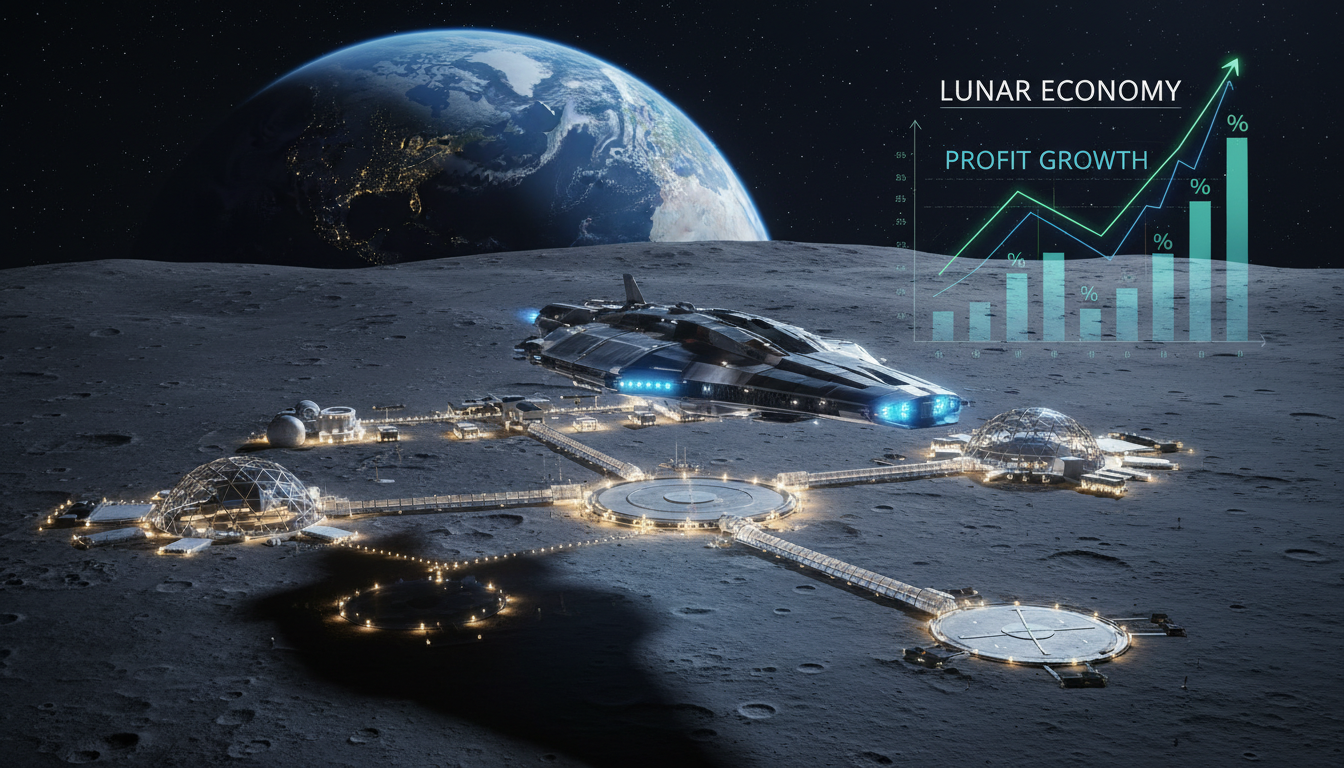
The dawn of 2026 has brought a monumental shift in the race for the “final frontier.” While the world previously looked toward Mars as the ultimate goal for human colonization, Elon Musk recently sent shockwaves through the financial markets by announcing that SpaceX is now prioritizing a “self-growing city” on the lunar surface. For forward-thinking investors, Elon Musk’s Moon City Plan represents more than just a scientific milestone; it is the catalyst for a fundamental restructuring of global technology and financial sectors.
By pivoting to the Moon—a destination reachable in just two days compared to the six-month journey to Mars—Musk is effectively accelerating the timeline for a trillion-dollar space economy. This strategic recalibration, combined with the integration of advanced artificial intelligence and satellite infrastructure, offers a unique window of opportunity for wealth building. If you are looking to position your portfolio for the next decade of growth, understanding the economic ripples of this lunar pivot is essential.
The Core Concept of the Lunar Pivot
At the heart of Elon Musk’s Moon City Plan is the realization that the Moon serves as the ideal “minimum viable product” for multi-planetary life. In February 2026, Musk clarified that while Mars remains a long-term goal, the logistical advantages of the Moon—such as launch windows every 10 days—make it the most practical path for “securing the future of civilization.”
The “Self-Growing City” Architecture
The concept of a “self-growing city” relies on autonomous robotics and 3D-printing technologies that utilize lunar regolith (soil) to construct habitats. Unlike previous mission concepts that required shipping every nut and bolt from Earth, this plan emphasizes in-situ resource utilization (ISRU). From a financial perspective, this shifts the cost model of space exploration from high-burn expendable missions to capital-intensive but sustainable infrastructure development.
The xAI and SpaceX Synergy: Space-Based Data Centers
One of the most disruptive elements of the 2026 roadmap is the merger of space logistics with high-level compute. SpaceX’s recent acquisition of xAI has paved the way for space-based data centers. By placing AI servers in lunar orbit or on the surface, companies can take advantage of the natural cold of space for cooling and the absence of atmospheric interference for laser-based data transmission. This integration ensures that Elon Musk’s Moon City Plan is not just about housing people, but about hosting the next generation of the global internet.
Valve’s Steam Machine Delay: Analyzing the RAM Crisis Impact on Tech Pricing
Practical Strategies for the Space Investor
As the space economy transitions from a government-funded endeavor to a commercially viable market, retail investors must move beyond speculation. To capitalize on Elon Musk’s Moon City Plan, you should focus on companies that provide the “picks and shovels” for lunar infrastructure.
Identifying “Pure-Play” Space Stocks
While SpaceX remains a private entity (despite persistent 2026 IPO rumors), several public companies are already deeply embedded in the lunar supply chain. These firms provide the essential services—from landing systems to Earth observation—that the Moon city will require.
- Lunar Logistics: Companies like Intuitive Machines (LUNR) have become essential partners for NASA’s Artemis program and commercial lunar deliveries.
- Geospatial Intelligence: As the Moon city grows, Earth-to-Moon monitoring will be critical. Firms like Planet Labs (PL) provide the satellite imagery necessary for resource mapping and environmental monitoring.
- Aerospace Giants: Traditional players such as Lockheed Martin and Northrop Grumman continue to hold massive contracts for the SLS (Space Launch System) and lunar gateway components.
The Satellite Broadband Disruption
The financial success of Elon Musk’s Moon City Plan is intrinsically tied to Starlink. In 2026, Starlink is no longer just a rural internet provider; it is the backbone of a new global telecommunications standard. By investing in telecom companies that are partnering with satellite providers for “Direct-to-Cell” (D2D) capabilities, you can gain exposure to the infrastructure that will eventually link Earthly markets with lunar colonies.
Actionable Investment Steps:
- Analyze the PEG Ratio: Look for space tech companies with a Price/Earnings to Growth ratio near 1.0 to ensure you aren’t overpaying for hype.
- Monitor SpaceX IPO News: If SpaceX conducts its rumored $50 billion IPO in late 2026, it will likely serve as a “rising tide” for the entire sector.
- Diversify via ETFs: If individual stock picking feels too risky, consider broad-based aerospace and suborbital defense ETFs to capture the sector’s growth.
Financial Scenarios and Market Impact
To appreciate the scale of Elon Musk’s Moon City Plan, we must look at the projected growth of the space sector. According to the OECD Space Economy Report, the global space industry is on track to exceed $1.8 trillion by 2035.
Scenario: The Infrastructure Value Chain
Consider a hypothetical investment in the “Lunar Infrastructure” sector. As SpaceX reduces launch costs via the fully reusable Starship V3, the price to deliver 1,000kg to the Moon is projected to drop by 70%.
| Sector Component | Primary Driver | 2026-2030 Outlook |
| Launch Services | Starship Reusability | Exponential Cost Reduction |
| Lunar Mining | Helium-3 & Water Ice | Early Stage R&D / High Risk |
| Satellite Comms | Starlink / Amazon Kuiper | Mature Revenue / High Cash Flow |
| AI Processing | Space-Based Data Centers | Emerging High-Margin Sector |
The “Starship Effect” on Global Finance
The ability to move massive amounts of cargo to the Moon changes the “Total Addressable Market” (TAM) for manufacturing. Fiber optics and pharmaceuticals produced in low-gravity environments could become multi-billion dollar industries. Investors who recognize these niche applications early can build significant wealth as the Elon Musk’s Moon City Plan moves from blueprint to reality.
While the potential for gains is astronomical, the risks are equally significant. Avoid these common investor traps:
- Underestimating Time Horizons: Building a city on the Moon is a multi-decade project. Do not invest capital that you will need in the next 12–24 months.
- Ignoring Regulatory Shifts: Space law is still in its infancy. Future treaties regarding lunar mining rights could drastically alter the profitability of certain companies.
- Chasing “Meme” Space Stocks: Be wary of small-cap companies that use the “Elon Musk” name to pump their stock without having actual contracts or hardware.
- Ignoring Energy Constraints: Lunar nights last two weeks. Companies without advanced nuclear or long-term battery storage solutions will struggle to maintain a permanent presence.
In conclusion, Elon Musk’s Moon City Plan is not merely a distraction from Mars; it is a calculated financial and technological pivot designed to create a sustainable, profitable presence in space. By shortening the distance to a “settled” colony, Musk is opening the door for commercial mining, orbital manufacturing, and space-based AI compute much sooner than previously anticipated.
For the modern investor, the key is to look for the “infrastructure play.” Focus on companies like Intuitive Machines for logistics, Planet Labs for data, and keep a close eye on the impending SpaceX IPO. The space economy is no longer a speculative dream—it is a $530 billion reality that is quickly scaling toward the trillions.
Are you ready to include frontier tech in your portfolio? Start by researching the latest NASA Artemis contracts to see which commercial partners are winning the most consistent revenue.






One Comment