
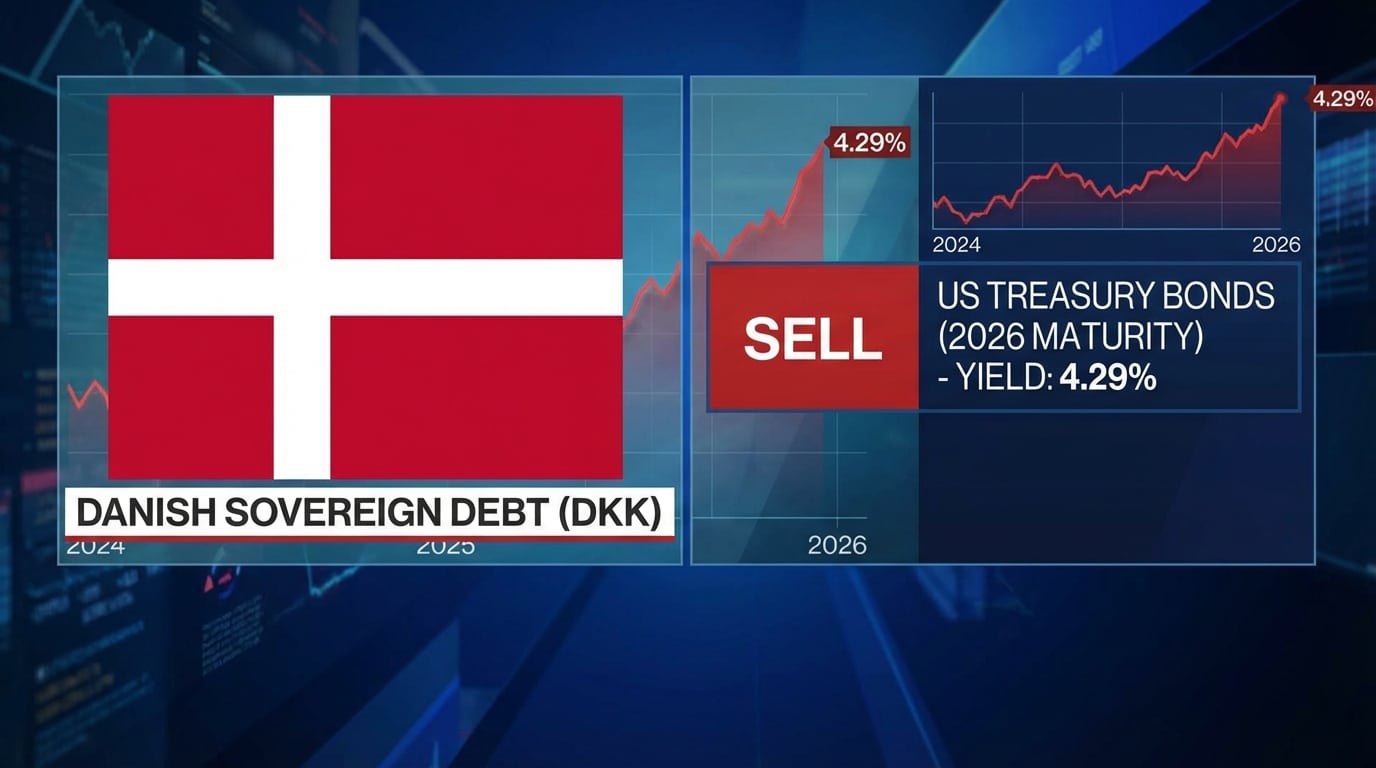
The global bond market is currently witnessing a significant “regime shift” as we move through early 2026. On Tuesday, January 20, 2026, the financial community was rattled by news that AkademikerPension, a prominent Danish pension fund, is selling its entire $100 million holding in U.S. government debt. While a $100 million divestment is a drop in the bucket of the $28 trillion Treasury market, the symbolic weight is historic. The Danish pension fund selling US Treasurys cited “unsustainable” government finances and “unignorable” credit risks as the primary drivers, signaling a potential erosion of trust in the world’s premier safe-haven asset.
For investors, this move is a “canary in the coal mine” moment. It highlights the growing tension between U.S. fiscal policy and international capital. As the Trump administration navigates a complex “Greenland annexation” narrative and aggressive tariff threats, institutional giants are beginning to reassess the “risk-free” status of the U.S. dollar. In this guide, we will analyze why this Danish pension fund selling US Treasurys matters to your portfolio and provide actionable strategies to navigate the volatility of the 2026 “Sell America” trade.
Section 1 – The Rationale Behind the Exit: Why US Credit is Under Fire
The decision by AkademikerPension to exit its Treasury positions is not a sudden whim but a calculated response to deteriorating fiscal fundamentals. Anders Schelde, the fund’s Chief Investment Officer, stated clearly that the U.S. is “basically not a good credit” in the long term. This assessment is grounded in the reality of the 2026 fiscal landscape, where the primary budget deficit remains over 3.7% of GDP despite a resilient labor market.
Fiscal Sustainability and the Greenland Factor
The Danish pension fund selling US Treasurys specifically mentioned that the administration’s threats to acquire Greenland—a Danish autonomous territory—made the decision to divest much easier. While the move is primarily financial, the geopolitical friction has acted as a catalyst. Investors are increasingly concerned that U.S. foreign policy is becoming a source of systemic risk rather than a stabilizer. Furthermore, the “One Big Beautiful Bill Act” (OBBBA) stimulus of 2025 has left the U.S. with a borrowing requirement of roughly $7 billion per day, a pace that many European funds view as a threat to dollar stability.
The Signaling Risk to Institutional Investors
The most dangerous aspect of a Danish pension fund selling US Treasurys is the “signaling risk.” Pension funds are traditionally the “stickiest” holders of government debt. When a reputable institution publicly declares that U.S. finances are no longer sustainable, it forces other funds—from Japan to the Middle East—to perform their own “stress tests.” If this localized divestment evolves into a broader European retreat, we could see a permanent upward shift in the yield curve, making it more expensive for the U.S. government (and by extension, American consumers) to borrow.
Section 2 – Practical Strategies: Navigating the “Sell America” Wave
With the 10-year Treasury yield hitting a four-month high of 4.29% following the news, investors must move beyond passive asset allocation. Danish pension fund selling US Treasurys is a signal to re-evaluate your fixed-income duration and diversify your currency exposure.
Step 1: Assessing Fixed-Income Exposure
In a 2026 environment defined by “fiscal anxiety,” long-duration bonds are the most vulnerable.
- Shorten Duration: Consider moving capital from 20-year or 30-year Treasurys into short-term T-bills or 2-year notes. Short-term yields are currently anchored by the Fed’s “shallow easing” path, while the long end of the curve is spiking on supply concerns.
- TIPS for Inflation Protection: With tariffs potentially pushing 2026 inflation toward a “sticky” 3%, Treasury Inflation-Protected Securities (TIPS) offer a hedge against the purchasing power erosion cited by the Danish fund.
Step 2: Diversifying into Defensive Assets
As the “Sell America” sentiment puts pressure on the dollar, capital is rotating into “neutral” assets.
- Precious Metals Surge: Gold has surged past $4,730 per ounce in early 2026, serving as the ultimate hedge against geopolitical uncertainty.
- International Equity Pivot: As European funds repatriate capital, look for opportunities in “shareholder-friendly” international markets. The earnings growth gap between the U.S. and the Rest of the World is narrowing as structural changes overseas begin to bear fruit.
2026 Asset Allocation Stress Test
| Asset Class | Risk Level | 2026 Tactical Outlook |
| Long-Term US Treasurys | High | Underweight; rising supply & fiscal risk. |
| Short-Term T-Bills | Low | Neutral; good for liquidity management. |
| Gold / Precious Metals | Medium | Overweight; primary hedge for dollar volatility. |
| US Quality Equities | Medium | Neutral; focus on free cash flow & low debt. |
| European Sovereign Debt | Low | Overweight; beneficiary of repatriated capital. |
Netflix All-Cash Offer for Warner Bros
Section 3 – Market Scenarios and Economic Insights: The 2026 Debt Outlook
The Danish pension fund selling US Treasurys is occurring against a backdrop of a “K-shaped” expansion. While AI-driven investments are pushing some sectors to record highs, the “fiscal weight” of the U.S. government is becoming a drag on others. According to reports from the International Monetary Fund (IMF), the global “weaponization of capital” is a rising threat that could see European allies use their $12.6 trillion in U.S. asset holdings as leverage in trade disputes.
Scenario A: The Gradual “De-Risking” (Base Case)
In this scenario, other funds follow AkademikerPension’s lead by slowly reducing their Treasury weightings without a total exit. Yields remain range-bound between 4.3% and 4.6%. The U.S. economy gathers momentum later in 2026 as OBBBA tax refunds hit household bank accounts, temporarily masking the fiscal cracks.
Scenario B: The “Yield Spike” Crisis (Bear Case)
If Japan or China joins the Danish pension fund selling US Treasurys trend, we could see a “VaR shock” where yields spike past 5% in a matter of weeks. This would trigger a hard reset for employment and a housing market freeze. In this scenario, the Fed would be forced into “Yield Curve Control,” which would further devalue the dollar but protect the government’s ability to service its debt.
Navigating the 2026 Tax Bracket Adjustments
Common Mistakes and Risks to Avoid
- Assuming “Risk-Free” Means “Volatility-Free”: Many beginners treat Treasurys as cash. In 2026, the price volatility of a 10-year bond can be higher than a blue-chip stock.
- Ignoring the Dollar Index (DXY): The Danish pension fund selling US Treasurys is as much a bet against the dollar as it is against the debt. If the DXY breaks below key support levels, your domestic purchasing power is at risk.
- Buying the “Dip” in Long Bonds: Catching a falling knife in the bond market during a “Sell America” trade is dangerous. Wait for fiscal discipline signals from the Treasury Department before going “long” on duration.
- Underestimating Geopolitical Spillovers: The Greenland dispute is not just rhetoric; it is affecting capital flows. Do not ignore the “Greenland Tax” on your international portfolio.
Conclusion – Key Takeaways & Next Steps
The news of a Danish pension fund selling US Treasurys marks a critical junction for the 2026 global economy. It is a reminder that even the world’s most powerful borrower is subject to the scrutiny of the “bond vigilantes.” While the divestment is currently small, the rationale—unsustainable finances and geopolitical risk—is being echoed across institutional boardrooms worldwide. By shortening your bond duration, increasing your allocation to precious metals, and monitoring the “fiscal discipline” narrative, you can protect your wealth from the potential “mutually assured destruction” of a transatlantic capital rift.
Stability in 2026 is no longer a given; it must be actively sought through diversification. Therefore, your next step should be a thorough audit of your “Fixed-Income Duration.” Are you holding the debt that the world’s smartest pension funds are currently rejecting?
Would you like me to help you analyze the “Duration Risk” of your current bond holdings to see how a potential Treasury spike would impact your net worth?






One Comment