
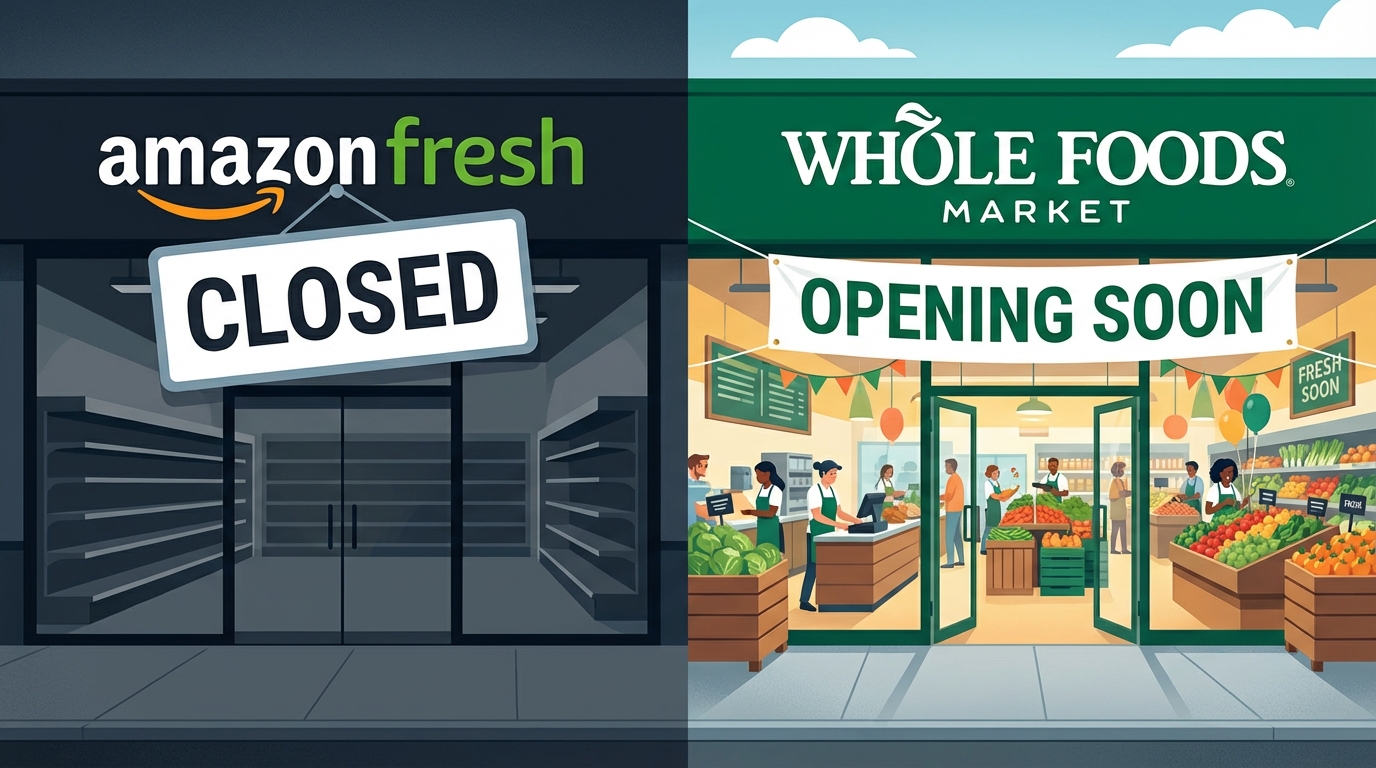
The retail landscape witnessed a seismic shift on Tuesday, January 27, 2026, as the world’s largest e-commerce giant announced a total retreat from its homegrown physical grocery brands. Amazon closing Fresh and Go stores marks the definitive end of a decade-long experiment in high-tech, cashierless brick-and-mortar retail. The company confirmed it will shutter all 57 Amazon Fresh locations and its remaining 15 Amazon Go convenience stores nationwide. In their place, the company is doubling down on its most successful physical asset: Whole Foods Market.
For investors and consumers, the news that Amazon closing Fresh and Go stores is a signal that “Just Walk Out” technology, while innovative, failed to create a scalable economic model for the grocery sector. Amazon now plans to open more than 100 new Whole Foods stores over the next several years, converting several former Fresh and Go sites into the premium organic banner. As we navigate the 2026 economic environment defined by selective consumer spending and high operational costs, this consolidation reflects a broader trend of big-tech companies prioritizing proven profitability over speculative expansion.
The End of the Amazon-Branded Grocery Experiment
The decision to close 72 stores nationwide is not a retreat from the grocery market, but rather a strategic reallocation of capital. According to Amazon’s official statement, the company had not yet created a “truly distinctive customer experience” with the right economic model needed for large-scale expansion of the Fresh and Go brands. Consequently, most stores will close their doors by Sunday, February 1, 2026.
The Economic Failure of the “Just Walk Out” Model
While the “Just Walk Out” technology pioneered in Seattle was a technical marvel, its implementation in large-format grocery stores proved to be a financial burden. The high cost of sensor-heavy infrastructure and the operational complexity of maintaining real-time inventory at scale resulted in razor-thin margins. In a 2026 economy where capital efficiency is paramount, Amazon decided that licensing this technology to third-party venues like stadiums and airports was a more profitable path than operating its own stores.
Consolidation Under the Whole Foods Banner
Whole Foods Market has seen more than 40% sales growth since its acquisition in 2017. By shuttering its experimental brands, Amazon is consolidating its physical grocery presence under a banner that already possesses deep brand equity and a loyal customer base. The move to open 100+ new Whole Foods locations signals a shift toward a “premium-hybrid” model, where physical stores act as both high-end retail destinations and high-speed fulfillment hubs for online orders.
Navigating the New Grocery Landscape
For the savvy investor, Amazon closing Fresh and Go stores provides a clear roadmap of where the retail giant sees future growth. The 2025–2026 period has shown that consumers value a trusted brand and physical reliability over futuristic gimmicks.
Step-by-Step – Evaluating the New “Amazon Grocery” Strategy
Amazon is not leaving the mass-market grocery space entirely; it is simply changing the format.
- Watch the “Supercenter” Pilot: Amazon has approved a 230,000-square-foot “supercenter” in Orland Park, Illinois, for 2027. This Walmart-style concept will combine fresh food with general merchandise.
- Monitor “Daily Shop” Formats: The “Whole Foods Market Daily Shop,” a smaller convenience format, is expanding from five to ten locations by the end of 2026. This is the true successor to the Amazon Go model.
- Analyze Same-Day Delivery Metrics: CEO Andy Jassy has stated that the format the company is most excited about is same-day delivery of perishables. Watch for Amazon’s Q1 2026 earnings to see if the “Amazon Now” 30-minute delivery initiative is capturing market share from Kroger and Walmart.
Strategic Shift – Betting on Hybrid Fulfillment
The modern grocery store must be a “dual-purpose” asset.
- Fulfillment Hubs: Use Whole Foods stores as micro-warehouses. This reduces the “last-mile” delivery cost, which remains the most expensive part of the logistics chain.
- Store-Within-a-Store: Amazon is testing a “store-within-a-store” concept in Pennsylvania where customers can shop for Amazon general merchandise alongside their organic groceries.
Actionable Steps for Investors:
- Re-evaluate Consumer Staples Exposure: As Amazon consolidates, legacy grocers like Kroger may face increased pressure from a more focused Whole Foods expansion.
- Track Licensing Revenue: Monitor Amazon’s “Other” revenue segment for growth in “Just Walk Out” licensing fees to third-party retailers.
- Audit “Capital Efficiency” Metrics: According to the International Monetary Fund (IMF), firms that cut non-performing “experiment” projects in high-interest-rate environments tend to see significant multiple expansion.
Examples and Market Insights: Fresh/Go vs. Whole Foods
To understand why the Amazon closing Fresh and Go stores decision was made, we must look at the performance gap between the two models.
| Feature | Amazon Fresh / Go (Closed) | Whole Foods Market (Expanding) |
| Brand Recognition | Emerging / Experimental | Established / Premium |
| Profit Margin | Lower (Tech-heavy Overhead) | Higher (Premium Pricing) |
| Store Footprint | ~35,000 sq. ft. (Fresh) | ~40,000 sq. ft. (Average) |
| Technology Focus | Cashierless (High Maintenance) | Frictionless Checkout / Mobile App |
| Growth Potential | Stagnant Economic Model | 40% Growth since 2017 |
Case Insight: The Orland Park Mega-Store
Earlier this month, Amazon announced plans for its largest-ever retail store near Chicago. This 230,000-square-foot facility would be large enough to fit two average-size Target stores. This move suggests that Amazon believes “Big-Box” value is the only way to truly compete with Walmart. While Amazon closing Fresh and Go stores removes the “middle ground” of grocery, the pivot toward “Supercenters” and “Daily Shops” shows a more nuanced, tiered retail strategy.
Economic Insight: The 2026 consumer is increasingly bifurcated. They are either seeking the absolute lowest price (Supercenters) or the highest quality and convenience (Whole Foods Daily Shop). Amazon’s removal of the Fresh brand is a recognition that there is no room for a “tech-first, brand-last” middle tier in the current economy.
Stock Market Today: Dow Plummets 800 Points Amid Trump’s Greenland Tariff Threats
Common Mistakes and Risks to Avoid
- Assuming Amazon is Quitting Physical Retail: The announcement of Amazon closing Fresh and Go stores is a consolidation, not an exit. The company is actually planning to open more physical square footage via Whole Foods and Supercenters than it is closing.
- Underestimating the “Delivery Wall”: Same-day delivery of perishables is notoriously difficult to make profitable. If Amazon cannot convert Fresh and Go shoppers into online-only customers, it may lose market share to local supermarket chains.
- Ignoring the Workforce Impact: While Amazon is working to place affected employees in other roles, another wave of corporate layoffs is expected this week.
- Chasing “Just Walk Out” Tickers: Just because Amazon is licensing the technology doesn’t mean it’s a guaranteed winner for the licensees. High implementation costs remain a primary hurdle for sports arenas and hospitals.
Conclusion – Key Takeaways & Next Steps
The news that Amazon closing Fresh and Go stores marks a pivotal moment in the history of automated retail. It proves that even the most advanced technology cannot save a business model that lacks a “truly distinctive customer experience.” By doubling down on Whole Foods and fast delivery, Amazon is returning to its core strengths: logistics, data, and a trusted premium brand.
As an investor or consumer, the takeaway is clear: 2026 is the year of the “Pragmatic Pivot.” Companies are no longer being rewarded for “experimenting” with your time or their capital; they are being rewarded for providing clear, reliable value.
What is your next move in the retail sector?
Start by auditing your exposure to “physical-first” vs. “digital-first” retail stocks. Would you like me to create a “2026 Grocery Wars Comparison” to help you see how Amazon’s new Whole Foods strategy stacks up against Walmart’s 2026 expansion plans?





One Comment