If your portfolio looks redder than a Valentine’s Day sale right now, you aren’t alone. In the early weeks of February 2026, the digital asset space has faced a significant reality check. Bitcoin, which touched staggering highs of $126,000 back in October 2025, is now hovering around the $67,000 mark. This sharp 45% retracement from the peak has left many retail and institutional investors asking the same question: What is really going on? This Cryptocurrency Market Dip Analysis will dive into the macroeconomic, regulatory, and technical forces currently driving the market lower and, more importantly, how you can navigate these choppy waters.
The current volatility serves as a stark reminder that while the “Institutional Era” of crypto has arrived, digital assets remain highly sensitive to global liquidity shifts. We are no longer in the era of “meme-coin moonshots” alone; we are in a sophisticated market where Federal Reserve policy and AI sector valuations now directly impact your crypto holdings. To build lasting wealth, you must understand the “why” behind the dip before you decide on your “how” for the recovery.
The 2026 Sell-Off – Core Factors Behind the Dip
To perform an effective Cryptocurrency Market Dip Analysis, we have to look past the scary price candles and examine the structural shifts in the global economy. The 2026 dip isn’t just a random “crash”; it is a calculated de-risking by major players.
The Federal Reserve and the “Warsh Hawk” Effect
A primary catalyst for the current downturn is the shift in U.S. monetary policy expectations. The nomination of Kevin Warsh as the next Federal Reserve chair has injected a dose of “hawkish” fear into speculative markets. Investors worry that a Warsh-led Fed will move toward a smaller balance sheet more aggressively than previously anticipated.
In a world where crypto thrives on excess liquidity, the threat of a “liquidity vacuum” is immediate. When the Fed signals a potential tightening, institutional capital often rotates out of high-beta assets like Bitcoin and Ethereum and back into the safety of the U.S. Dollar. Consequently, we have seen the U.S. Dollar Index (DXY) strengthen significantly as crypto prices falter.
Institutional ETF Outflows and Liquidity Stress
Unlike previous cycles, the 2026 market is heavily influenced by Spot ETFs. While these products brought billions in “new money” during 2025, they have now become a double-edged sword. In January 2026 alone, U.S. spot Bitcoin ETFs saw over $3 billion in net withdrawals.
This steady selling pressure creates a “forced liquidation” environment. When institutional investors redeem their ETF shares, the fund managers must sell the underlying Bitcoin on the open market. This creates a self-reinforcing downward spiral. According to the latest International Monetary Fund (IMF) World Economic Outlook, global financial conditions remain “divergent,” meaning that while some sectors are booming, speculative assets are facing a “higher-for-longer” liquidity squeeze.
Dollar’s ‘Relentless’ Slide Has Traders Bracing for More Pain
Practical Strategies for Navigating the 2026 Crypto Dip
Understanding the cause is only half the battle. As an investor focused on wealth building, your priority should be protecting your principal while positioning for the eventual rebound. Here is a framework for navigating this Cryptocurrency Market Dip Analysis in your personal portfolio.
Strategic Rebalancing and Risk Mitigation
The 2026 dip has highlighted a massive “dispersion” in asset performance. While Bitcoin has dropped significantly, “utility-heavy” sectors like Real-World Asset (RWA) tokenization and AI-integrated protocols have shown more resilience.
- Audit Your Altcoins: Many projects that thrived on 2025 hype are currently “underwater.” If a project lacks a clear revenue model or institutional partnership, it may not survive a prolonged “crypto winter.”
- Hedge with Yield: Use the current dip to move into regulated stablecoin yield products. With global rates still relatively high, you can earn 5-7% on your cash while waiting for a confirmed market bottom.
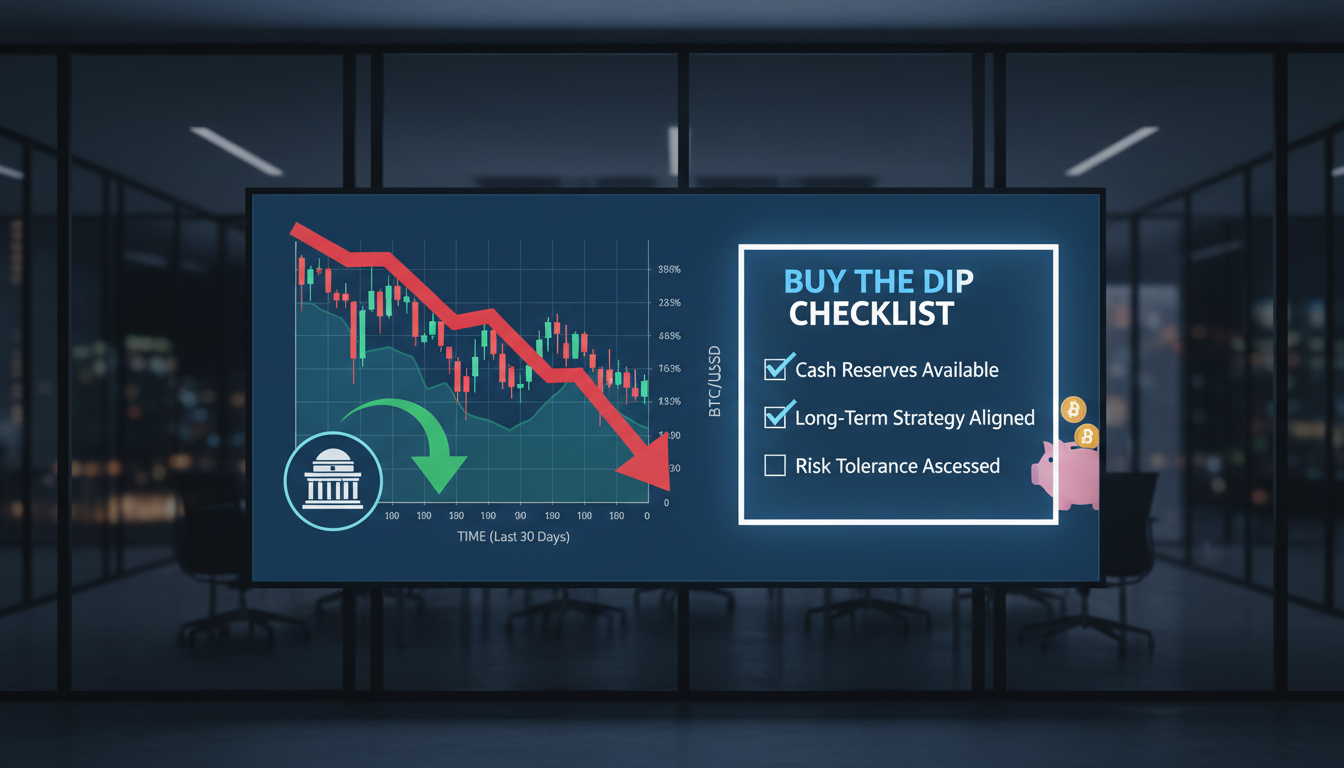
- Utilize “Smart” DCA: Instead of blindly buying the dip, use technical indicators like the RSI (Relative Strength Index). Currently, with the RSI near 30, the market is “oversold,” making it a statistically better time for incremental entries than it was in October.
Identifying “Blue Chip” Opportunities in Tokenization
In 2026, the narrative has shifted toward “Production, not Speculation.” Wall Street is watching platforms that facilitate the tokenization of Treasury bills and private equity. These assets provide a “floor” to the market because they have intrinsic, real-world value.
- Ethereum as the Financial Layer: Despite the price drop, Ethereum’s role as the settlement layer for global stablecoins remains unchallenged.
- Solana as the Execution Layer: For high-frequency “Agentic AI” transactions, Solana’s speed continues to attract developers, making its dip a potential opportunity for long-term believers.
Comparative Analysis – 2022 vs. 2026 Market Corrections
To gain perspective, it helps to compare our current situation with previous downturns. While the price drops feel similar, the underlying “market health” is vastly different in 2026.
Comparison Table: Why This Dip is Different
| Feature | 2022 “Crypto Winter” | 2026 “Liquidity Dip” |
| Primary Driver | Protocol collapses (Terra/FTX) | Macroeconomic shifts & Fed Policy |
| Institutional Presence | Low / Speculative | High (ETFs & Corporate Treasuries) |
| Regulatory Status | “Wild West” | Regulated (GENIUS Act & MiCA) |
| Total Market Cap | ~$800 Billion | ~$2.4 Trillion |
| Recovery Catalyst | Long-term building | Fed “Pivot” & Institutional Adoption |
Numeric Scenario: The Power of the “Dip-Buy”
Imagine you had $10,000 to invest during this Cryptocurrency Market Dip Analysis phase.
- Scenario A (Panic): You sell your BTC at $67,000, fearing a drop to $40,000. You miss the rebound and buy back at $90,000. Your purchasing power is reduced by ~25%.
- Scenario B (Strategic DCA): You keep your core position and deploy $1,000 every time BTC drops another 5%. If BTC returns to its $126,000 peak, your “dip-bought” layers represent a 88% return, significantly outperforming the “buy and hold” crowd.
Even with a solid Cryptocurrency Market Dip Analysis, individual mistakes can wipe out years of wealth building. Avoid these common pitfalls:
- Excessive Leverage: Over $1 billion in positions were liquidated in a single 24-hour window this February. In a 2026 market driven by algorithmic trading, “hunting for liquidity” means the price will often spike or dip just to clear out leveraged traders. Stay away from 10x leverage.
- Ignoring the IRS: 2026 marks a new era of crypto tax reporting. Selling at a loss can be a strategic move for “tax-loss harvesting,” but ensure you aren’t violating “wash sale” rules if they have been updated in your jurisdiction.
- The “Sunk Cost” Fallacy: Just because you bought a token at $10 doesn’t mean it has to go back to $10. If the fundamentals have changed (e.g., the team abandoned the project or a competitor launched a better version), cut your losses.
- Emotional FOMO (Fear Of Missing Out): Don’t rush into “V-shaped recovery” bets. Historically, crypto bottoms take months, not days, to form. Patience is your greatest asset in 2026.
The reality is that the “easy money” phase of the 2025 bull run has concluded, giving way to a more mature, volatile, and institutionalized market. Our Cryptocurrency Market Dip Analysis shows that while the $2 trillion wipeout is painful, it is a healthy “flush” of leverage and speculative excess. The core thesis for digital assets—as a scarce, programmable, and global financial layer—remains stronger than ever, supported by new laws like the GENIUS Act and the growing use of crypto in corporate treasuries.
Therefore, do not let short-term “red candles” blind you to long-term “green growth.” Focus on assets with real-world utility, keep your leverage low, and use this period of “extreme fear” to refine your portfolio. The investors who win in 2026 are those who view volatility as a discount, not a disaster.
Would you like me to build a 2026 rebalancing template for your digital asset portfolio to help you manage this volatility?