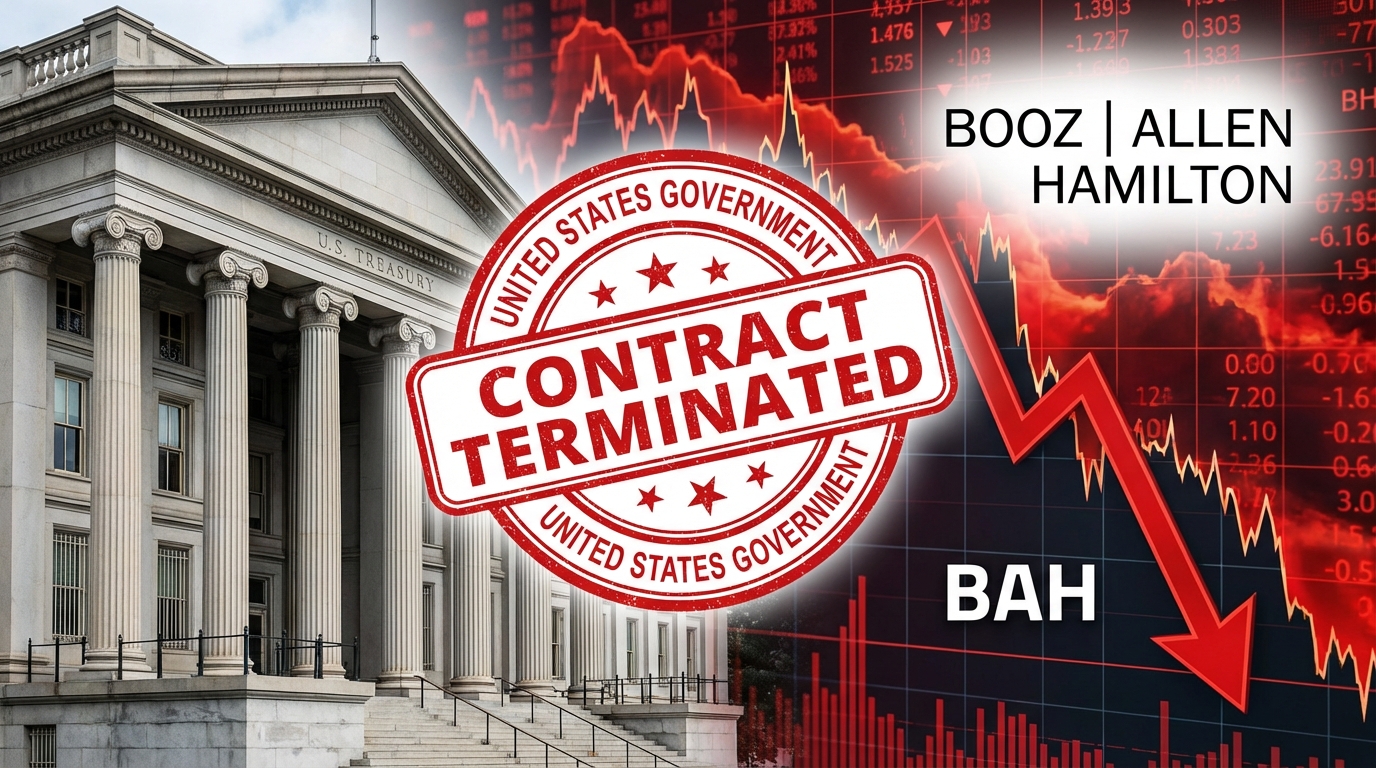
The relationship between the federal government and its largest consulting partners has faced a dramatic shift as the U.S. Treasury ends all contracts with Booz Allen Hamilton. Announced on Monday, January 26, 2026, the decision to terminate 31 active contracts—worth an estimated $21 million in total obligations—has sent shockwaves through the defense and government services sector. For anyone holding shares of Booz Allen Hamilton (BAH) or monitoring the stability of government-dependent portfolios, this development is a critical case study in “reputational risk” and the changing enforcement landscape of the current administration.
While $21 million represents a fraction of the firm’s multi-billion dollar annual revenue, the news that the U.S. Treasury ends all contracts with Booz Allen Hamilton carries a symbolic weight that the market has noted. In the high-stakes environment of 2026, where data security is the ultimate currency, the Treasury’s citing of “inadequate safeguards” for sensitive taxpayer information has raised questions about the firm’s broader standing across other federal agencies. In this guide, we will analyze the core reasons for this contract termination, the immediate financial impact on BAH stock, and the practical strategies for investors navigating the volatile world of federal contracting.
managing risk in a volatile stock market
Why the Treasury Terminated Booz Allen Hamilton
The primary driver behind the Treasury’s decision is rooted in a massive data breach involving the Internal Revenue Service (IRS). To understand why the U.S. Treasury ends all contracts with Booz Allen Hamilton, one must look back at the case of Charles Edward Littlejohn, a former Booz Allen contractor sentenced to prison in 2024.
The Littlejohn Data Leak and Security Failures
The Treasury Department, led by Secretary Scott Bessent, specifically cited the “unparalleled” leak of tax records belonging to over 406,000 high-income individuals, including President Donald Trump. Littlejohn, while employed by Booz Allen on an IRS contract between 2018 and 2020, methodically extracted sensitive data and shared it with media organizations. The current administration argues that the firm failed to implement the necessary “digital firewalls” and internal monitoring tools to prevent such a breach, leading to a total loss of trust within the Treasury’s bureaus.
The Role of DOGE and New Federal Oversight
In 2026, the Department of Government Efficiency (DOGE) has taken an aggressive role in auditing federal contractors. The termination of these contracts is part of a broader “performance-based” purge. The Treasury Department emphasized that the move is an essential step to “increase Americans’ trust in government” by rooting out what it perceives as institutional negligence. This shift indicates that in the 2025–2026 economic cycle, past performance and security lapses are being punished more severely than in previous decades.
Navigating Federal Contract Volatility
For investors, the U.S. Treasury ends all contracts with Booz Allen Hamilton provides a clear framework for assessing “contractual risk” within a diversified portfolio. While federal work is often seen as recession-proof, it is not “controversy-proof.”
Diversifying Away from Agency-Specific Risk
If your portfolio is heavily weighted in government services, you must analyze the “Agency Concentration” of your holdings.
- Assess the Fallout: While the Treasury cut ties, Booz Allen still holds significant, multi-billion dollar contracts with the Department of Defense (DOD) and the Intelligence Community.
- Actionable Step: Research a firm’s “Backlog Diversification.” If more than 25% of a company’s revenue comes from a single federal department that is currently under DOGE scrutiny, it may be time to trim the position.
- best financial planning tools for long-term growth
Monitoring the “Book-to-Bill” Ratio
In the 2026 market, the “Book-to-Bill” ratio is the most important metric for government contractors. It measures the number of orders received against the number of orders fulfilled.
- Track the Momentum: Despite the Treasury news, Booz Allen recently reported a record backlog of $38 billion in its Q3 2026 earnings.
- Watch for Contagion: The real risk is if other agencies—like the DIA or DTRA—follow the Treasury’s lead.
Actionable Steps for the Proactive Investor:
- Monitor the RSI (Relative Strength Index): BAH stock fell over 11% today, pushing the RSI into oversold territory. This may represent a “buy the dip” opportunity for those who believe the Treasury exit is a localized event.
- Review Cybersecurity Accreditations: In 2026, firms that lead in “Zero Trust” architecture will be the safest bets for government work. Verify if your holdings are achieving higher CMMC (Cybersecurity Maturity Model Certification) levels.
- Analyze Free Cash Flow (FCF): Booz Allen’s ability to maintain its $0.59 quarterly dividend depends on its FCF, which remained strong at $739 million for the fiscal year to date.
The Financial Math of Termination
To quantify the impact of the U.S. Treasury ends all contracts with Booz Allen Hamilton, we can compare the actual dollar loss against the firm’s total enterprise value.
| Metric | Treasury Contracts Affected | Booz Allen Hamilton Total (FY2026) |
| Annual Spending | $4.8 Million | ~$11.3 Billion (Estimated Revenue) |
| Total Obligations | $21 Million | $38 Billion (Total Backlog) |
| Market Cap Impact | ~$2 Billion Loss (Intraday) | ~$17 Billion Total Market Cap |
Scenario: The “Reputational Discount”
This table illustrates that the market reaction is not about the $21 million. A $21 million loss does not justify a 10% drop in stock price ($2 billion in market value). Instead, the market is pricing in a Reputational Discount.
- The Math: The market is betting that the Treasury’s exit increases the probability that Booz Allen will lose future bids or face higher compliance costs that eat into their 10.9% Adjusted EBITDA margins.
- The Insight: For the long-term wealth builder, this is a “Sentiment-to-Value” play. If Booz Allen can prove to the DOD and other agencies that their “Mission Control” AI and security tools are now bulletproof, the stock will likely recover its 2026 highs.
Economic Insight: According to theInternational Monetary Fund (IMF), the “efficiency of public spending” is the top macro-theme for 2026. This move by the U.S. Treasury is a domestic manifestation of a global trend toward stricter oversight of private-sector intermediaries.
Common Mistakes and Risks to Avoid
- Panic-Selling on Small-Value Cuts: Remember that $21 million is less than 0.2% of Booz Allen’s annual revenue. Don’t let a “headline shock” force you out of a high-quality, long-term position.
- Ignoring the DOGE Momentum: The Department of Government Efficiency is not finished. reminds us that regulatory shifts are the #1 risk for defense contractors this year.
- Assuming All Contracts Are Safe: In 2026, “Mission Critical” contracts are being re-evaluated daily. If a firm has a history of leaks or performance lags, its entire federal portfolio is under a microscope.
- Underestimating the Dividend Floor: Booz Allen’s commitment to its $0.59 dividend (payable March 2, 2026) provides a “valuation floor” for income investors, even during PR crises.
Conclusion – Key Takeaways & Next Steps
The news that the U.S. Treasury ends all contracts with Booz Allen Hamilton marks a defining moment for Tysons-based firm and its investors. While the immediate financial impact is manageable, the long-term narrative has shifted from “unchecked growth” to “security-first accountability.” By terminating 31 contracts due to data safeguards, the Treasury has issued a warning to the entire government services sector: past failures will no longer be ignored in the 2026 budget cycle.
Ultimately, your goal as a wealth builder is to separate the “Signal” from the “Noise.” The signal is that cybersecurity compliance is now the primary determinant of federal contract longevity.
Are you ready to audit your “Government Services” portfolio?
Start by reviewing the “Agency Exposure” of your top three defense holdings. Would you like me to create a “Contractor Risk Scorecard” to help you evaluate which firms are most vulnerable to the current DOGE audits?