
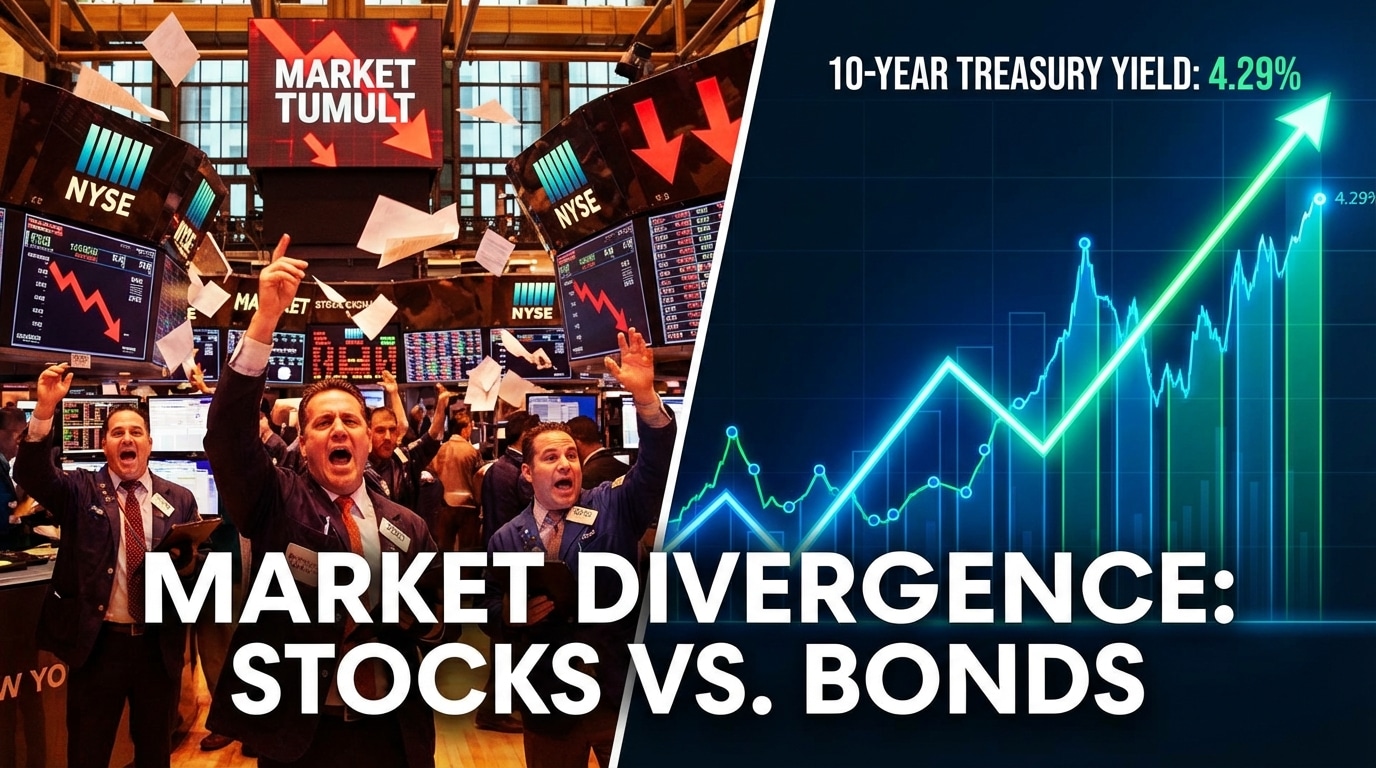
Wall Street is enduring a punishing session as a “perfect storm” of geopolitical friction and a global debt rout sends investors scrambling for cover.1 In a dramatic reversal of the recent New Year’s rally, the Dow Jones Industrial Average plummeted more than 700 points, while the tech-heavy Nasdaq and the benchmark S&P 500 shed nearly 2% in early trading. The twin catalysts—President Trump’s escalating tariff threats against European allies over Greenland and a sharp spike in U.S. Treasury yields—have effectively ignited a “Sell America” trade that is reverberating across global asset classes.
As traders returned from the holiday weekend, the relative calm of the winter markets was shattered.2 The Cboe Volatility Index (VIX), often called the market’s “fear gauge,” surged 27% to breach the 20 level for the first time since late 2025.3 This volatility reflects growing fears that the long-standing transatlantic alliance is entering a severe crisis, with economic logic taking a backseat to territorial ambitions and trade confrontations.4
The Greenland Standoff and Tariff Volatility
The primary driver of today’s equity retreat is the escalating dispute between Washington and Europe over the proposed U.S. acquisition of Greenland.5 President Trump has threatened to impose a 10% tariff on imports from eight European nations—including Denmark, France, Germany, and the UK—effective February 1, 2026.6 These levies are slated to rise to 25% by June if an agreement is not reached.7
Geopolitical “Wild Cards” in the Markets
Market participants generally dislike uncertainty, and the “Greenland tax” is a massive geopolitical wild card. The threat of a 200% tariff on French wine and champagne, specifically targeting President Macron for his refusal to join a U.S.-led initiative, has signaled to investors that trade policy is being used as a tool for diplomatic leverage.8 This departure from traditional trade negotiations has left analysts concerned about a “spiral of escalation” that could shave significant percentage points off global GDP growth.9
The Impact on European and Nordic Equities
The fallout was immediate in international markets. Denmark, given its direct sovereignty over Greenland, saw its Morningstar Nordic Index tumble over 3%.10 European benchmarks like the CAC 40 and DAX fell between 1.5% and 1.9%, as investors bet that European manufacturers would bear the brunt of any retaliatory “trade bazooka” measures from the EU.11 For U.S. investors, the risk is that higher costs for imported components will squeeze corporate margins and reignite inflationary pressures.12
Navigating the Global Bond Sell-off
While tariffs grabbed the headlines, a secondary and perhaps more systemic threat emerged in the fixed-income markets. U.S. Treasury yields spiked as global investors reassessed the safety of American debt amid the widening rift with allies.13
The Yield Spike and the “Sell America” Trade
The 10-year Treasury yield jumped seven basis points to reach 4.29%, its highest level in over four months.14 This move was exacerbated by heavy selling in Japanese government bonds and reports that major European pension funds, such as Denmark’s AkademikerPension, are planning to exit U.S. Treasuries entirely by the end of the month.15 This shift in capital flows suggests that the “automatic” recycling of foreign capital into U.S. assets is becoming less certain.16
Tactical Moves for Volatile Markets
In this high-yield, high-volatility environment, investors must be more surgical in their asset allocation. The “60/40” portfolio is currently under stress as both stocks and bonds sink simultaneously. To navigate this, consider the following actionable steps:
- Prioritize Safe Havens: Gold and silver have become the primary beneficiaries of today’s turmoil.17 Gold jumped to a record $4,730 per ounce, while silver hit a fresh high near $95.18
- Audit Tech Exposure: High-duration tech stocks in the Nasdaq are particularly sensitive to rising yields.19 Use a higher discount rate in your valuation models to account for the “higher-for-longer” yield reality.
- Watch the Dollar Index: Interestingly, the U.S. Dollar fell nearly 1% against a basket of currencies today.20 This divergence from its usual safe-haven status suggests a specific “Sell America” sentiment.
- Implement Trailing Stops: With the VIX above 20, the risk of “flash crashes” is elevated. Ensure your stop-losses are tight but allow for standard intraday volatility.
Safe Havens vs. Risk Assets
To understand the magnitude of today’s moves, one only needs to look at the divergence between precious metals and equity futures. As the Dow set up for a 700-point fall, the flight to safety was historic in scale.
The $4,700 Gold Milestone
Investors seeking protection from trade-war rhetoric drove gold past the $4,700 mark for the first time in history.21 This move reflects a “hedging of the hedges.” When traditional allies are at economic odds, gold serves as the ultimate neutral asset. For a portfolio of $100,000, a 5% allocation to gold would have provided a significant cushion against today’s 1.5% drop in the S&P 500.
| Asset Class | Movement (Jan 20, 2026) | Significance |
| S&P 500 Futures | Down 1.4% | Poised to wipe out YTD gains |
| Nasdaq 100 Futures | Down 1.7% | Hit by rising Treasury yields |
| 10-Year Treasury Yield | 4.29% (Up 7bps) | Highest level since August 2025 |
| Spot Gold22 | $4,730.84 (Up 1.3%)23 | Fresh all-time high24 |
| Silver | $95.52 (Up 3.2%) | Record high on industrial/safety bid |
According to the International Monetary Fund (IMF), the “spiral of escalation” in trade tensions is now the single biggest threat to the 2026 global growth projection of 3.3%. Investors are now pricing in a world where geopolitical cohesion is no longer guaranteed, leading to a “repricing” of risk assets globally.25
Netflix All-Cash Offer for Warner Bros
Common Mistakes and Risks to Avoid
- Buying the Dip Too Early: While “dip buying” has worked for the three-year bull run, current geopolitical tensions are fundamentally different. Wait for a clear “off-ramp” in the Greenland dispute before re-entering high-beta tech.
- Ignoring Yield Curve Steepening: As short-term rates remain anchored by Fed expectations but long-term yields spike on supply concerns, the yield curve is steepening.26 This can be painful for long-duration bond holders.
- Underestimating Retailer Impact: Tariffs are ultimately paid by U.S. importers and passed to consumers. Watch for margin compression in major retailers as the February 1 deadline approaches.
- Over-reliance on the Dollar: The dollar’s retreat today shows it isn’t always the “safest” haven. Diversification into Swiss Francs or Yen may be necessary in a “Sell America” scenario.
Conclusion – Key Takeaways & Next Steps
The market sell-off on January 20, 2026, serves as a stark reminder that political risk can override economic optimism in an instant. With the Dow, S&P 500, and Nasdaq sinking on tariff fears and rising bond yields, the “enthusiasm for artificial intelligence” is being tested by the reality of a potential trade war with Europe. Gold’s surge to $4,730 indicates that professional money is seeking a shelter that Treasuries and the Dollar are currently struggling to provide.27
Stability in 2026 is no longer about finding growth; it is about protecting it. Therefore, your next step should be a thorough audit of your portfolio’s “tariff sensitivity.” Are your core holdings dependent on European supply chains or transatlantic harmony?
Would you like me to help you analyze the earnings impact of the 10% European tariffs on specific consumer discretionary stocks in your portfolio? Stay tuned for our deep dive into the 2026 trade war hedges.






One Comment