
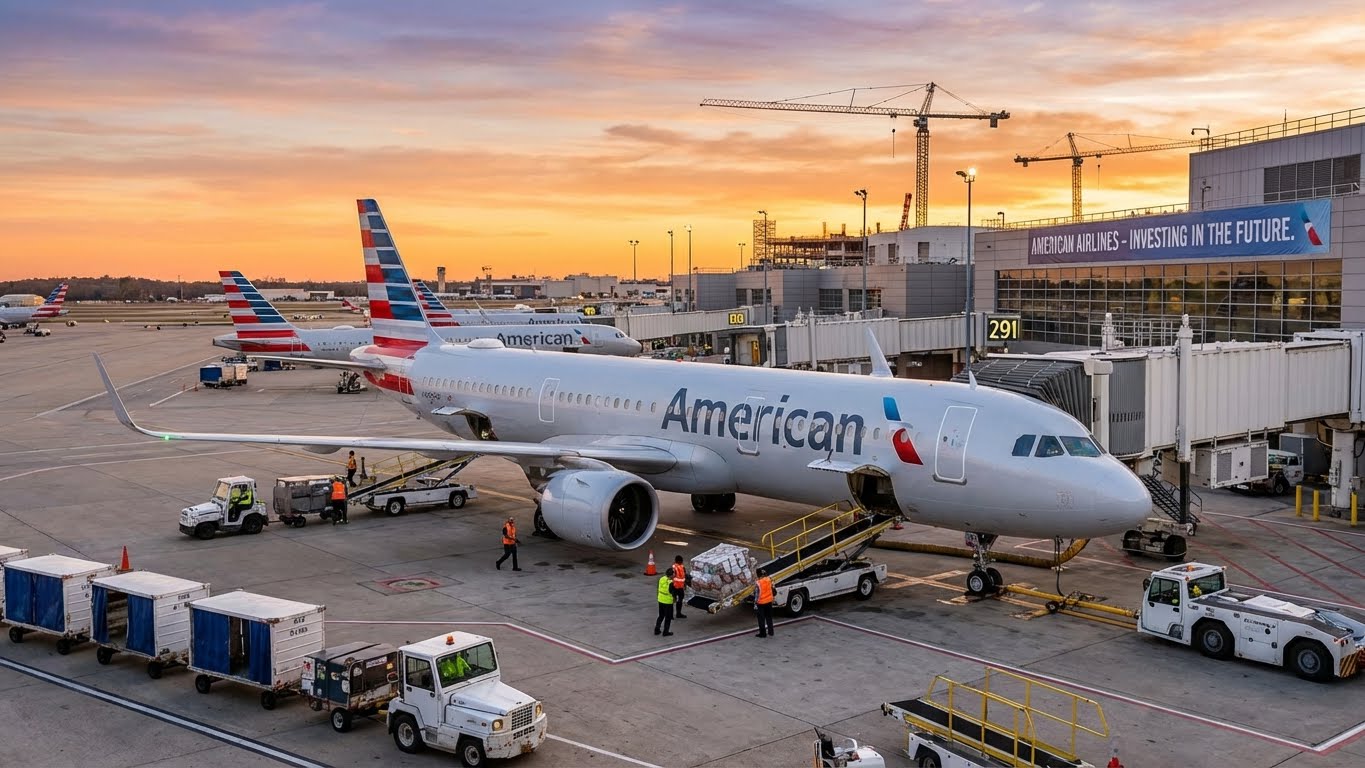
American Airlines new Airbus rollout is more than a shiny new plane—it’s a snapshot of the airline’s long-term strategy. Cabin layout, seat density, premium sections, and fuel efficiency all quietly reveal how management thinks about growth, margins, and the customer mix.
In a world of persistent inflation, choppy travel demand, and higher-for-longer interest rates, American Airlines new Airbus decisions can either strengthen the balance sheet… or amplify risk. This article breaks down what the new aircraft strategy really signals, and how you, as an investor, can read it like a roadmap of American’s plan.
Section 1 – Core Concept/Overview
At first glance, a new aircraft order might look like routine fleet housekeeping. But in reality, American Airlines new Airbus deliveries touch almost every major driver of shareholder value:
- Cost per seat mile
- Revenue per seat (especially from premium cabins)
- Network flexibility and route economics
- Balance sheet leverage and capital intensity
Think of the American Airlines new Airbus order as a physical, flying business strategy. The configuration choices—how many economy seats, how many extra-legroom and premium seats, how much space devoted to galleys and lavatories—are all deliberate trade-offs between volume and value.
Key Component 1: Fleet Modernization and Cost Efficiency
One core part of American’s plan is usually lowering unit costs over time. Newer Airbus aircraft tend to offer:
- Better fuel efficiency per seat
- Lower maintenance expenses compared to older jets
- Improved reliability, which reduces delays and compensation costs
For investors, this matters because airlines operate on thin margins. A 3–5% improvement in fuel burn per seat can translate into meaningful gains in operating margin over a full fleet cycle.
When you hear about American Airlines new Airbus joining the fleet, you should immediately think:
“How does this change cost per available seat mile (CASM) over the next 5–10 years?”
If the new aircraft allow American to retire older, less efficient planes, the long-term cost curve bends downward—exactly what you want to see in a capital-intensive, cyclical business.
Key Component 2: Revenue Mix and Premium Strategy
The second pillar of American’s plan is the revenue side. New Airbus layouts can be:
- Premium-heavy (more business class, premium economy, and extra-legroom seats)
- High-density (more standard economy seats to maximize volume)
- Hybrid (a balanced mix tailored to each route type)
A premium-heavy American Airlines new Airbus configuration signals a strategy focused on:
- Higher-yield business and affluent leisure travelers
- Loyalty and co-branded credit card economics
- Ancillary revenue (seat selection fees, early boarding, etc.)
A high-density layout signals a focus on:
- Unit cost advantage
- Competing on price on domestic or high-volume routes
- Capturing price-sensitive travelers while still charging extras for bags and seat selection
The “metaphor for American’s plan” lies in how these cabins are balanced. If the new Airbus aircraft lean toward more premium seating and better onboard tech, American is telling you it wants to climb the revenue quality ladder, not just fill seats.
Third Straight Fed Interest Rate Cut
Section 2 – Practical Strategies / Framework
How do you translate American Airlines new Airbus headlines into actual investment decisions? Use a simple, repeatable framework so you aren’t just reacting emotionally to news.
Strategy Type 1: The 4-Pillar Airline Stock Framework
When you see coverage of American Airlines new Airbus aircraft, walk through these four pillars:
- Profitability
- Are new planes expected to lower CASM or raise revenue per available seat mile (RASM)?
- Is the company guiding to higher margins over the next few years?
- Portfolio Role
- Is AAL a speculative growth play in your portfolio, or a small cyclical satellite around a core of diversified index funds?
- Payout and Balance Sheet
- With heavy capex for new Airbus jets, is there room for debt reduction or shareholder returns (buybacks/dividends)?
- Airlines are usually more leveraged than many sectors; keep that in mind.
- Position Sizing and Risk Management
- Even if American Airlines new Airbus strategy looks attractive, it’s still a cyclical business exposed to fuel prices, recessions, and shocks.
- Limit position size relative to your total equity portfolio and risk tolerance.
Strategy Type 2: Step-by-Step Process for Evaluating the New Airbus News
Here’s a practical sequence you can follow whenever American Airlines new Airbus updates appear:
- Identify the aircraft type and role
- Narrowbody vs widebody? Domestic focus or long-haul international?
- Assess operational impact
- More range? Better fuel efficiency? Ability to open new routes or increase frequency on key business corridors?
- Analyze cabin configuration
- More premium seats = higher potential yields but higher execution risk.
- More economy seats = lower CASM, but potentially weaker pricing power.
- Connect to macro context
- In 2025–2026, many central banks are still balancing inflation control with supporting growth. Air travel demand may slow in a downturn, so lower-cost fleets give airlines more flexibility.
- An American Airlines new Airbus fleet with lower CASM can be a competitive advantage in softer demand cycles.
- Check capital intensity
- Are these aircraft purchased outright, financed, or leased?
- High upfront commitments can pressure free cash flow if demand dips.
- Revisit your thesis and time horizon
- If your thesis was “American is improving its fleet and margins,” then new Airbus deliveries may reinforce that idea—provided management is executing.
Actionable checklist for investors:
- Read the key details of the American Airlines new Airbus announcement
- Note any comments about cost savings or premium revenue
- Look at the latest earnings guidance and capex plans
- Compare valuation metrics (P/E, EV/EBITDA) to peers
- Decide if you’ll:
- Increase position
- Hold and watch
- Trim exposure if risk/valuation looks stretched
Section 3 – Examples, Scenarios, or Case Insights
Let’s use simplified numbers to see how American Airlines new Airbus can affect economics. Numbers are illustrative, not actual company guidance.
Example 1: Cost per Seat and Margin Impact
Assume:
- Old aircraft: 170 seats, cost per flight $25,000
- New American Airlines new Airbus: 190 seats, cost per flight $24,000 (better fuel efficiency & maintenance)
Old plane cost per seat:
- $25,000 ÷ 170 ≈ $147 per seat
New plane cost per seat:
- $24,000 ÷ 190 ≈ $126 per seat
That’s a reduction of about 14% in cost per seat. If tickets still sell at similar average prices, the margin on each flight improves significantly. Across hundreds of daily flights, this is exactly why airlines invest in new fleets even in a higher rate environment.
Example 2: Premium Mix and Revenue
Now imagine the new American Airlines new Airbus cabin is more premium-heavy:
- Old layout: 12 business, 24 extra-legroom, 134 economy
- New layout: 20 business, 36 extra-legroom, 134 economy (more total seats and more premium)
Suppose average one-way fares (illustrative):
- Business: $650
- Extra-legroom: $320
- Economy: $220
Old revenue per fully booked flight:
- Business: 12 × $650 = $7,800
- Extra-legroom: 24 × $320 = $7,680
- Economy: 134 × $220 = $29,480
- Total: $44,960
New revenue per fully booked flight:
- Business: 20 × $650 = $13,000
- Extra-legroom: 36 × $320 = $11,520
- Economy: 134 × $220 = $29,480
- Total: $53, ,?
Let’s calculate properly:
- $13,000 + $11,520 = $24,520
- $24,520 + $29,480 = $54,000
So a similar route, at similar prices, could generate about:
- $44,960 → $54,000 (≈ 20% more revenue)
If costs only rise modestly due to upgraded interiors and service, this can materially boost operating margin. This is the type of strategic shift American Airlines new Airbus may be aiming to achieve: more revenue per flight, not just more flights.
Example 3: Portfolio Scenario
Assume you have a $60,000 portfolio and you’re considering a $3,000 position in American Airlines (5% of your portfolio). You see headlines about American Airlines new Airbus and the metaphor for American’s plan:
- If you view the new fleet as a margin-enhancing, premium-mix strategy and valuation looks reasonable, you might:
- Initiate or maintain the 5% position and plan to hold through the fleet rollout cycle.
- If you worry about leveraged balance sheets and recession risk, you might:
- Limit exposure to 2–3% and pair it with a broad airline or transportation ETF to diversify company-specific risk.
The point: use the American Airlines new Airbus headlines as input into a structured decision process, not as a standalone “buy” or “sell” trigger.
Common Mistakes and Risks
When analyzing American Airlines new Airbus and similar fleet moves, avoid these frequent investor errors:
- Chasing the story without checking the balance sheet
New planes are exciting, but they’re also expensive. High debt plus rising rates increases financial risk. - Ignoring the airline cycle
Airlines are highly cyclical. Even a great American Airlines new Airbus strategy can be derailed by recessions, fuel price spikes, or demand shocks. - Overestimating premium demand
Adding more premium seats assumes sustained demand from business and high-end leisure travelers. If the economy slows, these cabins may be harder to fill at target fares. - Underestimating competition
Other carriers may also modernize their fleets, eroding the advantage of American Airlines new Airbus aircraft over time. - Overconcentration in one airline stock
Airlines can look attractive after news headlines, but concentration risk is real. Keep position sizes appropriate for your risk tolerance. - Forgetting regulatory and ESG pressure
Environmental rules and public pressure around emissions may require further investment in fuel-efficient or sustainable technology later, impacting long-term capex needs.
Also remember that global economic forecasts from institutions like the International Monetary Fund still highlight uncertainty around growth and inflation, which can affect travel demand and airline profitability.
Conclusion – Key Takeaways & Next Steps
The American Airlines new Airbus rollout is more than a fleet upgrade. It’s a visible, tangible metaphor for American’s broader plan:
- Lower long-term unit costs with more efficient aircraft
- Improve revenue quality through premium-heavy or optimized cabin layouts
- Increase strategic flexibility in a volatile macro environment
For you as an investor, the key is to:
- Treat news about American Airlines new Airbus as a window into management’s long-term thinking, not just a product announcement.
- Run the news through a clear framework: profitability, portfolio role, payout/balance sheet, and risk management.
- Combine qualitative insights (cabins, brand positioning) with quantitative metrics (margins, capex, leverage) over several quarters before making big portfolio moves.
If you want to keep improving your process, your next steps could be:
- Review American’s latest financial reports and commentary on fleet strategy.
- Compare its approach and valuation to other major carriers and transportation stocks.
- Decide how airline exposure fits into your broader diversified investment plan.
Used thoughtfully, the American Airlines new Airbus story can become a real-world case study that sharpens how you analyze cyclical, capital-intensive businesses—not just in airlines, but across your entire portfolio.




One Comment