
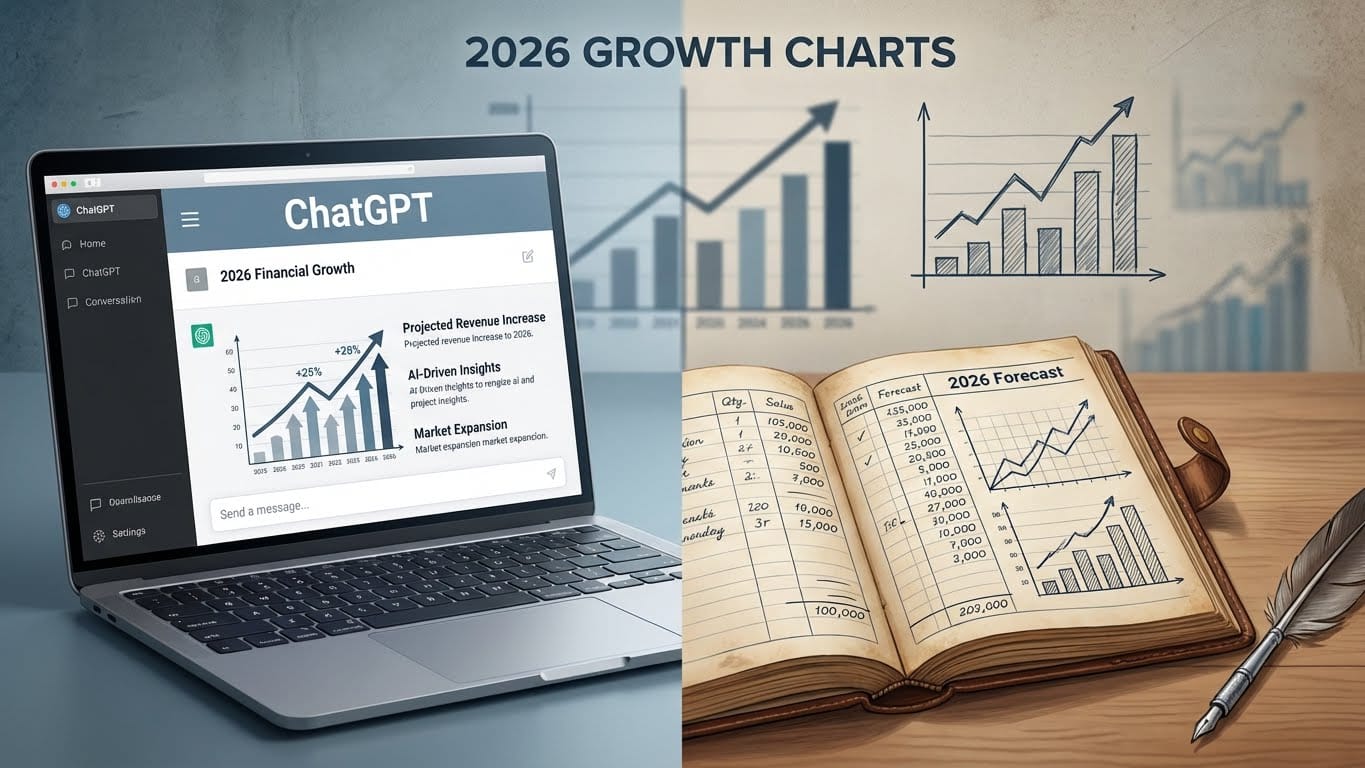
The financial landscape of 2026 is defined by a rapid convergence of artificial intelligence and personal wealth management. As we navigate an era of “sticky” inflation and shifting global markets, the traditional, static financial document is becoming obsolete. Today, writing a financial plan with ChatGPT has emerged as a high-leverage strategy for both novice and experienced investors. By utilizing the latest reasoning models, you can transform a simple AI interface into a dynamic, 24/7 financial analyst that adapts to real-time economic shifts.
However, simply asking an AI for “money tips” is not a strategy. Success in 2026 requires a structured, multi-phase approach that combines your personal goals with the computational power of Large Language Models (LLMs). This guide will provide you with the exact framework and prompts needed for writing a financial plan with ChatGPT that is resilient, actionable, and tailored to the current high-yield environment.
The AI-Financial Advisor Hybrid
The fundamental idea behind writing a financial plan with ChatGPT is not to replace human judgment, but to augment it. In 2026, we have moved beyond “Generative AI” and into the era of “Agentic AI.” This means the tool can now reason through complex financial trade-offs, such as whether to prioritize high-interest debt repayment or capitalize on the 4% risk-free rates currently available in money market funds.
The Shift from Static to Dynamic Planning
Historically, a financial plan was a one-time PDF that gathered dust. With ChatGPT, your plan becomes a “living document.” You can feed the AI updated information about your monthly expenses or new tax law changes—like the provisions of the 2025 “One Big Beautiful Bill Act”—and receive an immediate update on your projected net worth. This dynamic nature allows you to pivot your strategy as the economic environment of 2026 evolves.
The Importance of the “Human-in-the-Loop” Model
While ChatGPT is an expert at processing data and identifying patterns, it lacks fiduciary responsibility. Therefore, the most successful investors in 2026 use a “human-in-the-loop” model. You use the AI to do the “heavy lifting”—the math, the scenario modeling, and the initial drafting—but you remain the final decision-maker. This synergy ensures that your plan is mathematically sound while remaining aligned with your unique values and emotional risk tolerance.
The 2026 Prompting System
To get professional-grade results when writing a financial plan with ChatGPT, you must use a sophisticated prompting framework. You cannot simply ask, “How do I get rich?” Instead, you should use the R.T.C.S. Model (Role, Task, Context, Structure).
Phase 1: Role Setting and Data Grounding
The first step is to tell the AI exactly who it needs to be. For 2026, you want a “Certified Financial Planner (CFP) with expertise in modern tax law and high-yield investment environments.”
Actionable Prompt Strategy:
“Act as a senior financial advisor. I am going to provide you with my current income, debts, and 2026 goals. Your task is to analyze my cash flow and suggest an allocation strategy that prioritizes tax efficiency under current 2026 tax brackets. Ask me 10 clarifying questions before you begin to ensure you have the full picture.”
Phase 2: Creating the Actionable Framework
Once the data is grounded, you move into the drafting phase. This is where you use the AI to build the specific “buckets” of your wealth-building engine.
- Debt Repayment Logic: Ask ChatGPT to compare the “Debt Snowball” versus the “Debt Avalanche” based on your specific interest rates.
- Investment Benchmarking: Use the AI to compare your current portfolio’s expense ratios against 2026 industry standards.
- Tax Optimization: Instruct the AI to “Identify which of my accounts are best suited for the new 2026 long-term capital gain exclusions.”
7 AI Trading Tools That Save You 10 Hours of Trading Daily
Examples, Scenarios, and Case Insights
To illustrate how writing a financial plan with ChatGPT works in real life, let’s look at a comparative scenario for an investor starting their plan in early 2026.
Scenario: The $5,000 Monthly Pivot
Imagine “Alex,” a 35-year-old earning $120,000 annually. Alex has $20,000 in a 4.5% HYSA and $15,000 in credit card debt at 24% APR.
| Strategy Item | Manual Planning Result | ChatGPT-Driven Plan |
| Initial Focus | Save more for a house. | Aggressive $2,000/mo Debt Avalanche. |
| Tax Strategy | Standard deduction. | Bunching 2 years of charity to itemize. |
| Retirement | 5% to 401(k). | 10% to Roth to lock in current rates. |
| Projected 12-Mo Gain | $4,500 (Savings) | $9,200 (Debt interest saved + growth) |
The “What-If” Analysis
In 2026, the most powerful feature of writing a financial plan with ChatGPT is the “what-if” scenario. You can ask: “If inflation stays at 3.2% for the next five years, but my salary only grows by 2% annually, how much do I need to increase my side-hustle income to maintain my 2045 retirement date?” The AI can run this complex math in seconds, allowing you to prepare for the “worst-case” while hoping for the best.
According to a 2026 report from the World Bank, AI-driven financial literacy is expected to be a primary driver in reducing household debt across developed economies. By utilizing these tools, you are front-running a global shift toward more efficient personal finance.
Common Mistakes and Risks to Avoid
- The Hallucination Trap: ChatGPT can sometimes “invent” financial products or interest rates. Always verify specific numbers—like the current 2026 Fed Funds Rate—through an official financial news source.
- Sharing Sensitive Data: Never input your full legal name, Social Security Number, or actual bank account numbers into a public AI. Use “rounded numbers” or “Placeholders” (e.g., Bank A, Account B).
- Blindly Following “Stock Picks”: ChatGPT is a planning tool, not a crystal ball. If it suggests a specific ticker, perform your own fundamental analysis before buying.
- Ignoring the “Fiduciary” Gap: ChatGPT does not have a legal obligation to put your interests first. Use its output as a “second opinion” or a “working draft” to bring to a human advisor.
- Prompt Vaguery: Asking the AI to “make me a plan” will yield generic results. The more specific your context (e.g., “I live in a high-tax state and have three dependents”), the more valuable the plan.
Rich or Hungry? The 2026 Pyramid Reveals All
Conclusion – Key Takeaways & Next Steps
The age of the static financial plan is over. Writing a financial plan with ChatGPT in 2026 gives you a competitive advantage by transforming raw data into a strategic, adaptive roadmap. By using the R.T.C.S. prompting model, focusing on “real-time” scenario modeling, and maintaining a “human-in-the-loop” approach, you can build a portfolio that is resilient to inflation and optimized for growth.
Therefore, your next step should be to open a fresh ChatGPT session and begin the “Role Setting” phase described above. Do not wait for the market to move; build the plan that allows you to move first.
Would you like me to draft a specific “Goal-Setting Prompt” for you based on your target retirement year and current age? Explore our further resources to stay updated on the latest AI-driven wealth strategies.





3 Comments