The financial markets have a funny way of humbling even the most seasoned bulls, and right now, the greenback is the primary target. As of late January 2026, the US Dollar relentless slide has become the dominant narrative on Wall Street. For many traders, the start of the year was supposed to be a period of “American Exceptionalism,” but instead, we are witnessing a rapid erosion of confidence. Between escalating trade wars, political interference in monetary policy, and shifting interest rate differentials, the currency that once reigned supreme is currently testing its lowest levels in four years.
If you are an investor trying to navigate this volatility, you aren’t alone. The US Dollar relentless slide is not just a technical correction; it is a fundamental re-pricing of global risk. As the Federal Reserve moves toward an aggressive easing cycle while geopolitical tensions—specifically regarding the “Greenland tariff” dispute—unnerve foreign capital, the path of least resistance for the dollar appears to be lower. In this guide, we will analyze why the greenback is stumbling, the practical strategies you can use to hedge your portfolio, and what the “smart money” is doing to prepare for even more pain in the months ahead.
The Convergence of Policy and Politics
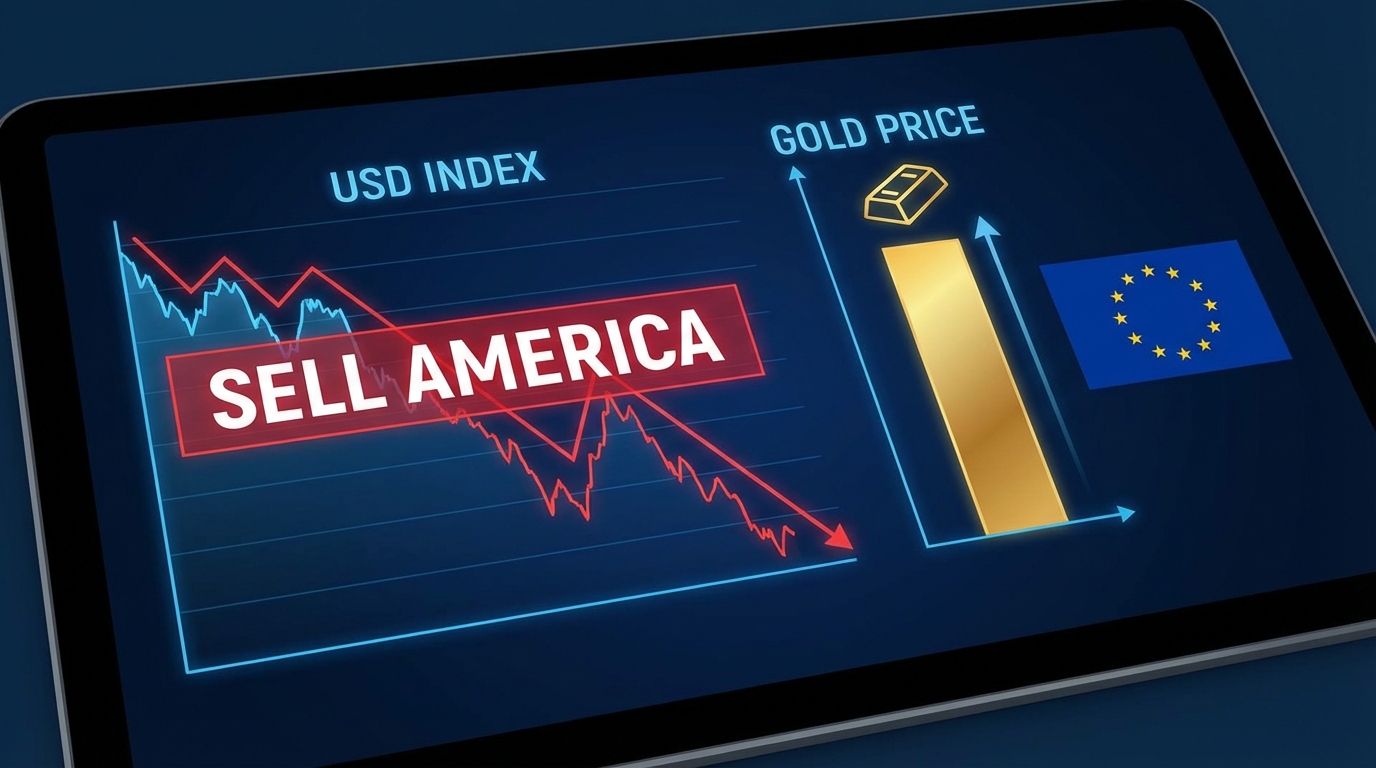
To understand why the US Dollar relentless slide is occurring, we must look at the unique convergence of factors hitting the market simultaneously. Historically, the dollar benefits from a “safe-haven” bid during times of global stress. However, in 2026, the source of the stress is the United States itself. This has flipped the script, leading to a “Sell America” narrative that hasn’t been seen with this intensity since the mid-2000s.
The “Greenland Discount” and Trade Tensions
The most visible weight on the currency is the escalating tension over the Arctic. President Trump’s insistence on the “purchase of Greenland” has transitioned from a diplomatic curiosity into a full-scale economic weapon. The threat of 10% to 25% tariffs on European allies—including Germany, France, and the UK—has sparked fears of a fractured NATO and a retaliatory “trade bazooka” from the EU. When the US uses its currency and trade policy to pressure allies, it undermines the very trust that supports the dollar’s status as the global reserve currency.
The Fed Independence Crisis
Beyond trade, the US Dollar relentless slide is being fueled by a domestic struggle for the soul of the Federal Reserve. The Department of Justice’s ongoing investigation into Chair Jerome Powell and the administration’s public “jawboning” of the central bank have raised the “political risk premium” for US assets. Markets loathe uncertainty, especially when it concerns the independence of the institution responsible for price stability. Consequently, foreign investors are reducing their US Treasury allocations, fearing that monetary policy is becoming a tool for political leverage rather than a data-driven science.
Hedging the Dollar Breakdown
For the proactive trader, the US Dollar relentless slide provides a clear roadmap for capital reallocation. While the momentum is currently bearish, 2026 is an environment that rewards those who can distinguish between a temporary “dip” and a structural “break.”
Pivot Toward High-Yield Relative Strengths
As the dollar weakens, currencies like the British Pound (GBP) and the Euro (EUR) are emerging as the primary beneficiaries. Despite local political hurdles, the Euro has pushed toward 1.22 against the USD, a multi-year high.
- The “Relative Growth” Trade: Look at economies that are implementing fiscal stimulus while the US is grappling with shutdown fears. The German fiscal package of late 2025 is currently providing a structural floor for European assets.
- Yen Intervention Monitoring: Keep a close eye on the USD/JPY pair. Speculation of a coordinated US-Japan intervention to support the yen has cooled slightly, but any move toward 160 would likely trigger aggressive selling of the dollar.
- best financial planning tools for long-term growth in 2026
Tactical Allocation to “Hard Assets”
When fiat confidence erodes, the market returns to the “old guard.” In January 2026, we have seen gold cross the $5,100 mark and silver surge past $100.
- Identify the “Chaos Hedge”: Gold remains the ultimate non-correlated asset. In the US Dollar relentless slide scenario, gold is not just rising because it is priced in USD, but because it carries zero counterparty risk in a fractured geopolitical world.
- Utilize Trailing Stops: The current volatility means “bear market rallies” in the dollar can be violent. Set trailing stop-losses on your EUR/USD long positions to protect your capital from “T.A.C.O.” (Trump Always Chickens Out) trade reversals.
Actionable Steps for Traders:
- Audit your USD exposure: If your portfolio is 100% long US stocks, you are indirectly 100% long the dollar. Consider diversifying into international ETFs.
- Watch the 10-Year Treasury Yield: If the yield spikes toward 4.5% while the dollar falls, it signals a “flight from quality” rather than a “flight to quality.”
- Leverage Cross-Rates: Trade GBP/EUR or AUD/NZD to stay in the market without being exposed to the direct “Greenland noise” affecting the USD.
- Analyze Volatility: Use the VIX and the DXY’s standard deviation to measure risk. For those interested in the math, the Expected Volatility ($EV$) of your position can be modeled as:$$EV = \sigma \sqrt{t} \cdot Z$$Where $\sigma$ is the historical volatility, $t$ is the time horizon, and $Z$ is your confidence interval score.
Section 3 – Market Scenarios: The Financial Math of the Slide
To visualize the US Dollar relentless slide, we must compare the greenback against its primary peers as of January 28, 2026. The shift in “interest rate differentials” is the true engine driving the price action.
| Currency Pair | Jan 1, 2026 Price | Jan 28, 2026 Price | % Change (MTD) |
| EUR/USD | 1.14 | 1.22 | +7.0% |
| GBP/USD | 1.32 | 1.39 | +5.3% |
| USD/JPY | 158 | 154 | -2.5% |
| USD/CHF | 0.92 | 0.88 | -4.3% |
| Gold (per oz) | $4,580 | $5,105 | +11.4% |
Scenario: The “Double Deficit” Squeeze
The US Dollar relentless slide is being compounded by the “twin deficits”—the simultaneous fiscal and trade deficits. In 2026, the cost of financing US debt has risen as the Fed cuts rates to support a slowing economy.
- The Math: If the Fed cuts rates to 3.25% by June, as many analysts now expect, the “Yield Advantage” the US held over Europe (where the ECB is on hold at 2%) will narrow significantly.
- The Outcome: Capital flows naturally toward higher relative real yields. As US inflation remains “sticky” near 2.8%, the real yield on the dollar is no longer enough to attract the massive foreign inflows required to stabilize the currency.
Economic Insight: According to theInternational Monetary Fund (IMF), the “fragmentation of global trade” is a major risk to global growth in 2026. The US Dollar relentless slide is the market’s way of pricing in the high cost of this fragmentation.
Common Mistakes and Risks to Avoid
- Chasing the Bottom: Never try to “catch the falling knife” in the US Dollar relentless slide without a technical signal. The DXY has broken through 97.75 support and is currently targeting the 95.00 level.
- Underestimating “T.A.C.O. Days”: The administration’s trade policy can pivot in a single social media post. Always have an “exit plan” for when the rhetoric softens, as this often triggers a massive 1-2% short-squeeze in the dollar.
- Ignoring the “New Fed Chair” Risk: Chair Powell’s term expires in May 2026. The uncertainty surrounding his successor—and their potential “dovishness”—is already being priced into the long-term dollar curve.
Conclusion – Key Takeaways & Next Steps
The US Dollar relentless slide of January 2026 is more than a seasonal blip; it is a signal of a world adjusting to a new geopolitical order. Between the “Greenland tariffs,” the investigation into the Fed, and the narrowing yield gap with Europe and Japan, the greenback is facing its most significant challenge in decades. For traders, the “More Pain” anticipated in the title is not just a threat—it is an opportunity to re-position for a “Post-Peak USD” world.
Ultimately, your strategy should be one of “Diversified Vigilance.” The dollar may be down, but it is not out. However, until we see a definitive resolution to the trade tensions and a clear path for Fed leadership, the path of least resistance remains firmly to the downside.
Are you ready to hedge your dollar exposure?
Start by reviewing your international equity weighting. Would you like me to create a “Currency Risk Audit” for your current portfolio to see how much a further 5% drop in the DXY would impact your net worth?