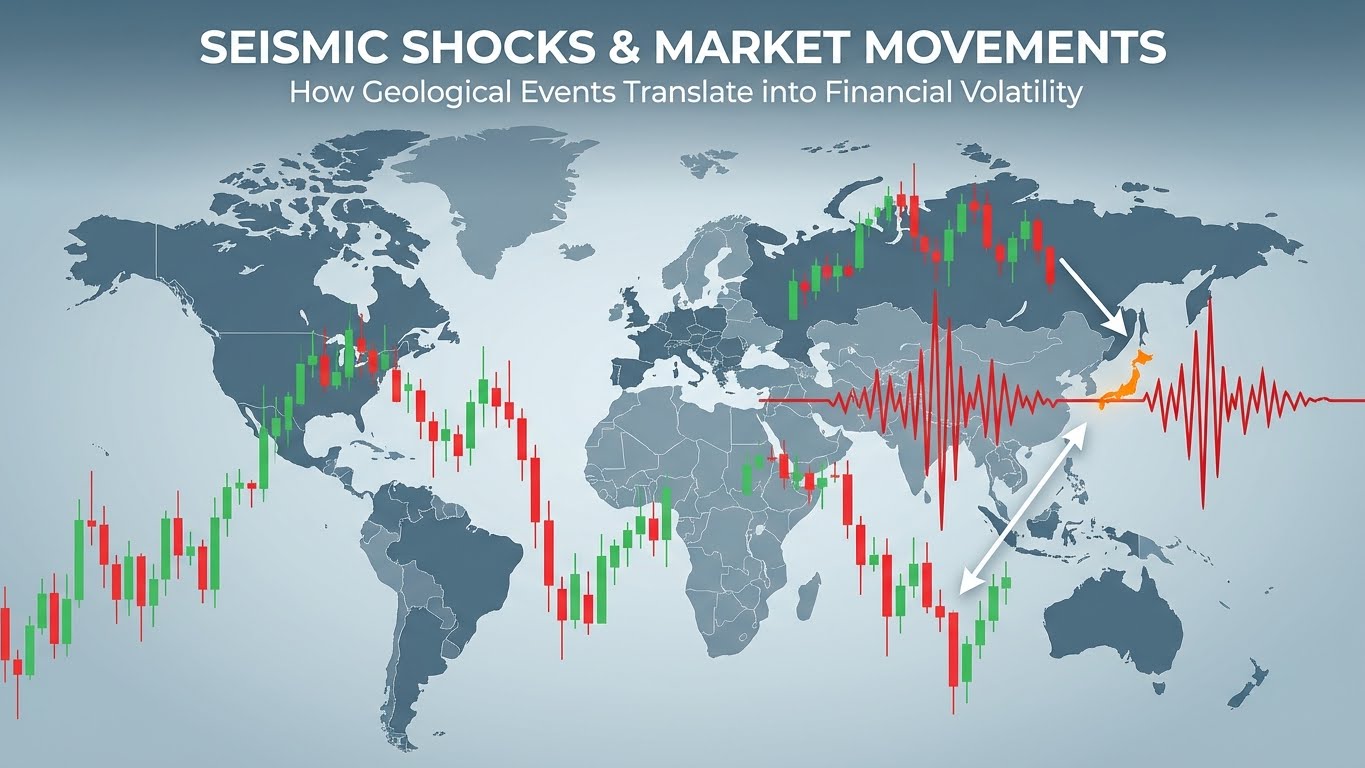
When a major Japan earthquake economic impact headline hits your news feed, it can feel both tragic and financially confusing. Beyond the human cost, earthquakes disrupt factories, ports, power grids, and consumer confidence. For investors, that means sudden market volatility, shifting sector winners and losers, and new macro risks to consider.
In this guide, we’ll break down how the Japan earthquake economic impact typically flows through the real economy and financial markets — and how you can respond thoughtfully instead of reacting emotionally.
Section 1 – Core Concept: How a Japan Earthquake Economic Impact Ripples Through the Economy
Japan is one of the world’s largest economies and a key player in autos, electronics, machinery, and high-tech components. When a big quake strikes, the Japan earthquake economic impact doesn’t stay local — it can ripple through global supply chains and markets.
After past earthquakes, official and academic analyses have highlighted several recurring themes:
- Industrial production and exports can drop sharply in the immediate aftermath as factories, ports, and logistics networks are disrupted. IMF+1
- Reconstruction spending later supports GDP, construction activity, and certain industrial sectors. elibrary.imf.org+1
- The fiscal burden and insurance payouts influence government debt dynamics and the financial sector. elibrary.imf.org+1
The 2024 Noto Peninsula earthquake, for example, led the Japanese government to warn of a lasting economic impact and increased attention to exports and regional activity. Reuters
Key Component 1: Short-Term Shock From a Japan Earthquake Economic Impact
In the short term, the Japan earthquake economic impact usually shows up as:
- Supply disruptions
- Damaged factories and ports reduce output.
- Just-in-time production chains globally feel the pinch if critical parts are produced in the affected region.
- Market volatility
- Japanese equities, particularly insurers, utilities, and regionally exposed companies, can sell off initially.
- The yen may either strengthen (as a “safe-haven” currency) or weaken (if investors expect aggressive monetary easing), depending on broader risk sentiment.
- Sentiment shock
- Consumer confidence and business investment can dip as uncertainty rises.
- Foreign investors reassess country and sector risk.
For you as an investor, the first phase of a Japan earthquake economic impact is about heightened volatility rather than a clear, long-term trend.
Key Component 2: Long-Term Structural Effects of a Japan Earthquake Economic Impact
Over the medium to long term, the Japan earthquake economic impact often transitions from damage to rebuilding:
- Reconstruction wave
- Infrastructure, housing, and industrial facilities are repaired or replaced.
- Construction, materials, engineering, and certain industrial firms can benefit from sustained demand.
- Regulatory and risk-management upgrades
- Building codes tighten, and investments in resilience (seawalls, backup power, data redundancy) increase.
- This can support demand for specialty materials, engineering services, and insurance products.
- Macro and fiscal implications
- Government spending rises; debt levels may edge higher.
- Long-term bond yields and fiscal policy discussions can shift.
IMF research on earthquakes shows that macro outcomes depend heavily on state capacity, fiscal space, and financial depth — factors where Japan is relatively strong. elibrary.imf.org+1
For investors, this means the Japan earthquake economic impact is not just “negative”: it’s a complex mix of damage, adaptation, and opportunities for resilient businesses.
Section 2 – Practical Strategies: A Framework for Investors
How should you respond when a Japan earthquake economic impact is unfolding in real time? Here’s a simple framework you can apply.
Step-by-Step or Strategy Type 1: Map Your Exposure to Japan Earthquake Economic Impact
Start by understanding where the risk actually sits in your portfolio.
- List your Japan exposures
- Direct: Japan ETFs, Japanese individual stocks, Japan corporate or government bonds.
- Indirect: Global companies that rely heavily on Japan-based suppliers (autos, semiconductors, industrials).
- Segment by sector and region
- Which holdings are concentrated in at-risk regions or industries?
- Which sectors are likely to be resilient or even benefit from reconstruction?
- Evaluate time horizon
- If your investment thesis is 5–10 years, a temporary selloff may be a buying opportunity.
- If your horizon is short and you need liquidity soon, you may need to reduce volatility exposure.
- Review currency risk
- Are you exposed to the yen directly?
- Is your ETF hedged or unhedged against currency fluctuations?
This mapping exercise turns a vague headline about Japan earthquake economic impact into a clear, quantified risk profile.
Step-by-Step or Strategy Type 2: Position Your Portfolio for Resilience
Once you understand your exposure, you can fine-tune your strategy.
Actionable steps:
- Rebalance, don’t react
- Revisit your target asset allocation (e.g., 60% stocks, 30% bonds, 10% alternatives).
- Trim positions that have become oversized, add to sectors where long-term prospects remain solid.
- Diversify across geographies and sectors
- Avoid overconcentration in a single country or disaster-prone region.
- Pair Japan exposure with other developed markets and resilient sectors (healthcare, consumer staples, utilities).
- Consider quality and balance sheet strength
- Favor companies with low leverage, strong cash flow, and robust risk management practices.
- These firms are better positioned to handle Japan earthquake economic impact shocks.
- Use dollar-cost averaging (DCA)
- If you want more exposure to Japan over the long term, spread purchases over months instead of going all-in after a selloff.
- Align with your risk tolerance
- If the volatility is making you lose sleep, your risk profile may be too aggressive.
- Adjust your equity/fixed-income mix and consider discussing your plan with a licensed advisor.
You can also deepen your understanding by exploring related topics like diversification and crisis investing.
Section 3 – Examples and Case Insights
Let’s turn the Japan earthquake economic impact into simple, concrete scenarios.
Example 1: Global ETF Investor
You hold:
- 40% in a global equity ETF (with ~8% Japan exposure)
- 20% in a developed Asia ETF (with ~25% Japan exposure)
- 40% in global bonds
Total Japan equity exposure = (0.40 × 0.08) + (0.20 × 0.25)
= 0.032 + 0.05 = 8.2% of your portfolio.
Suppose a significant earthquake leads to a Japan earthquake economic impact where Japanese equities fall 12% in the short term, while global equities drop 3%.
- Impact from Japan: 8.2% × (-12%) ≈ -0.98%
- Impact from global markets: 31.8% (the rest of equities) × (-3%) ≈ -0.95%
Net short-term hit ≈ -1.9% of your total portfolio.
This drawdown is meaningful but not catastrophic — a reminder that diversification cushions shocks.
Example 2: Sector Winners and Losers
A simplified sector view after a major quake:
| Sector | Likely Near-Term Effect | Potential 3–5 Year Effect |
|---|---|---|
| Construction & Materials | Higher demand from rebuilding | Sustained growth from infrastructure upgrades |
| Insurance | Claim costs rise; short-term earnings hit | Premiums and risk pricing may increase |
| Utilities & Energy | Disruption risk; possible regulatory scrutiny | Investment in grid resilience and renewables |
| Autos & Manufacturing | Supply chain interruptions; export delays | Modernized facilities, more automation and risk management |
| Tourism & Services | Dip in travel and local consumption | Gradual recovery as confidence returns |
This table shows how the Japan earthquake economic impact is not uniform: some sectors face deep short-term pain but also long-term tailwinds.
Example 3: Currency and Hedging
Imagine:
- You own an unhedged Japan equity ETF worth $10,000.
- After an earthquake, Japanese stocks fall 8%, but the yen strengthens 4% as risk sentiment shifts.
Net result:
- Equity return: -8%
- FX return: +4%
- Combined: roughly -4% impact instead of -8%.
If the Japan earthquake economic impact includes aggressive monetary easing and a weaker yen, the reverse could happen. This illustrates why understanding currency risk is crucial.
Common Mistakes and Risks
When headlines about Japan earthquake economic impact hit, many investors fall into predictable traps:
- Panic selling at the bottom
- Exiting quality positions during peak fear, then missing the recovery.
- Chasing “disaster trades”
- Overloading on a single “reconstruction winner” stock based on hype, not fundamentals.
- Ignoring liquidity needs
- Being forced to sell during volatility because cash reserves were too small.
- Overlooking currency risk
- Underestimating how yen swings can amplify or offset equity moves.
- Failing to revisit risk tolerance
- Keeping the same aggressive allocation even after realizing the emotional impact of drawdowns.
- Relying solely on short-term news
- Making long-term investment decisions based only on initial reports and social media.
Being aware of these pitfalls helps you navigate Japan earthquake economic impact events with a calmer, more disciplined approach.
Conclusion – Key Takeaways & Next Steps
Earthquakes are tragic, unpredictable events — but their financial effects follow patterns. The Japan earthquake economic impact typically includes:
- Short-term disruption to production, trade, and markets.
- Medium-term reconstruction spending and sector rotation.
- Long-term shifts in regulation, resilience investment, and fiscal policy.
As an investor, your job is not to forecast the next earthquake. It is to:
- Know your exposures.
- Diversify across countries, sectors, and asset classes.
- Align your portfolio with your true risk tolerance.
- Respond with a plan instead of reacting to fear.
The next time you see a breaking-news banner about Japan earthquake economic impact, you’ll know how to translate that into practical portfolio decisions — not panic.
To keep building your skills:
- Learn more about diversification and risk management.
- Study how markets behaved after previous disasters.
- Use a written investment policy or checklist to guide decisions during crises.
The Psychology of Wealth: How Mindset Shapes Financial Success