
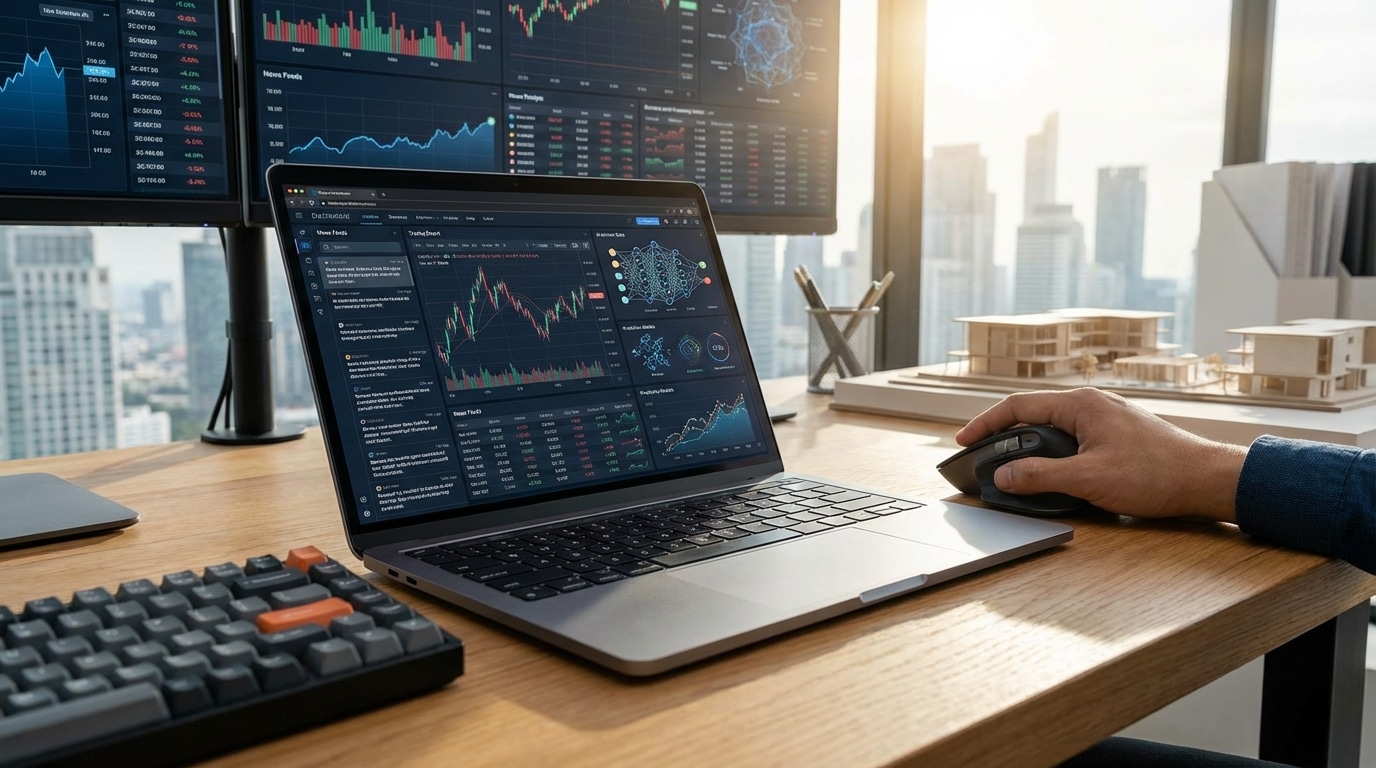
The financial world is no longer a battleground of human intuition; it has become a sophisticated arena of algorithmic precision. As we navigate the complexities of 2026, the rise of ai trading has transitioned from a high-frequency luxury for hedge funds to an essential toolkit for retail investors. With “sticky” inflation hovering near 2.6% and the Federal Reserve maintaining a neutral policy rate around 3.5%, the traditional “buy and hold” strategies of the past decade are being challenged. Today, the most successful market participants are those who leverage artificial intelligence to parse through petabytes of data, identify hidden correlations, and execute trades with mechanical discipline.
In this environment, ai trading acts as a force multiplier, allowing you to scan thousands of tickers in seconds—a feat humanly impossible. Whether you are seeking to capitalize on the productivity surge promised by the “One Big Beautiful Bill Act” or looking to hedge against geopolitical volatility, understanding the mechanics of AI-driven markets is paramount. This guide will provide a comprehensive framework for integrating AI into your wealth-building journey, ensuring you stay ahead of the “creative destruction” currently reshaping the S&P 500.
The Augmentation Era of Finance
At its core, ai trading in 2026 is defined by “augmentation” rather than total replacement. While fully autonomous bots exist, the most significant edge is found in the “human-in-the-loop” model. This approach combines the strategic judgment and ethical oversight of a human trader with the raw processing power of machine learning. In 2026, we have moved beyond simple “if-then” rules toward “Agentic AI” systems—intelligent agents that can plan, reason, and execute multi-step financial workflows across global asset classes.
Key Component: Sentiment and Multimodal Analysis
One of the most powerful sub-concepts within ai trading is multimodal sentiment analysis. Modern AI models no longer just look at price charts; they process Natural Language Processing (NLP) feeds from SEC filings (10-Ks, 10-Qs), earnings call transcripts, and real-time social media sentiment. By analyzing the “tone” of a CEO during a 2026 quarterly update, an AI can detect subtle shifts in confidence that might not appear in the raw numbers. This allows you to front-run institutional rotations before they manifest in a standard technical breakout.
Key Component: Neural Networks and Deep Learning
The engine behind today’s trading algorithms is deep learning. These neural networks simulate human decision-making but at a scale that accounts for thousands of variables simultaneously. In 2026, these models are particularly adept at recognizing “repeating structures” in market volatility. For example, an AI might notice that every time a specific tariff headline breaks, a certain cluster of mid-cap industrial stocks reacts with a 0.5% dip followed by a V-shaped recovery. Identifying these “volatility pockets” provides a high-probability setup that manual research would likely overlook.
Practical Strategies: The 2026 AI Framework
To succeed in ai trading, you need a structured framework that mitigates risk while maximizing the utility of the technology. The market in 2026 is no longer human-driven; competing with instinct alone is, as many experts say, an “unfair fight.”
Step-by-Step Guidance: The Weekly Scanning Method
Most successful retail traders in 2026 follow a rigorous five-step workflow to filter out the noise and focus on quality signals:
- Weekly Market Scanning: Use an AI-based scanner every weekend to identify trend shifts and sector relative strength. This reduces 8,000+ stocks to a manageable shortlist of 20.
- Fundamental Filtering: Ground your AI in real data. Use generative AI to summarize 10-K debt levels and revenue growth patterns for your shortlist.
- Technical Confirmation: Use AI chart assistants to identify precise support and resistance zones. This answers “when” to act, not just “what” to buy.
- Risk Calibration: Before entry, use AI to calculate downside probabilities and optimal position sizing based on your specific 2026 risk tolerance.
- Autonomous Monitoring: Set up agentic alerts. Instead of staring at screens, let the AI notify you only when a trend weakens or a stop-loss is approaching.
Strategy Type: Predictive Journaling
In 2026, journaling is no longer a “post-mortem” exercise; it is predictive. AI-enhanced journals now cluster your past trades to highlight recurring emotional mistakes, such as “confidence collapse” during 2:00 PM sell-offs. By integrating these insights, the ai trading system acts as a personal coach, suggesting adjustments to your stop placements based on your historical win rate in similar market environments.
Essential AI Tools for 2026 Traders
- AI Scanners: For identifying high-probability trend structures across thousands of equities.
- Sentiment Engines: For tracking global news and social mood to predict market “vibe” shifts.
- Predictive Backtesters: For running simulations across years of data in seconds to find the “fire test” for any new strategy.
- Agentic Portfolio Managers: For autonomous rebalancing that eliminates “quarterly review delays.”
Still Trading the Hard Way? Click Here to Start on AlgosOne
Examples, Scenarios, and Case Insights
To illustrate the power of ai trading, consider the hypothetical scenario of “The 2026 Tech Rotation.” In early 2026, a major hyperscaler announces a delay in its next-gen chip deployment.
Scenario: The AI-Speed Divergence
- Traditional Trader: Reads the headline on a news app at 9:30 AM, feels panic, and sells their entire tech portfolio at a 5% loss.
- AI-Integrated Trader: Their ai trading agent has already processed the 8-K filing at 8:31 AM. It identifies that the delay actually benefits a mid-cap competitor. The AI doesn’t panic; it rotates capital from the “loser” to the “winner” before the market even opens. By 10:00 AM, the AI-integrated trader is up 2%, while the manual trader is licking their wounds.
Another case insight involves the “AI PC” cycle. While the general market was excited about hardware, AI sentiment engines detected a surge in software-as-a-service (SaaS) mentions in technical forums. Investors using ai trading tools were alerted to this “groundswell” three weeks before mainstream analysts upgraded the sector, capturing a significant “Style Alpha” return.
writing a financial plan with ChatGPT
Common Mistakes and Risks to Avoid
- Over-Optimization (Curve Fitting): This is the #1 risk. Just because a strategy worked perfectly on 2025 data doesn’t mean it will work in 2026. AI can sometimes “tailor” a strategy so specifically to the past that it fails in a new, unforeseen situation.
- The “Black Box” Trap: Never trade what you don’t understand. If your ai trading tool executes a trade and you can’t explain why, you are in a “black box” scenario that lacks accountability.
- Data Quality Dependence: AI is only as good as its inputs. If you feed it biased or “noisy” data from unreliable social sources, it will generate “garbage” signals.
- Emotional Overriding: The most common mistake is letting an AI run, then panicking and manually closing a trade because of a headline. Trust the logic or refine the model; don’t interfere mid-flight.
- Ignoring the “Creative Destruction”: In 2026, new entrants are eroding the profitability of legacy giants. If your AI only looks at historical blue chips, it might miss the “new entrants” that are the true winners of the AI supercycle.
Conclusion – Key Takeaways & Next Steps
The integration of ai trading is no longer a choice for the elite; it is a necessity for anyone serious about building wealth in the 2026 landscape. By moving away from gut feelings and toward data-driven augmentation, you can reduce emotional errors and scale your analysis across entire global markets. Remember, the goal is not “man vs. machine,” but rather “man with machine.” The machines provide the processing speed and objectivity, while you provide the strategic judgment and human oversight.
Stability in 2026 is found in data-driven clarity. Therefore, your next step should be a thorough audit of your current decision-making process. Are you making “blind decisions” based on headlines, or are you utilizing AI to see the patterns that are invisible to the human eye?
Would you like me to help you draft a specific “Role-Based Prompt” for your first AI stock analysis agent? Explore our further resources to stay updated on the latest AI-driven wealth strategies.



One Comment