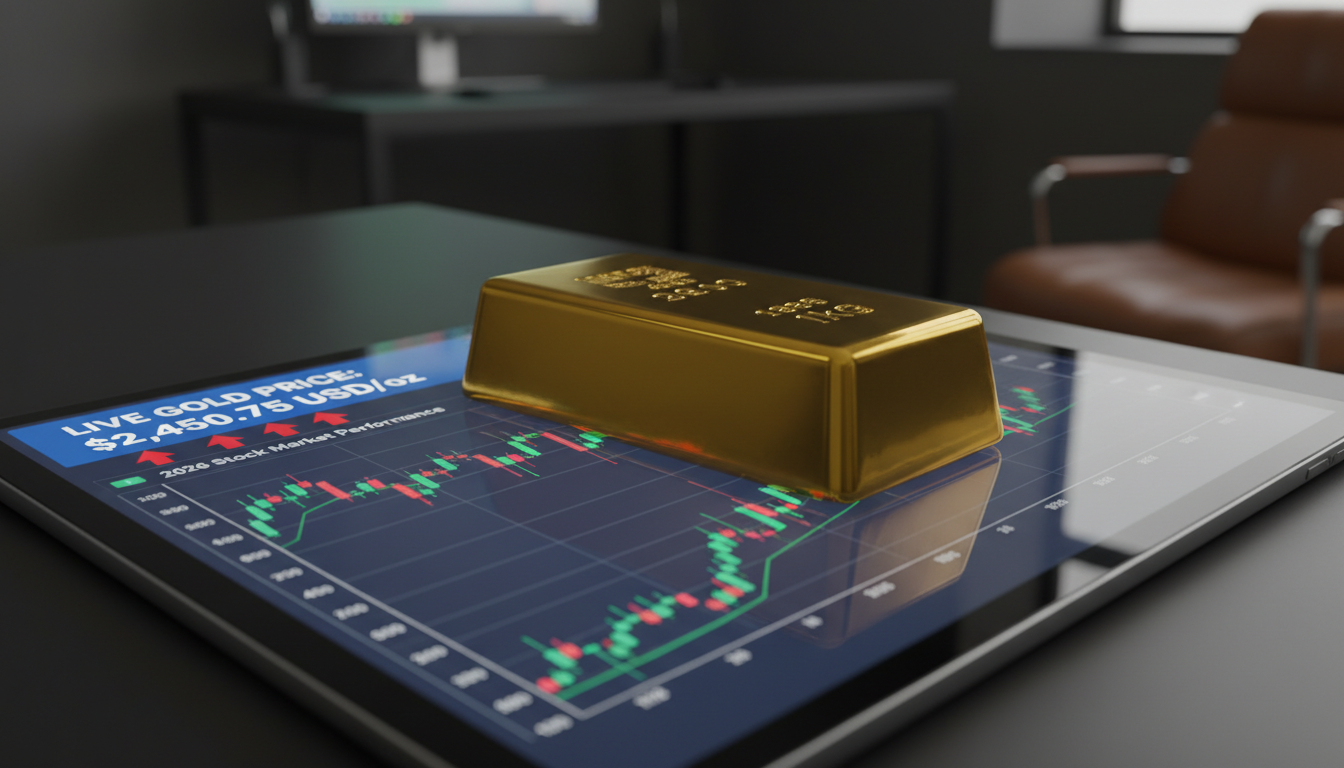
The global financial landscape is currently experiencing a historic “February Reset,” making the gold rate today a primary focus for investors worldwide. As of February 3, 2026, gold has entered a period of intense volatility following a record-breaking surge in January. For those focused on wealth building and personal finance, understanding why the gold rate today is fluctuating is crucial for making informed allocation decisions. Whether you are looking at physical bullion or digital gold ETFs, the current price action reflects a complex tug-of-war between hawkish monetary signals and sustained demand from global central banks.
Today’s market behavior isn’t just about a single number; it is a reflection of the broader macroeconomic shifts of 2025 and early 2026. With interest rates stabilizing and geopolitical tensions persisting, gold remains the ultimate “safe haven.” However, the sharp correction from recent all-time highs has left many asking: is the gold rate today a buying opportunity or a warning sign of a deeper retracement? In this article, we will break down the fundamental drivers of the current price and provide actionable strategies for your portfolio.
The “February Reset” and Gold’s Structural Bull Run
To understand the gold rate today, one must look at the “Warsh Shock” and the subsequent market correction. In late January 2026, gold reached a staggering peak of approximately $5,600 per ounce before retreating. This decline was largely driven by profit-taking and technical liquidations after an extreme, crowded rally. Despite this short-term volatility, the structural case for gold remains remarkably strong due to two primary factors: central bank diversification and the erosion of confidence in “paper assets.”
Central Bank Accumulation as a Price Floor
Global central banks have become the “hidden hand” supporting the gold rate today. In 2025 alone, central banks purchased over 860 tonnes of gold, and institutional forecasts suggest they will accumulate another 800 tonnes throughout 2026. This sustained demand creates a formidable floor for prices, as nations like Poland, India, and China continue to reduce their reliance on US dollar reserves. When the official sector buys on dips, it signals to retail investors that gold’s role as a primary reserve asset is only expanding.
Inflation vs. Interest Rate Realities
In the 2025–2026 economic cycle, inflation has eased from its 2022 peaks but remains stickier than many anticipated. While nominal interest rates are higher than in the previous decade, “real” interest rates (inflation-adjusted) often favor gold. The gold rate today reflects the market’s anticipation of future Fed rate cuts later in the year. Historically, gold performs exceptionally well when the opportunity cost of holding a non-yielding asset decreases as rates fall.
Best Financial Planning Tools for Long-Term Growth
Practical Strategies for Investing in Gold
Navigating the gold rate today requires more than just checking a live ticker; it requires a disciplined framework. Because gold does not produce cash flow, your return is entirely dependent on price appreciation and its role as a hedge. Here is a step-by-step strategy to integrate gold into your wealth-building plan during this volatile 2026 period.
The “Tiered Entry” Approach
Rather than attempting to time the absolute bottom of the current correction, use a tiered entry strategy. This involves breaking your total intended investment into four smaller tranches. For example, if the gold rate today is $4,850/oz, you might deploy 25% of your capital now and set “limit orders” at $4,600 and $4,400 to capture further potential downside. This reduces the emotional stress of a sudden price drop and ensures a better average cost basis.
Physical vs. Digital Allocation
In 2026, the choice between physical bullion and digital gold (ETFs or tokenized gold) is about balancing liquidity with security.
- Physical Gold: Best for “worst-case scenario” insurance. It should be held for a minimum of 5–10 years due to the “spread” (the difference between buying and selling price).
- Gold ETFs/Digital Gold: Ideal for those who want to trade the gold rate today with high liquidity and low storage costs. These are more suitable for tactical portfolio rebalancing.
Actionable Steps for Investors:
- Calculate your “Gold Weight”: Most financial advisors recommend a 5% to 10% allocation to gold for a diversified portfolio.
- Monitor the DXY: Keep an eye on the US Dollar Index (DXY). Since gold is priced in dollars, a strengthening dollar often puts downward pressure on the gold rate today.
- Verify Your Sources: If buying physical gold, only use LBMA-approved refiners or reputable national mints to ensure purity and resale value.
- Automate your Savings: Consider a digital “gold savings plan” where you buy a fixed dollar amount of gold every month, regardless of the price.
Gold in the 2026 Portfolio
To visualize how the gold rate today affects a standard investment portfolio, let’s look at two hypothetical investors during the February 2026 volatility.
Case A: The “All-In” Speculator
An investor sees gold at $5,500 in late January and fears missing out (FOMO). They invest $50,000 at the peak. When the gold rate today hits $4,850, their portfolio is down roughly 12% ($6,000 loss). Because they have no “dry powder” left, they are forced to wait for a recovery or sell at a loss to meet other obligations.
Case B: The Disciplined Rebalancer
A second investor maintains a strict 10% gold allocation in a $500,000 portfolio. In January, as gold surged to $5,500, their gold position grew to $65,000 (13% of the total). They sold $15,000 of gold to “rebalance” back to 10%. Now that the gold rate today has dropped back to $4,850, they have that $15,000 in cash ready to buy gold at a discount, effectively “selling high and buying low.”
| Metric | Investor A (FOMO) | Investor B (Disciplined) |
| Entry Price | $5,500/oz | $3,800/oz (Historical Avg) |
| Current Value at $4,850/oz | $44,090 | $48,500 (Base) + Profit from Sell |
| Emotional State | High Stress | Calm / Opportunistic |
| Long-Term Outlook | Recovering Principal | Compound Growth |
As the table illustrates, the gold rate today is not an enemy to the disciplined investor; it is a tool for rebalancing. By taking profits during the January mania, Investor B protected their capital and is now in a position to benefit from the $6,300 year-end targets set by major financial institutions like J.P. Morgan.
Investing in gold is not without peril, especially when market sentiment is as heated as it is in 2026. Avoid these common pitfalls:
- Chasing the Rally: Never buy gold after it has risen 20% in a single month. The gold rate today shows that a correction is always around the corner.
- Ignoring Storage Costs: Physical gold requires secure storage and insurance. If you don’t factor these in, your net returns will be lower than expected.
- High Leverage: Using margin to trade gold during high volatility is extremely risky. A 5% move against you can wipe out your entire account.
- Over-Allocation: Gold is a hedge, not a primary growth engine like equities. Don’t let your gold holdings exceed 15-20% of your total net worth unless you are a specialized commodities investor.
The gold rate today on February 3, 2026, reflects a healthy “breather” in a long-term structural bull market. While the headlines may focus on the sharp 20% drop from recent highs, the underlying fundamentals—central bank demand, geopolitical uncertainty, and a shift toward real assets—remain fully intact. For the smart investor, this correction is a moment to reassess allocations and potentially add to positions at more reasonable valuations.
In summary, remember these three points:
- Volatility is normal: The retreat from $5,600 is a technical reset, not a fundamental collapse.
- Central banks are buyers: The institutional floor for the gold rate today is much higher than it was in 2024.
- Discipline over Hype: Use dollar-cost averaging and rebalancing to take the emotion out of your investing.
Would you like me to generate a personalized gold allocation plan based on your current portfolio size and risk tolerance? Taking the first step today can help you build a “fortress” around your wealth for the years to come.