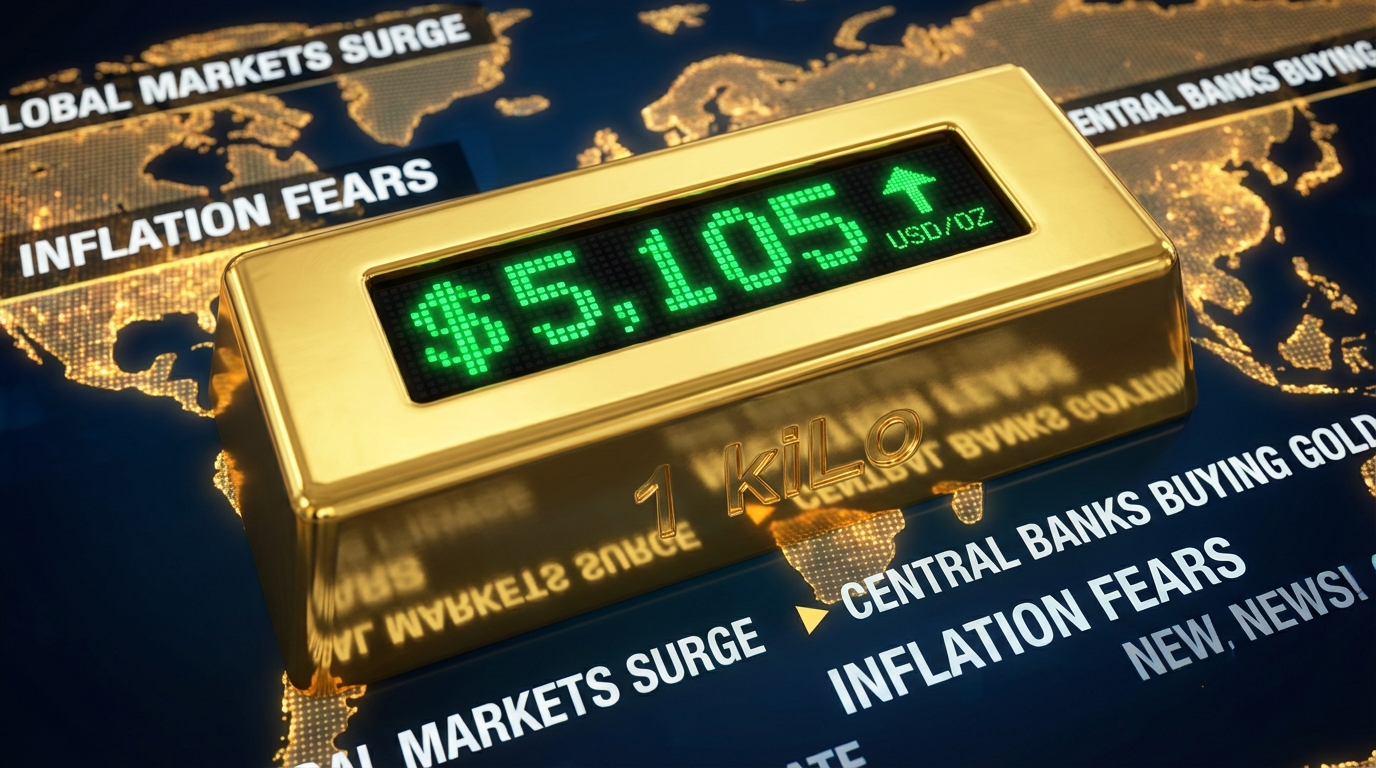
The financial world witnessed a historic milestone this morning as gold prices cross $5,100 for the first time, defying conventional market expectations and setting a staggering new record. As of January 26, 2026, the yellow metal surged past this psychological barrier, fueled by a perfect storm of systemic risks and escalating geopolitical friction. While traditional equities grapple with policy shifts in Washington and trade disputes in Europe, gold has reasserted its dominance as the ultimate “chaos hedge.” For wealth builders, the news that gold prices cross $5,100 for the first time is not merely a headline; it is a fundamental signal that the global monetary landscape is shifting toward tangible, “hard” assets.
Understanding the drivers behind this parabolic move is essential for anyone looking to protect their purchasing power in the mid-2020s. We are currently seeing a rare alignment of central bank accumulation and a “flight to quality” from retail and institutional investors alike. In this guide, we will analyze the core factors propelling gold to these heights, provide practical strategies for managing precious metal allocations, and explore what this record-breaking price means for the future of your portfolio.
The Drivers of $5,100 Gold
To understand why gold prices cross $5,100 for the first time, we must look beyond simple supply and demand. In 2026, gold is acting as a “geopolitical barometer,” reflecting the deep-seated uncertainties regarding international trade alliances and currency stability. Unlike the speculative bubbles of the past, this rally is built on a foundation of structural shifts in the global economy.
The Breakdown of the “Petrodollar” and Sovereign Demand
A primary catalyst for this record high is the aggressive de-dollarization strategy employed by BRICS+ nations. Throughout late 2025 and into early 2026, central banks in emerging markets have shifted record portions of their reserves away from U.S. Treasuries and into physical bullion. This sovereign demand creates a “hard floor” for prices, as these institutions are “price-insensitive” buyers looking for long-term strategic security rather than short-term trading gains.
Geopolitical Friction: The Greenland and European Trade Disputes
Geopolitical uncertainty is the most immediate driver in the current market cycle. Recent friction regarding Arctic security and the “Davos Eight” trade framework has caused a massive rotation out of high-beta tech stocks and into defensive assets. As nations reconsider their dependence on globalized supply chains, investors are returning to the only asset that carries zero counterparty risk. The fact that gold prices cross $5,100 for the first time suggests that the market is pricing in a “fragmentation premium” that could persist for years.
Managing Precious Metals in 2026
When gold prices cross $5,100 for the first time, the temptation is to “FOMO” (Fear Of Missing Out) into a position at the peak. However, professional wealth building requires a more disciplined framework. High-price environments demand agility and a focus on cost-basis management.
The “Barbell” Rebalancing Framework
If you have been holding gold since the $2,000 range, your portfolio’s risk profile has changed.
- Assess your allocation: If gold now represents more than 15-20% of your total net worth due to price appreciation, consider “trimming” 10% of your position to lock in gains.
- Rotate into “Silver Alpha”: Historically, silver lags gold but eventually outperforms it in percentage terms. With gold at $5,100, look for silver to close the ratio gap.
- precious metals investment strategies for $100 silver
Utilizing “Digital Gold” and Tokenized Assets
In 2026, owning gold doesn’t just mean holding physical bars in a safe.
- Tokenized RWAs: Utilize tokenized real-world assets (RWAs) to gain fractional ownership of institutional-grade bullion stored in non-bank vaults like those in Singapore or Switzerland.
- Gold Miners with “High Beta”: Look for mining companies with low “All-In Sustaining Costs” (AISC). As gold prices cross $5,100 for the first time, these firms effectively become cash-flow machines, often paying out significantly higher dividends than the metal itself.
- Internal Link Placeholder: tokenized real-world assets (RWAs)
Actionable Steps for the 2026 Gold Investor:
- Establish a “Chaos Hedge” size: Most financial planners recommend a 5% to 10% allocation to gold as a baseline for any long-term portfolio.
- Monitor the 10-Year Real Yield: Gold typically has an inverse relationship with real interest rates. If the Fed begins a cutting cycle in mid-2026, the “opportunity cost” of holding gold vanishes, which could push prices even higher.
- Avoid “Paper” Certificates: In a high-uncertainty environment, prioritize physical bullion or “fully allocated” digital products over unallocated bank certificates.
Gold vs. Traditional Assets in 2026
To visualize the impact of gold prices cross $5,100 for the first time, let’s examine a comparative performance table of major asset classes during the January 2026 rally.
| Asset Class | Jan 1, 2026 Price | Jan 26, 2026 Price | % Gain (Year-to-Date) |
| Gold (Spot) | $4,580 | $5,105 | +11.4% |
| S&P 500 | 5,820 | 5,615 | -3.5% |
| Bitcoin (BTC) | $84,200 | $89,800 | +6.6% |
| Silver (Spot) | $71.40 | $100.29 | +40.5% |
Scenario: The “Safe Haven” Rotation
Imagine an investor with a $100,000 portfolio split 60/40 between stocks and bonds on January 1st. In the first three weeks of the year, the stock portion would have dropped by $2,100. However, if that same investor had maintained a 10% “Chaos Hedge” in gold, that $10,000 position would have gained $1,140—mitigating more than half of their equity losses. This is exactly why gold prices cross $5,100 for the first time is such a critical event; it validates gold’s role as a portfolio “stabilizer” during structural market shifts.
Economic Insight: According to theInternational Monetary Fund (IMF), the “fragmentation of global financial systems” is leading to a renewed interest in neutral, non-fiat reserve assets. Gold remains the only asset that no single nation can “de-platform.”
Common Mistakes and Risks to Avoid
- Buying at the “Blow-off Top”: Parabolic moves like the one where gold prices cross $5,100 for the first time are often followed by 5% to 8% “healthy corrections.” Do not “lump sum” all your cash at record highs; use a dollar-cost averaging (DCA) approach.
- Ignoring the Dollar Index (DXY): If the U.S. Dollar suddenly strengthens due to a “safe-haven” move into Treasuries, gold could see a temporary pullback. storage and insurance. Ensure these “carry costs” don’t exceed your expected annual appreciation.
- Forgetting About Taxes: In many jurisdictions, gold is taxed as a “collectible” at a higher rate (up to 28%) than standard capital gains.
Conclusion – Key Takeaways & Next Steps
The fact that gold prices cross $5,100 for the first time marks a watershed moment in the 2026 economic cycle. It confirms that we have entered a “commodity-centric” decade where scarcity and geopolitical security are the primary drivers of value. While the $5,100 milestone is a historic record, it is also a warning that the “fiat-only” investment models of the last 40 years are under extreme pressure.
As an investor, your goal should be to remain “balanced but prepared.” Celebrate the appreciation of your “hard” assets, but use this record high as a signal to refine your risk management. Gold is the anchor of your ship; even as the waves of geopolitical uncertainty grow, it ensures you stay on course for long-term wealth building.
What is your next step in the precious metals revolution? Start by reviewing your current gold-to-equity ratio. Would you like me to create a “2026 Gold Portfolio Audit” to help you decide if you should rebalance your gains into other undervalued commodities or high-yield defensive stocks?