
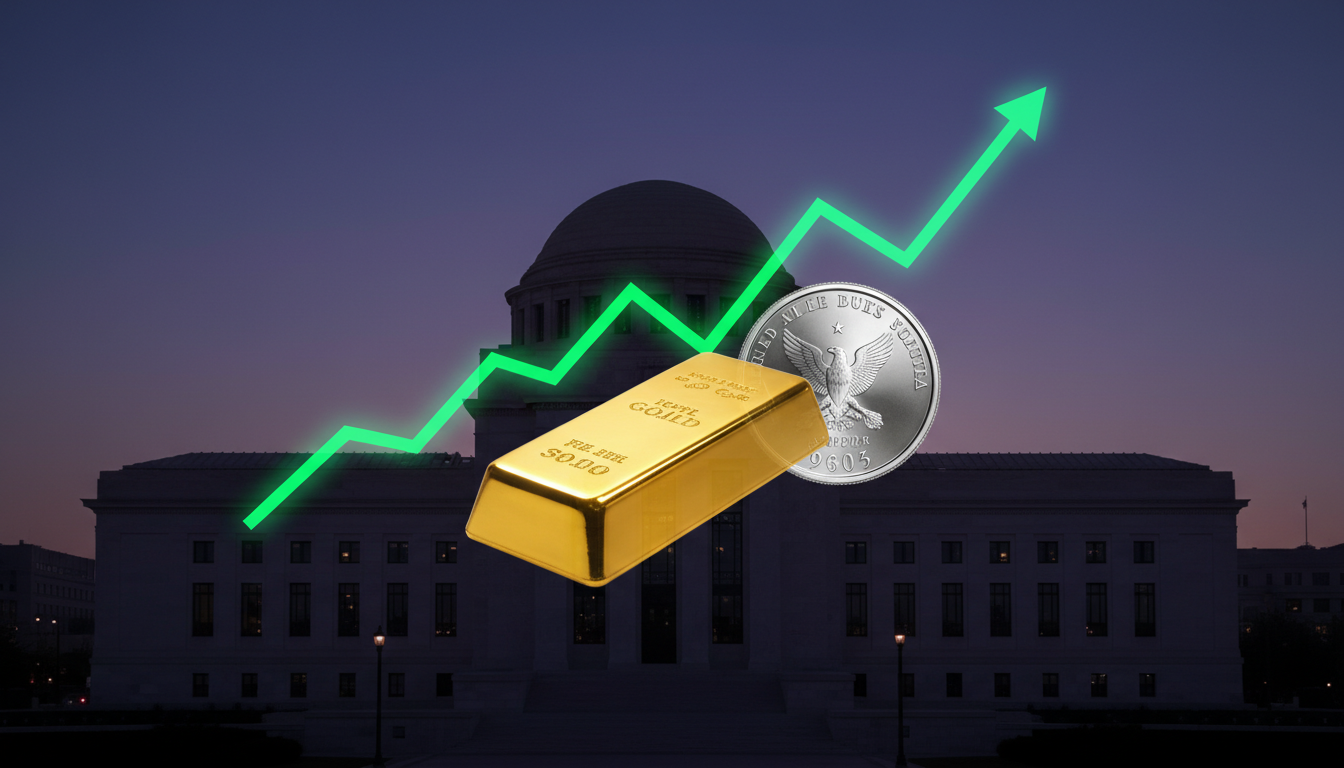
The financial landscape of early 2026 is shifting rapidly, and for those watching the precious metals market, the stakes have never been higher. With the Federal Reserve holding interest rates steady at 3.5%–3.75% in its January 2026 meeting, a new era of market volatility has begun. Understanding the intersection of Fed policy and gold and silver trends is no longer just for professional traders; it is a vital necessity for any wealth builder looking to preserve purchasing power in a world of political friction and “parabolic” price runs. Whether you are a seasoned gold bug or a cautious newcomer, the current decoupling of hard assets from traditional currencies signals a profound transformation in global finance.
The New Monetary Paradigm
To navigate the current market, you must first understand the fundamental mechanics driving the surge in bullion. Historically, gold and silver have served as a “mirror” to the health of the U.S. dollar and the credibility of the Federal Reserve.
The Pivot from Easing to “Strategic Pause”
After three consecutive rate cuts in late 2025, the Fed’s decision to pause in January 2026 has sent a mixed signal to the markets. While the central bank aims to balance solid economic growth (forecasted at 2.0% for 2026) with “sticky” inflation, the pause suggests that the “easy money” era is maturing. However, because real interest rates—the nominal rate minus inflation—remain low or negative in many sectors, the opportunity cost of holding non-yielding metals remains historically attractive.
The “Warsh” Factor and Leadership Uncertainty
A significant driver of current Fed policy and gold and silver trends is the upcoming leadership transition. With Chair Jerome Powell’s term set to expire in May 2026, and names like Kevin Warsh circulating as potential successors, investors are pricing in a more “dovish” or politically influenced Fed. This uncertainty typically pushes capital toward gold and silver, as they are the only assets that do not carry “counterparty risk” or rely on a central bank’s policy success.
best financial planning tools for long-term growth in 2026
Positioning for 2026
How should you react to the current “investor alert”? Successful wealth building in 2026 requires more than just buying a few coins; it demands a strategic framework that accounts for the current “price discovery” phase in silver and the record highs in gold.
The Asymmetric Silver Play
Silver has recently outperformed gold, surging toward the $120 mark and prompting analysts to call it “gold on steroids.” Given that industrial demand from AI data centers and green technologies is hitting a structural deficit, silver offers a unique dual-play: it acts as a monetary hedge and a critical industrial commodity.
- Action: Consider a “tilted” allocation where silver represents a slightly higher percentage of your metals portfolio than usual, specifically targeting a 60/40 silver-to-gold ratio to capitalize on industrial scarcity.
Hedging Against “Debasement”
As the U.S. national debt continues to climb and political tensions (such as the 2026 tariff wars) simmer, the risk of dollar debasement is high. The International Monetary Fund (IMF) has noted that global central banks are diversifying away from the dollar at a pace not seen in decades.
- Action: Use a “Core and Satellite” approach. Keep 70% of your metals in physical form (bars/coins) as a permanent insurance policy, and use 30% in highly liquid ETFs (like GLD or SLV) to trade the swings caused by Fed announcements.
Step-by-Step Guidance for Entry:
- Monitor the “Dot Plot”: Watch the Fed’s quarterly projections. If the “dots” move lower, it is a green light for metals.
- Audit Your Storage: Ensure your physical holdings are in “LBMA-approved” vaults if you are holding significant wealth.
- DCA During Dips: When gold corrects toward the $5,000 support level, use it as a buying opportunity rather than a reason to panic.
The Bullion Shift in Real Time
Let’s look at how a typical investor might rebalance their portfolio in response to the latest Fed policy and gold and silver trends. In 2025, a 60/40 stock-to-bond portfolio was standard. In 2026, that “60/40” is increasingly becoming “50/30/20″—with 20% allocated to hard assets.
Numeric Scenario: The “Stability Hedge”
Imagine a $1,000,000 portfolio. In a high-volatility 2026 environment, a 10% move down in the S&P 500 would result in a $100,000 loss. However, if that same portfolio had 15% in gold and silver, and those metals rose by 20% (a common move during market stress), the $30,000 gain in metals would offset nearly a third of the equity loss.
| Asset Class | Allocation | 2026 Performance (Est.) | Portfolio Contribution |
| Equities (S&P 500) | 50% | -5.0% | -$25,000 |
| Fixed Income | 30% | +3.5% | +$10,500 |
| Gold & Silver | 20% | +25.0% | +$50,000 |
| Total Result | 100% | +$35,500 (Net Gain) |
This table illustrates why metals are no longer “fringe” investments. They are the stabilizers that allow your total wealth to grow even when the traditional stock market faces headwinds from a hawkish Fed or geopolitical shocks.
While the trends are bullish, the path is rarely a straight line. Investors often fall into traps when reacting to Fed policy and gold and silver trends:
- Chasing the Vertical: Buying silver after a 65% monthly gain (as seen in Jan 2026) is dangerous. Wait for a “mean reversion” to a key moving average.
- Ignoring the 10-Year Yield: If the 10-year Treasury yield spikes unexpectedly, gold will likely face a sharp, temporary correction.
- Leveraging Too Heavily: In the 2026 market, “flash crashes” are common. Using 10x leverage on silver futures can wipe out an account in minutes, even if the long-term trend is right.
- Lack of Diversification: Don’t sell your entire stock portfolio to buy gold. Balance is the key to surviving the Fed’s “balancing act.”
Navigating Fed policy and gold and silver trends in 2026 requires a blend of macroeconomic awareness and technical discipline. The Federal Reserve’s current pause at 3.5%–3.75% provides a temporary floor for the dollar, but the structural demand from central banks and industrial users for silver suggests that the “bull run” has significant legs. As we move closer to the Fed leadership transition in May, expect volatility to increase.
The main takeaway is simple: Gold and silver are behaving as “truth barometers” in an uncertain economy. By integrating these assets into a diversified portfolio and using the strategies outlined above, you can turn market anxiety into a calculated advantage.
Ready to secure your portfolio? Start by auditing your current allocation and determining if you are adequately hedged against the next Fed move. Subscribe to our newsletter for weekly “Fed Watch” updates and exclusive technical levels for gold and silver.





One Comment