
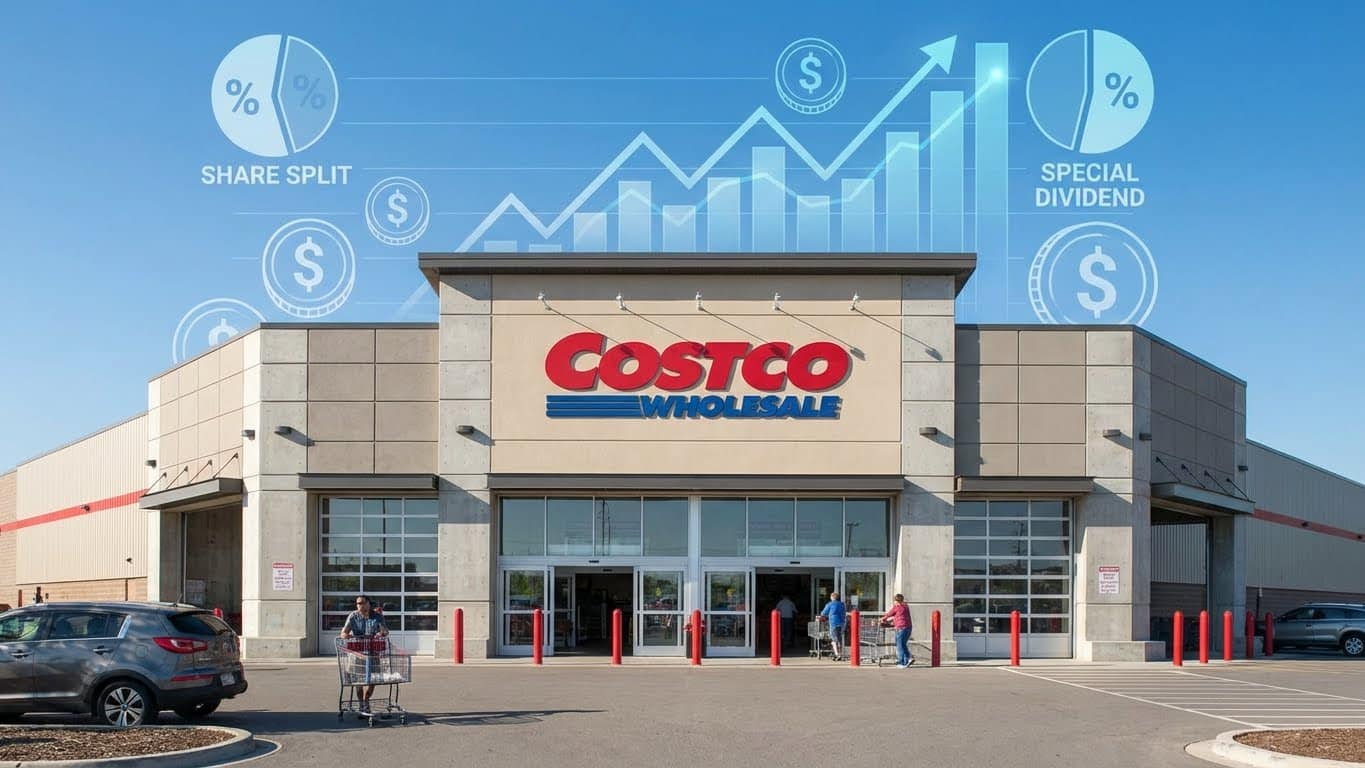
Costco has once again delivered strong sales, and analysts are buzzing. November comparable sales rose solidly despite macro headwinds, prompting renewed debate: could a Costco special dividend or stock split be the next catalyst for shareholders? Recent coverage highlights robust traffic, consistent execution, and record-high share prices as reasons why investors are asking this question more loudly than ever.
With Costco stock recently trading in the high-$800s, the company’s history of large cash returns and its long gap since the last split are front and center in investor discussions. This article walks through what a Costco special dividend or stock split would really mean, how to think about each option, and how you can position your portfolio around the possibilities.
Section 1 – Core Concept/Overview
What’s Driving Talk of a Costco Special Dividend or Stock Split?
Costco’s latest monthly sales update showed healthy comparable sales growth, underscoring the resilience of its membership model even as consumers face elevated prices and higher interest rates.
At the same time:
- The stock price has surged, putting shares out of reach for some smaller investors.
- Analysts have openly flagged a Costco special dividend or stock split as potential “upside surprises” over the next few years, even though management has not promised anything.
- Investors remember Costco’s history of large one-time payouts and wonder if rising cash flows and strong sales set the stage for another.
In other words, Costco’s operating strength plus its shareholder-friendly history create a natural setup for speculation.
Key Background: Costco’s History of Special Dividends and Stock Splits
To understand today’s debate, you need the historical context.
Special dividends: Costco has paid several outsized, one-time dividends:
- $7 per share in 2012
- $5 per share in 2015
- $7 per share in 2017
- $10 per share in 2020
- $15 per share announced in late 2023
These specials sit on top of a regular quarterly dividend that has been raised over time. They signal management’s willingness to return excess cash when the balance sheet is strong.
Stock splits: Costco has not split its stock since a 2-for-1 split in January 2000. That long drought, combined with a high nominal share price, explains why a stock split is described as “elusive” in recent commentary.
A Costco special dividend or stock split would be consistent with the company’s shareholder-friendly track record—but not guaranteed.
Section 2 – Practical Strategies / Framework
Strategy 1 – How to Think About a Costco Special Dividend
A special dividend is a one-time cash payment to shareholders. It doesn’t change your percentage ownership but does immediately impact your cash flow and tax situation.
Step-by-Step: Evaluating a Potential Special Dividend
- Check Costco’s cash and leverage profile
- Historically, specials came when Costco had strong cash balances and modest debt. Look at recent cash flow trends and credit metrics in the company’s filings and investor presentations.
- Estimate a reasonable range
- Past special dividends ranged from $5 to $15 per share. Using this history, you can sketch a rough scenario range (e.g., $10–$20) while remembering that no amount is promised.
- Assess your tax impact
- Special dividends are typically taxed as dividend income in many jurisdictions. Depending on your tax rate, a Costco special dividend or stock split might be less attractive than it looks on the surface.
- Decide what you would do with the cash
- Will you reinvest into Costco, diversify into other stocks, or fund near-term expenses? That decision affects whether a big cash payout is a net positive for your plan.
Strategy 2 – How to Think About a Costco Stock Split
A stock split changes the number of shares but not the total value of your position at the moment of the split. For example, in a 2-for-1 split, 1 share at $900 becomes 2 shares at $450.
Step-by-Step: Evaluating a Potential Stock Split
- Recognize that a split doesn’t create value by itself
- Your market value stays the same right after the split. The key question is whether a Costco special dividend or stock split could influence future demand, liquidity, or investor sentiment.
- Check historical patterns
- Research on stock splits shows that some companies enjoy higher liquidity and modest valuation uplifts when prices become more accessible to smaller investors, but this is not guaranteed.
- Consider your time horizon
- If you’re a long-term holder, split-driven trading pops are far less important than Costco’s underlying earnings, membership renewal rates, and competitive position.
- Plan for options and fractional shares
- If you trade options on Costco, a split will alter contract terms. If you use fractional shares, a split might matter less because you already invest in dollar amounts rather than share counts.
Section 3 – Examples, Scenarios, or Case Insights
Let’s look at simplified numeric examples to highlight the trade-offs between a Costco special dividend or stock split. These are illustrative, not forecasts.
Scenario Assumptions
- Your current position: 50 COST shares
- Current price: $890 (approximate recent trading level)
- Position value: 50 × $890 = $44,500
Example 1 – Special Dividend Scenario
Assume Costco announces a $15 special dividend, similar to 2023.
- Cash received: 50 × $15 = $750
- On ex-dividend date, the stock price typically adjusts down by roughly the dividend amount (other market factors aside).
- New reference price might be around $875 instead of $890.
Your total value right after the adjustment:
- Shares: 50 × $875 = $43,750
- Cash: $750
- Combined: $44,500 (ignoring taxes and price moves).
Economically, nothing magical happened. But you:
- Now have $750 in cash to redeploy or spend.
- Might owe tax on that $750 depending on your jurisdiction.
Example 2 – Stock Split Scenario
Assume a 2-for-1 stock split with no special dividend.
- Shares double from 50 to 100.
- Price halves from $890 to about $445.
- Position value remains ≈ $44,500.
Psychologically, some investors feel more comfortable buying a $445 stock than an $890 one. That perception can sometimes support demand, but the fundamental value is still tied to Costco’s earnings and cash flows, not to the split itself.
Example 3 – No Action, Strong Fundamentals Continue
Costco could simply do nothing—no special dividend, no split—while continuing to grow sales and earnings in a moderating but still uncertain global economy where inflation is easing but remains above central bank targets in some advanced economies.
In that case, your return would depend on:
- Earnings growth
- Valuation (P/E multiple) changes
- Regular dividend increases
The company’s history of disciplined growth and member loyalty suggests that long-term value creation does not depend on a Costco special dividend or stock split, even if either could be a positive secondary catalyst.
Quick Comparison Table
| Scenario | Shares | Approx. Price | Cash Received | Immediate Economic Value* | Key Takeaway |
|---|---|---|---|---|---|
| Special dividend ($15) | 50 | $875 | $750 | ~$44,500 | More cash now, potential tax bill |
| 2-for-1 stock split | 100 | $445 | $0 | ~$44,500 | More liquidity, same total value |
| No corporate action | 50 | $890 | $0 | ~$44,500 | Return driven purely by fundamentals |
*Ignoring market moves and taxes for simplicity.
Common Mistakes and Risks
When thinking about a Costco special dividend or stock split, investors often fall into these traps:
- Confusing optics with value
- A lower share price after a split doesn’t make the company cheaper; valuation still depends on earnings and cash flows.
- Overestimating the impact of a special dividend
- It’s a re-labeling of shareholders’ equity into cash, not free money created out of nowhere.
- Ignoring tax consequences
- Large cash payouts can generate significant tax liabilities, especially in higher brackets.
- Trading purely on rumors
- Analyst notes mention potential catalysts, but Costco management has not committed to a Costco special dividend or stock split at this time.
- Losing sight of macro conditions
- Global growth is forecast to remain modest, with inflation declining but downside risks from tariffs and geopolitical tensions. Over-concentrating in any single retailer—even one as strong as Costco—adds idiosyncratic risk.
- Forgetting your own investment plan
- Chasing short-term catalysts can move you away from your long-term asset allocation and risk tolerance.
Conclusion – Key Takeaways & Next Steps
Strong sales and a powerful membership model have put Costco in an enviable position. It’s no surprise that investors are debating whether a Costco special dividend or stock split might be next. History shows that:
- Costco is willing to pay sizable special dividends when balance sheet conditions warrant it.
- The company has not split its stock in more than two decades, so any split would be a noteworthy signaling event.
- Long-term total returns have been driven primarily by steady earnings, membership growth, and disciplined operations—not by corporate “events” alone.
For you as an investor, the smart move is to:
- Anchor your Costco thesis on fundamentals, not just on the chance of a Costco special dividend or stock split.
- Run the numbers on how each scenario would affect your cash flow, taxes, and portfolio concentration.
- Stay diversified and align any Costco position with your risk tolerance and time horizon.
If you want to go deeper, review Costco’s latest annual report and earnings calls, then compare its valuation and growth profile with other high-quality retailers and membership-based businesses. Use potential special dividends or stock splits as bonus catalysts, not the core reason you own—or avoid—the stock.






One Comment