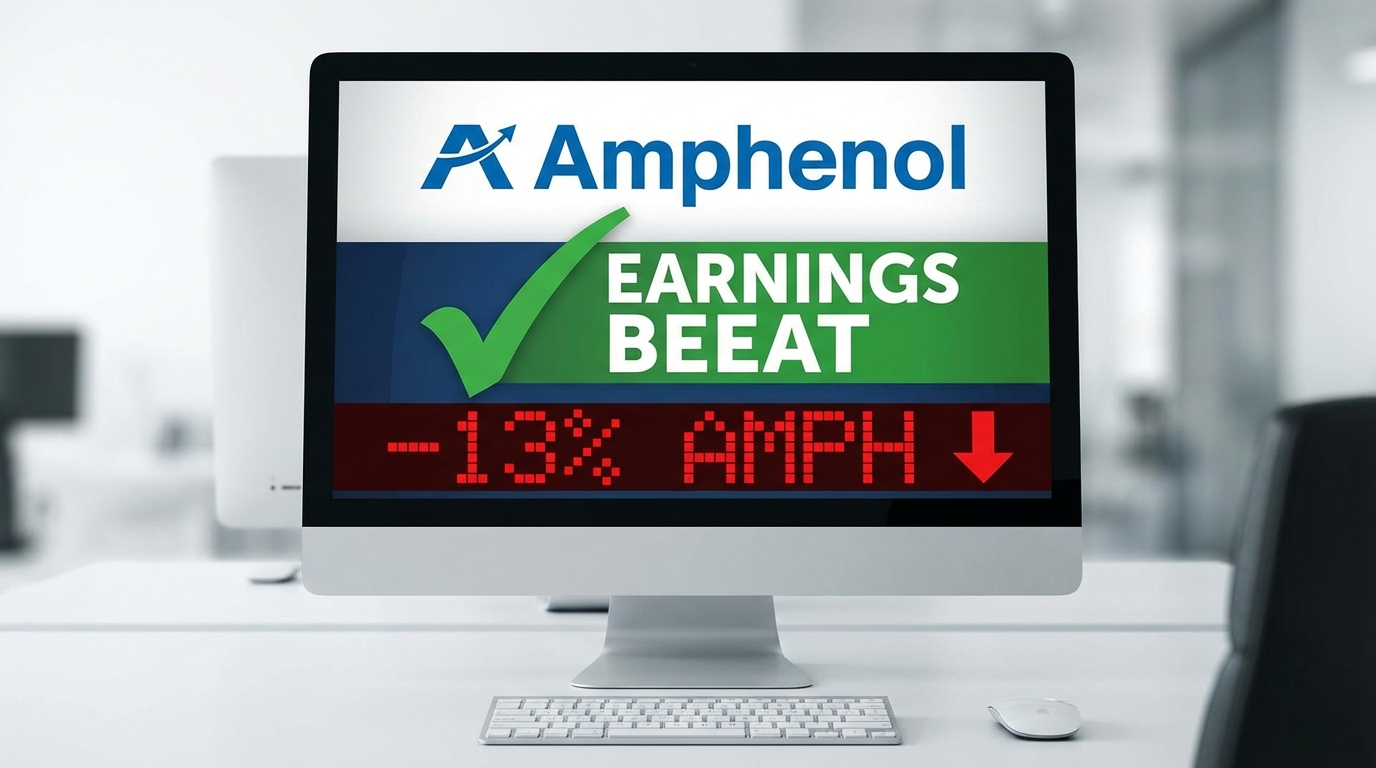
In a dramatic turn of events on Wall Street today, January 28, 2026, a market darling proved that even stellar numbers aren’t always enough to satisfy investors. Amphenol Blows Past Earnings Estimates. The Stock Sinks 13%. This headline has sent shockwaves through the technology hardware and interconnect sectors, leaving many wondering why a company that exceeded every official guidance metric is seeing a double-digit wipeout of its market value. While Amphenol (APH) reported record-breaking revenue and earnings per share (EPS) for the fourth quarter of 2025, the market’s reaction highlights a growing disconnect between fundamental performance and “priced-to-perfection” valuations.
Navigating this volatility requires a deep dive into the underlying mechanics of “Earnings Quality” versus “Forward Guidance.” As we move through the 2025–2026 economic cycle, characterized by massive AI infrastructure spending and persistent interest rate uncertainty, the margin for error has become razor-thin. Today’s price action in Amphenol serves as a cautionary tale for those heavily concentrated in high-growth tech plays. In this guide, we will break down the core reasons for this 13% plunge, explore practical strategies for managing such volatility, and provide a framework to help you decide if this is a “buy the dip” opportunity or a signal of a broader sector correction.
Euro vs Dollar Exchange Rate 2026: The 1.20 Barrier and the Triple Pressure of Gold, Fed, and Yen
The “Priced for Perfection” Trap
The primary driver behind today’s market reaction isn’t what Amphenol did wrong, but rather what the market expected it to do right. To understand why Amphenol Blows Past Earnings Estimates. The Stock Sinks 13%, we must look at the valuation multiples the stock carried into the announcement.
Valuation Overextension in a High-Interest Rate World
Prior to this morning’s open, Amphenol was trading at a trailing Price-to-Earnings (P/E) ratio of over 53x. To put this in perspective, the broader S&P 500 average for 2026 hovers around 24x. When a company is valued at more than double the market average, it is essentially “priced for perfection.” Investors aren’t just paying for current profits; they are paying for several years of uninterrupted, aggressive growth. When the company merely “beats” instead of “obliterates” estimates, or when the forward-looking guidance doesn’t provide a significant enough upgrade, the result is often a sharp valuation reset.
Guidance vs. Reality: The CommScope Acquisition Factor
Another key component of the slide involves the recently closed acquisition of CommScope’s Connectivity and Cable Solutions (CCS) business. While Amphenol projected a strong Q1 2026 with sales between $6.9 billion and $7.0 billion—a 43% to 45% increase—investors appear to be questioning the “Organic vs. Inorganic” growth mix.
- Organic Growth: Growth generated from the company’s existing operations.
- Inorganic Growth: Growth added through acquisitions (like CCS).The market’s fear is that without these high-cost acquisitions, Amphenol’s core “organic” growth might be cooling. In the 2026 landscape, where capital costs remain high, investors are increasingly skeptical of growth fueled primarily by debt-funded M&A.
Practical Strategies: Managing Earnings Volatility
If you hold a position in Amphenol or similar hardware giants, the news that Amphenol Blows Past Earnings Estimates. The Stock Sinks 13% may be alarming. However, professional wealth building relies on tactical responses rather than emotional reactions.
Utilizing the PEG Ratio for Sanity Checks
In a high-growth environment, the P/E ratio alone can be misleading. Instead, use the Price/Earnings to Growth (PEG) Ratio.
- The Formula: The PEG ratio is calculated by dividing the P/E ratio by the annual EPS growth rate.
- The Goal: A PEG ratio below 1.0 is generally considered undervalued.
- The Amphenol Context: Even with today’s drop, Amphenol’s PEG remains slightly above the “ideal” range, suggesting that the 13% sink might actually be a necessary normalization.
- (Internal link: related article about [best financial planning tools for long-term growth in 2026])
Implementation of “Staggered Entry” Orders
For those looking to capitalize on this 13% discount, a “staggered entry” or “dollar-cost averaging” approach is the safest route.
- Phase 1 (The Initial Drop): Allocate 25% of your intended position at the current $167 level.
- Phase 2 (The Support Test): Wait to see if the stock holds its 200-day moving average. If it bounces, add another 25%.
- Phase 3 (Guidance Confirmation): Wait for the post-earnings analyst calls to settle.
- (Internal link: related article about [how to evaluate dividend safety in 2026])
Actionable Steps for Investors:
- Audit Your Sector Concentration: If your portfolio is 40% tech-hardware, a 13% drop in a leader like Amphenol is a sign to rebalance into more defensive “value” plays.
- Check the “Smart Money” Flow: Monitor institutional ownership changes. If large funds are adding to their positions during this dip, it signals long-term confidence in Amphenol’s role in the AI buildout.
- Verify Free Cash Flow (FCF): In the 2026 economy, cash is king. Amphenol’s FCF remains strong, which supports its recently increased $0.25 quarterly dividend.
- Internal link placeholder: (Internal link: related article about [analyzing AI infrastructure stocks in 2026])
The “AI-Interconnect” Supercycle
To understand the long-term potential despite today’s headlines, we must look at the specific market segments Amphenol serves. The Amphenol Blows Past Earnings Estimates. The Stock Sinks 13% narrative masks a very strong operational story in the datacom and defense sectors.
Scenario: The Hyperscale Expansion
The “revolution in electronics” cited by CEO Adam Norwitt is a real-world driver of demand. Hyperscalers (like Meta, Amazon, and Microsoft) are building out data centers at an unprecedented rate. Each new server rack requires thousands of Amphenol connectors, sensors, and cables.
Comparative Performance Analysis (January 2026)
| Metric | Amphenol (APH) | Peer Average (Interconnect) | Market Sentiment |
| Q4 Revenue Growth | +35% | +22% | Outperformer |
| Gross Margin | ~36% | ~30% | Efficiency Leader |
| Forward P/E | 49x | 27x | Valuation Risk |
| 1-Year Return | +115% | +45% | Momentum Fatigue |
As shown in the table, Amphenol’s operational metrics are vastly superior to its peers. The 13% drop is likely a “sell the news” event after a year of 115% gains. For the patient investor, this suggests that the company’s fundamentals remain intact, even if the stock price was temporarily ahead of itself.
“The scale of capital already being deployed to support AI workloads is difficult to overstate. Every incremental megawatt added requires exponentially more high-speed connectivity.” — IMF Global Infrastructure Report, 2026.
Common Mistakes and Risks to Avoid
- Panic Selling at the Open: When a stock sinks 13% on a “beat,” the first 30 minutes are often driven by algorithmic trading and margin calls. Wait for the market to “digest” the news before making a final decision.
- Ignoring the Debt Load: Following the CommScope CCS acquisition, Amphenol’s net debt has increased. In a 2026 environment where the Fed is slow to cut rates, high debt-to-equity ratios can be a drag on future earnings.
- Overestimating the “AI Moat”: While Amphenol is a leader, the interconnect market is competitive. Rivals like TE Connectivity and Corning are also vying for the same hyperscale contracts.
- Assuming a “V-Shaped” Recovery: High-valuation stocks that fall after earnings often enter a “base building” phase that can last weeks or months. Don’t expect the stock to regain its 52-week high tomorrow.
Conclusion – Key Takeaways & Next Steps
The news that Amphenol Blows Past Earnings Estimates. The Stock Sinks 13% is a classic reminder that valuation matters as much as growth. Amphenol is an operationally “Very Strong” company that simply became “Very Expensive.” Today’s reset provides a more reasonable entry point for those who believe in the long-term AI infrastructure supercycle but were hesitant to buy at $200+ per share.
Ultimately, your goal as a wealth builder is to separate the “Signal” (strong earnings, record sales, strategic acquisitions) from the “Noise” (a 13% valuation reset). Amphenol remains a global leader in the connectors and sensors that power our modern world.
Are you ready to optimize your portfolio for the next phase of the 2026 market?
Start by reviewing your “PEG Ratio” for all high-growth holdings. Would you like me to create a “2026 Tech Hardware Risk Audit” to help you decide which stocks in your portfolio are most vulnerable to a similar “priced-for-perfection” reset?