
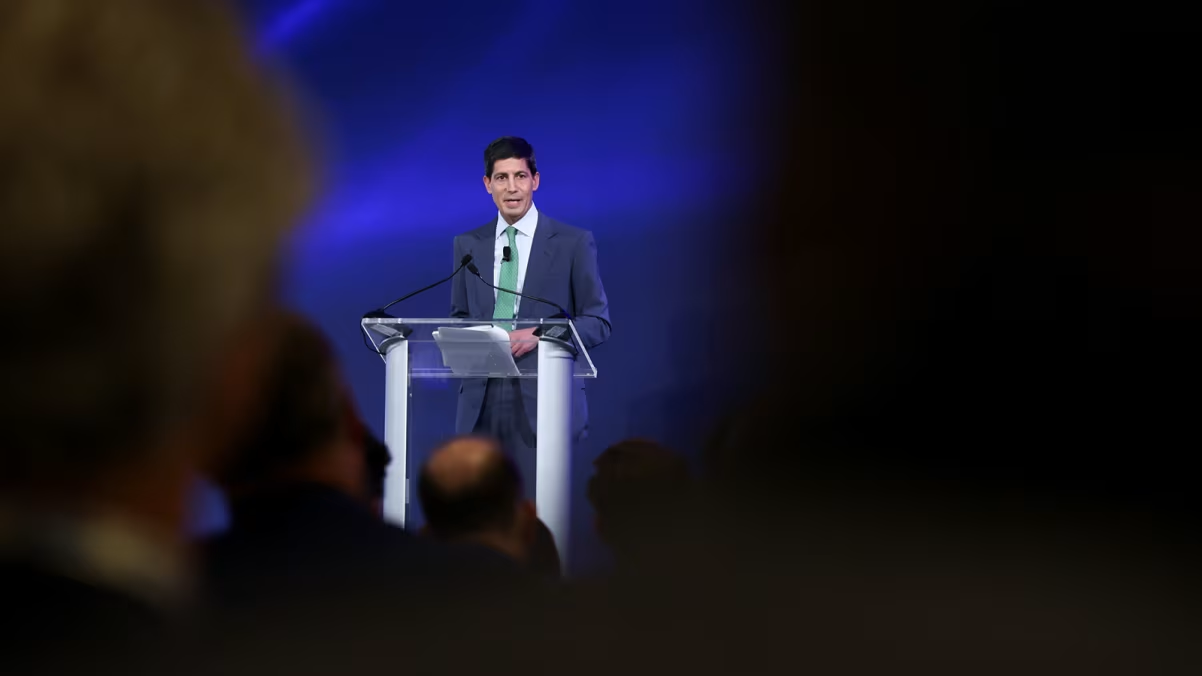
The global financial landscape shifted significantly on January 30, 2026, when President Donald Trump officially announced the Kevin Warsh Federal Reserve Chair nomination. As Jerome Powell prepares to conclude his tenure, the selection of Warsh—a former Fed Governor and Wall Street veteran—signals a potential “regime change” in American monetary policy. For investors and savers, this isn’t just a change in leadership; it is a fundamental pivot in how the world’s most powerful central bank will manage interest rates, its multi-trillion-dollar balance sheet, and its relationship with the U.S. Treasury.
The “Regime Change” at the Fed: Why Kevin Warsh?
Kevin Warsh is no stranger to the halls of the Eccles Building. Having served as the youngest-ever Fed Governor from 2006 to 2011, he was a key figure during the 2008 Global Financial Crisis. However, the Kevin Warsh Federal Reserve Chair nomination comes at a time when Warsh himself has been a vocal critic of the very institution he is set to lead.
Warsh has argued that the Federal Reserve has become too “backward-looking,” relying on lagging data rather than anticipating market shifts. His philosophy centers on a more transparent, formulaic approach to monetary policy. Unlike the Powell era, which was characterized by “higher for longer” caution during the inflation spike of the early 2020s, Warsh is expected to lean into a pro-growth framework that aligns more closely with the executive branch’s economic agenda.
From Morgan Stanley to the Hoover Institution
Warsh’s background is rooted in the private sector, having spent seven years at Morgan Stanley in mergers and acquisitions. This “Wall Street savvy,” as former Fed Chair Ben Bernanke once called it, gives him a unique perspective on how monetary policy filters through to real-market liquidity. His recent years as a fellow at Stanford’s Hoover Institution have seen him refine his critique of “Quantitative Easing” (QE), arguing that a bloated Fed balance sheet distorts price signals and encourages excessive risk-taking.
The Vision: A New Treasury-Fed Accord
One of the most intriguing aspects of the Kevin Warsh Federal Reserve Chair nomination is his proposal for a “new accord” between the Fed and the Treasury. This harkens back to the 1951 agreement that separated federal debt management from monetary policy. Warsh suggests that by coordinating more clearly with the Treasury on the size of the balance sheet, the Fed can provide more stability to the markets while potentially allowing for lower short-term interest rates to spur investment.
best financial planning tools for long-term growth in 2026
Investment Strategies for the Warsh Era
The transition from Jerome Powell to Kevin Warsh suggests a shift from a “reactionary” Fed to a “strategic” one. As an investor, your portfolio needs to adapt to a leader who views inflation through the lens of productivity and technology rather than just labor market tightness.
Fixed Income and the “Small Balance Sheet” Trade
Warsh has been a long-time advocate for a smaller Fed balance sheet. While Trump has pushed for lower interest rates, Warsh’s preference for “Quantitative Tightening” (reducing the Fed’s bond holdings) creates a complex dynamic for bondholders.
- Short-Term Yields: May stay lower if Warsh follows the administration’s pro-growth, low-rate mandate.
- Long-Term Yields: Could face upward pressure as the Fed stops being the “buyer of last resort” for Treasuries.
- Strategy: Investors might consider “barbell” strategies—balancing short-term liquid assets with selective long-term positions that benefit from a steeper yield curve.
Sector Winners: Banking, Tech, and Deregulation
The Kevin Warsh Federal Reserve Chair nomination is widely viewed as a “win” for sectors sensitive to regulation and capital costs.
- Financials & Banking: Warsh’s history in M&A and his critical view of “over-regulation” suggest a more favorable environment for big banks. A steeper yield curve generally helps bank margins, and less stringent capital requirements could spark a new wave of consolidation.
- Technology & AI: Warsh has publicly stated that Artificial Intelligence (AI) acts as a deflationary force by boosting productivity. This view suggests he might be less inclined to hike rates even if growth is strong, providing a tailwind for high-growth tech stocks.
- Energy & Infrastructure: If the “Warsh Fed” successfully coordinates with the Treasury to fund large-scale projects at lower cost, industrial and energy sectors could see increased capital expenditure.
Comparison: Jerome Powell vs. Kevin Warsh
To understand the impact of the Kevin Warsh Federal Reserve Chair nomination, we must compare his likely approach to the established “Powell Doctrine.”
| Feature | Jerome Powell (Current) | Kevin Warsh (Nominee) |
| Primary Focus | Data-dependent, labor market strength | Productivity, price signals, and growth |
| Balance Sheet | Gradual reduction (QT) | Aggressive reduction to “right-size” |
| Communication | Nuanced, “Fedspeak,” consensus-driven | Direct, reform-oriented, formulaic |
| Independence | Strictly shielded from White House | Advocates for a “New Accord” with Treasury |
| Rate Outlook | Cautious, “Wait and See” | Likely pro-cut to support deregulation |
Practical Steps for Individual Investors
How should you position your wealth following the Kevin Warsh Federal Reserve Chair nomination? Here is a step-by-step framework:
- Review Your Bond Duration: If Warsh moves to shrink the balance sheet aggressively, long-duration bonds may become more volatile. Ensure you aren’t over-exposed to 20+ year Treasuries without a hedge.
- Increase Exposure to “Real” Growth: Shift focus toward companies with high productivity gains (AI and automation). Warsh’s “productivity-led growth” thesis favors firms that can grow without triggering labor inflation.
- Monitor the U.S. Dollar: Early market reactions showed a strengthening dollar following the nomination news. A “Warsh Fed” that focuses on American economic exceptionalism could keep the USD dominant against a basket of currencies.
- Watch the Senate Confirmation: The path won’t be entirely smooth. Some senators, like Thom Tillis, have expressed reservations until other Fed-related probes are resolved. Political friction can create buying opportunities in the short term.
Common Mistakes and Risks to Avoid
The excitement of a new Fed Chair often leads to “headline trading.” Avoid these common pitfalls:
- Assuming Rate Cuts are Guaranteed: While Trump wants lower rates, Warsh is a principled economist. If inflation re-accelerates due to tariffs or fiscal spending, Warsh may prioritize his “inflation-fighting” credibility over political pressure.
- Ignoring the Independence Factor: The International Monetary Fund (IMF) and other global bodies closely watch Fed independence. If the market perceives Warsh as a “political tool,” the “inflation premium” on U.S. debt could rise, making borrowing more expensive despite lower nominal rates.
- Over-leveraging in Real Estate: While lower rates help, a shrinking Fed balance sheet can tighten credit conditions at the regional bank level, where most real estate lending happens.
Navigating the Kevin Warsh Federal Reserve Chair Nomination
The Kevin Warsh Federal Reserve Chair nomination represents a watershed moment for the U.S. economy in 2026. By moving away from the cautious, data-lagging approach of the past and toward a productivity-focused, balance-sheet-conscious framework, Warsh aims to modernize the Federal Reserve for a new era of American growth.
For you, the investor, this means the “Fed Put”—the idea that the central bank will always bail out the markets with liquidity—may be changing shape. Success in the Warsh era will require a focus on fundamental value, an understanding of the yield curve, and an eye on the deregulatory wave that this nomination facilitates.
As the Senate confirmation process begins, staying informed is your best defense against market volatility. The Kevin Warsh Federal Reserve Chair nomination is the first chapter in a new economic book; make sure you are positioned to profit from the narrative shift.
Would you like to stay ahead of the curve? [Sign up for our newsletter] to receive deep-dive analysis on every Fed meeting and how the “Warsh Era” will redefine your retirement strategy.






2 Comments