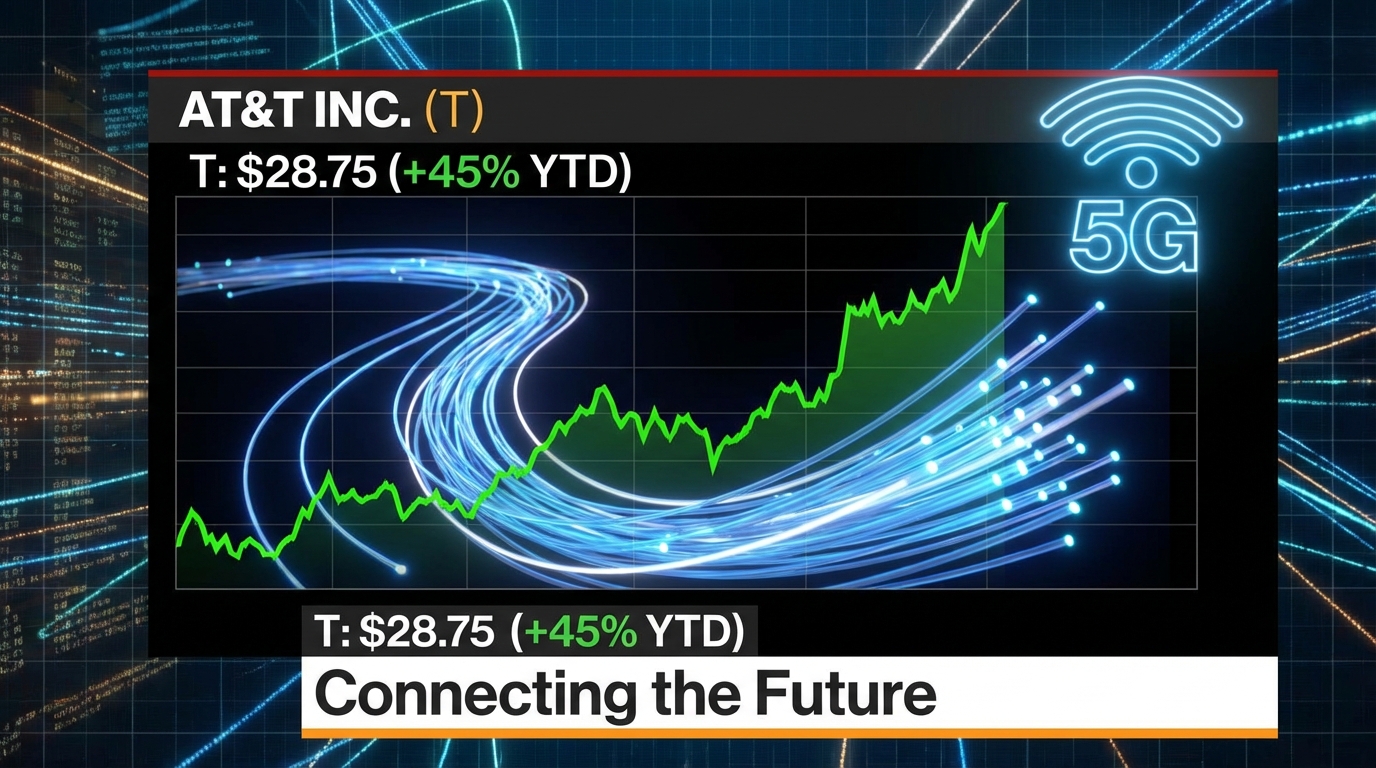
The telecommunications giant made waves this morning as the AT&T stock jump dominated the premarket ticker, following a fourth-quarter 2025 earnings report that surpassed Wall Street’s expectations. On Wednesday, January 28, 2026, the Dallas-based carrier proved that its “investment-led” strategy is finally yielding a clearer signal for long-term growth. With a combination of robust fiber adoption, steady wireless gains, and a massive new capital return program, the company is attempting to shed its image as a sluggish “legacy” utility and re-emerge as a high-yield growth engine.
For investors who have weathered the volatility of the past three years, today’s results provide more than just a momentary pop. The AT&T stock jump is rooted in improved fundamentals, specifically a beat on both the top and bottom lines. While the broader market remains sensitive to interest rate shifts, AT&T’s focus on the “convergence” of fiber and 5G is creating a sticky customer base that is proving resilient to inflationary pressures. In this guide, we will analyze the core drivers behind today’s rally and provide a framework for evaluating whether this is the start of a multi-year recovery.
The “Signal” of Converged Growth
The primary reason for the AT&T stock jump today is the company’s success in its “Convergence” strategy. For the 2025–2026 cycle, AT&T has focused on selling a unified connectivity experience—essentially bundling high-speed fiber internet with unlimited 5G wireless plans. This isn’t just a marketing gimmick; it is a fundamental shift in the company’s unit economics.
The Power of 42% Convergence
In its latest report, AT&T revealed a convergence rate of 42%. This means that more than four out of ten fiber households are also choosing AT&T for their wireless needs. This synergy is critical because converged customers typically exhibit lower churn rates and higher Average Revenue Per User ($ARPU$). By securing a customer’s home internet and their mobile device, AT&T creates a defensive moat that is difficult for pure-play competitors to breach.
Free Cash Flow and the $45 Billion Promise
Perhaps the most important metric for long-term “income” investors is Free Cash Flow ($FCF$). AT&T reported a fourth-quarter $FCF$ of $4.2 billion, soundly beating the FactSet consensus of $3.9 billion. More importantly, management unveiled a bold capital return plan for 2026–2028, targeting over $45 billion in returns to shareholders. This includes:
- Maintaining the high-yield dividend ($1.11$ annualized).
- A new $10 billion share repurchase authorization.
- Planned buybacks of approximately $8 billion in 2026 alone.
Navigating the 2026 Telecom Landscape
As the AT&T stock jump resets the valuation floor, investors must look ahead to the rest of 2026. The telecommunications sector is currently in a “maintenance and monetization” phase rather than the “build-at-all-costs” phase seen in the early 2020s.
Assessing the Dividend Safety Net
With a current dividend yield hovering near 4.8%, AT&T remains a cornerstone for income-focused portfolios. However, yield alone is not a strategy. You must look at the “Payout Ratio” based on $FCF$.
- Calculate the Payout: $Dividend Coverage = \frac{Dividends Paid}{Free Cash Flow}$.
- The 2026 Outlook: With $FCF$ projected to rise to $18 billion+ in 2026, the dividend is now more secure than it has been in a decade.
Trading the Buyback Momentum
The announcement of $8 billion in buybacks for 2026 acts as a massive “buyer of last resort.” Share repurchases are typically $EPS$-accretive, meaning they reduce the number of shares outstanding and increase the earnings attributed to each remaining share.
- The Step-by-Step: Look for pullbacks in the stock price during broader market corrections.
- The Target: If the company executes its plan, the “buyback tailwind” could support a steady upward trajectory in the stock even if the broader S&P 500 remains flat.
Numerical Breakdown of the Beat
To understand why the AT&T stock jump was so pronounced, we must look at the specific “beats” versus analyst expectations. In 2026, the market is rewarding companies that can deliver “Clean Earnings” without excessive one-time adjustments.
Q4 2025 vs. Consensus Estimates
| Metric | Q4 2025 Reported | Analyst Consensus | Result |
| Adjusted EPS | $0.52$ | $0.46$ | 13% Beat |
| Revenue | $33.5$ Billion | $32.9$ Billion | $600M Beat |
| Fiber Net Adds | $283,000$ | $265,000$ | Outperformer |
| Free Cash Flow | $4.2$ Billion | $3.9$ Billion | Strong Cash Gen |
Practical Real-Life Application
If you are an investor with a $10,000$ position in AT&T, today’s 6% jump represents a $600 increase in equity value in a single morning. However, the real story for you is the 4.8% yield. In an environment where the World Bank warns of persistent global debt pressures, companies that generate massive, domestic cash flows like AT&T offer a “hard-asset” quality that is increasingly valuable.
Common Mistakes and Risks to Avoid
- Chasing the Gap Up: While the AT&T stock jump is impressive, avoid “FOMO” (Fear Of Missing Out) at the market open. Stocks often pare their gains in the afternoon as short-term traders take profits.
- Ignoring the Debt Load: Despite the good news, AT&T still carries a net debt of approximately $119 billion. While this is manageable given their $FCF$, any sudden spike in interest rates could increase the cost of refinancing.
- Overlooking Churn Rates: The wireless industry is hyper-competitive. If Verizon or T-Mobile launch aggressive price wars in mid-2026, AT&T’s margins could face pressure.
- Underestimating Capex Requirements: Building fiber is expensive. AT&T plans to spend $23B–$24B annually on capital investments through 2028. Any cost overruns could eat into the buyback budget.
Conclusion – Key Takeaways & Next Steps
The AT&T stock jump on January 28, 2026, is a significant milestone that suggests the company’s “convergence” strategy is finally bearing fruit. By beating earnings estimates, raising its 2026 profit guidance, and authorizing a massive $10 billion buyback, AT&T has sent a clear message: it is a cash-flow machine that is ready to reward its shareholders. The combination of 283,000 new fiber customers and a 4.8% dividend yield makes it a unique hybrid of growth and income in a volatile market.
Ultimately, your goal as a wealth builder is to find companies with sustainable competitive advantages. AT&T’s move to own the “last mile” of fiber while dominating the 5G landscape is a structural advantage that is hard to ignore.
Would you like me to help you analyze your portfolio’s exposure to the telecom sector? Start by reviewing your current dividend-paying stocks. I can create a “2026 Income Comparison Table” to show how AT&T’s new capital return plan stacks up against rivals like Verizon or Comcast.