
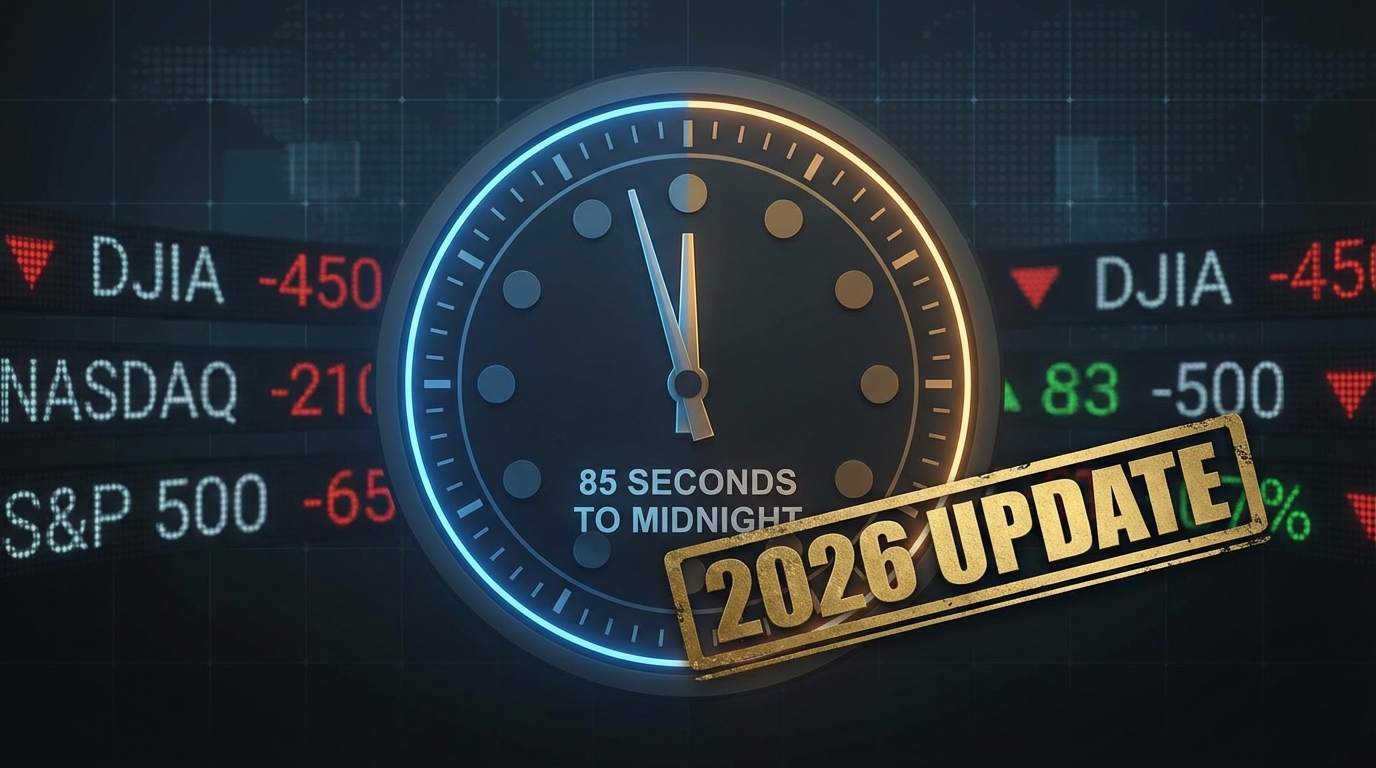
The world’s most ominous timepiece has reached its most alarming setting yet. On Tuesday, January 27, 2026, the Doomsday Clock 2026: Scientists set new time at just 85 seconds to midnight. This historic move forward—a shift of four seconds from the previous year—marks the closest humanity has ever been to global catastrophe since the clock’s inception in 1947. For investors, the announcement from the Bulletin of the Atomic Scientists is more than a symbolic warning; it is a profound signal of systemic risk across global markets. As geopolitical friction, the integration of AI into nuclear command, and climate instability reach a “terminal phase,” the financial implications for long-term wealth building in 2026 are immediate and undeniable.
The decision to set the Doomsday Clock 2026: Scientists set new time at 85 seconds reflects a world where international security norms are eroding. With ongoing conflicts in Europe and the Middle East, along with a multipolar arms race involving the U.S., Russia, and China, the “peace dividend” of the late 20th century has officially vanished. For the savvy investor, this era of “permancrisis” requires a tactical shift in capital allocation. In this guide, we will analyze the core drivers behind this year’s setting and provide a strategic framework for managing your portfolio in a world where the margin for error has narrowed to its thinnest point in human history.
The Triple Threat of 2026
To understand why the Doomsday Clock 2026: Scientists set new time at a record-breaking 85 seconds, we must look at the three distinct existential risks cited by the Bulletin’s Science and Security Board. For investors, these risks represent “tail-risk” events that can trigger massive market volatility without warning.
Nuclear Proliferation and the “Third Nuclear Era”
The primary driver for the 2026 setting is the collapse of diplomatic guardrails between major nuclear powers. The Bulletin specifically noted the expiration of key nuclear treaties and the lack of dialogue between the U.S., Russia, and China.
- Regional Conflicts: Ongoing wars in Ukraine, recent military exchanges between Israel and Iran, and border clashes between India and Pakistan have normalized the “shadow of nuclear threat.”
- The “Winner-Takes-All” Mentality: Scientists warned that the rise of nationalistic autocracies has replaced cooperative security with zero-sum competition.
The Accelerating Climate Crisis
Despite global summits, 2025 was the hottest year on record, and 2026 has already seen devastating heatwaves and floods. The Doomsday Clock 2026: Scientists set new time reflects the failure of nations to move away from fossil fuel infrastructure. For portfolios, this means that “Environmental, Social, and Governance” (ESG) metrics are transition from elective to essential as regulatory costs and physical climate damage begin to impact corporate balance sheets.
Disruptive Technology and “Information Armageddon”
For the first time, the Bulletin placed significant weight on the uncontrolled development of Generative AI and its integration into military systems.
- Shortened Decision Time: AI-enabled nuclear command systems reduce the time leaders have to verify a threat, increasing the risk of accidental escalation.
- Disinformation: Nobel Laureate Maria Ressa, a guest speaker at the 2026 announcement, described our current reality as an “information Armageddon,” where AI-driven disinformation erodes the public trust necessary for global problem-solving.
Euro vs Dollar Exchange Rate 2026: The 1.20 Barrier and the Triple Pressure of Gold, Fed, and Yen
Investing at 85 Seconds to Midnight
Navigating a world that is officially “closer than ever” to catastrophe requires a disciplined approach to risk management. While the Doomsday Clock 2026: Scientists set new time announcement is distressing, it provides a clear roadmap for sectors that will likely experience “structural tailwinds” due to increased global instability.
Defensive Anchoring and the Defense Sector
In a world characterized by “great power competition,” defense spending is no longer discretionary; it is a baseline for national survival.
- Order Backlogs: Major defense contractors in the U.S. and Europe are seeing record backlogs as nations scramble to modernize their arsenals.
- Actionable Step: Focus on companies involved in cybersecurity, satellite communications, and “hardened” infrastructure. These firms act as the bedrock of the 2026 security economy.
The “Safe Haven” Rotation: Gold and Hard Assets
When trust in international institutions collapses, investors return to assets with zero counterparty risk.
- Gold and Silver: As the dollar faces pressure from “de-dollarization” efforts by BRICS+ nations, gold has surged past historic milestones in early 2026.
- Energy Independence: Investing in domestic energy producers—including nuclear and renewable sectors—provides a hedge against the supply chain disruptions cited in the Doomsday Clock 2026: Scientists set new time statement.
Actionable Steps for the 2026 Investor:
- Audit Your “Geopolitical Exposure”: Identify companies in your portfolio with heavy supply chain dependence on high-friction zones (e.g., the Taiwan Strait or Eastern Europe).
- Increase Liquidity: Maintain a higher-than-average cash position to capitalize on “volatility spikes” that are likely to occur throughout the year.
- Utilize Tail-Risk Hedges: Consider modest allocations to put options or inverse ETFs during periods of extreme geopolitical rhetoric.
- Engage in “Resilient” Diversification: According to the International Monetary Fund (IMF), the best defense against systemic risk is a broad, globalized diversification that includes emerging markets less tied to the “Great Power” rivalry.
Defense Backlogs and Volatility
To visualize the impact of the current global climate, let’s examine the performance and outlook of key “Security-First” sectors as of late January 2026.
| Sector | 2025 Performance | 2026 Outlook | Primary Driver |
| Defense & Aerospace | +18% | Strong Bullish | Nuclear modernization & NATO rearmament. |
| Cybersecurity | +24% | Strong Bullish | AI-driven disinformation & state-sponsored hacks. |
| Precious Metals | +15% | Moderate Bullish | Safe-haven demand amid dollar instability. |
| Consumer Discretionary | -5% | Bearish/Volatile | Inflationary pressure & reduced purchasing power. |
Case Insight: The AI-Security Convergence
The Doomsday Clock 2026: Scientists set new time specifically highlighted the risks of AI. Paradoxically, this makes Cybersecurity AI one of the most attractive growth sectors. Companies that provide “automated defense” against AI-generated attacks are seeing their valuations soar. In 2026, the market is rewarding firms that can “fight fire with fire,” using machine learning to protect critical data centers and grid infrastructure from the very threats the Bulletin of the Atomic Scientists warns about.
Common Mistakes and Risks to Avoid
- “Doomerism” Portfolio Paralysis: The biggest mistake is selling everything and “going to cash” out of fear. Markets have historically rallied through Cold War tensions. Stay invested, but stay hedged.
- Over-leveraging on Defense: While the defense sector is growing, it is also highly sensitive to government budget pivots. Never allow a single sector to dominate more than 15-20% of your total portfolio.
- Ignoring the “Climate Regulatory” Wall: The Doomsday Clock 2026: Scientists set new time points to climate failure. Governments are likely to respond with sudden, aggressive carbon taxes.
- Underestimating “Information Risk”: In an “Information Armageddon,” your own investment data can be compromised. Ensure you are using multi-factor authentication and verified financial planning tools.
Conclusion – Key Takeaways & Next Steps
The announcement that the Doomsday Clock 2026: Scientists set new time is 85 seconds to midnight is a sobering reminder that we are living in the most precarious era of the modern age. The convergence of nuclear aggression, climate failure, and unregulated AI has pushed the hands of the clock closer to the theoretical point of annihilation than ever before. For the wealth builder, this is a call to move away from “speculative growth” and toward “strategic resilience.”
Ultimately, the goal of investing in 2026 is to build a “fortress portfolio” that can withstand the shocks of a fragmenting world. While the scientists warn that we are running out of time, you still have time to secure your financial future through disciplined diversification and proactive risk management.
Are you ready to stress-test your portfolio for 85 seconds to midnight? Start by reviewing your exposure to high-friction geopolitical zones. Would you like me to help you create a “2026 Resilience Audit” to identify which of your holdings are most vulnerable to the risks cited by the Bulletin of the Atomic Scientists?






One Comment