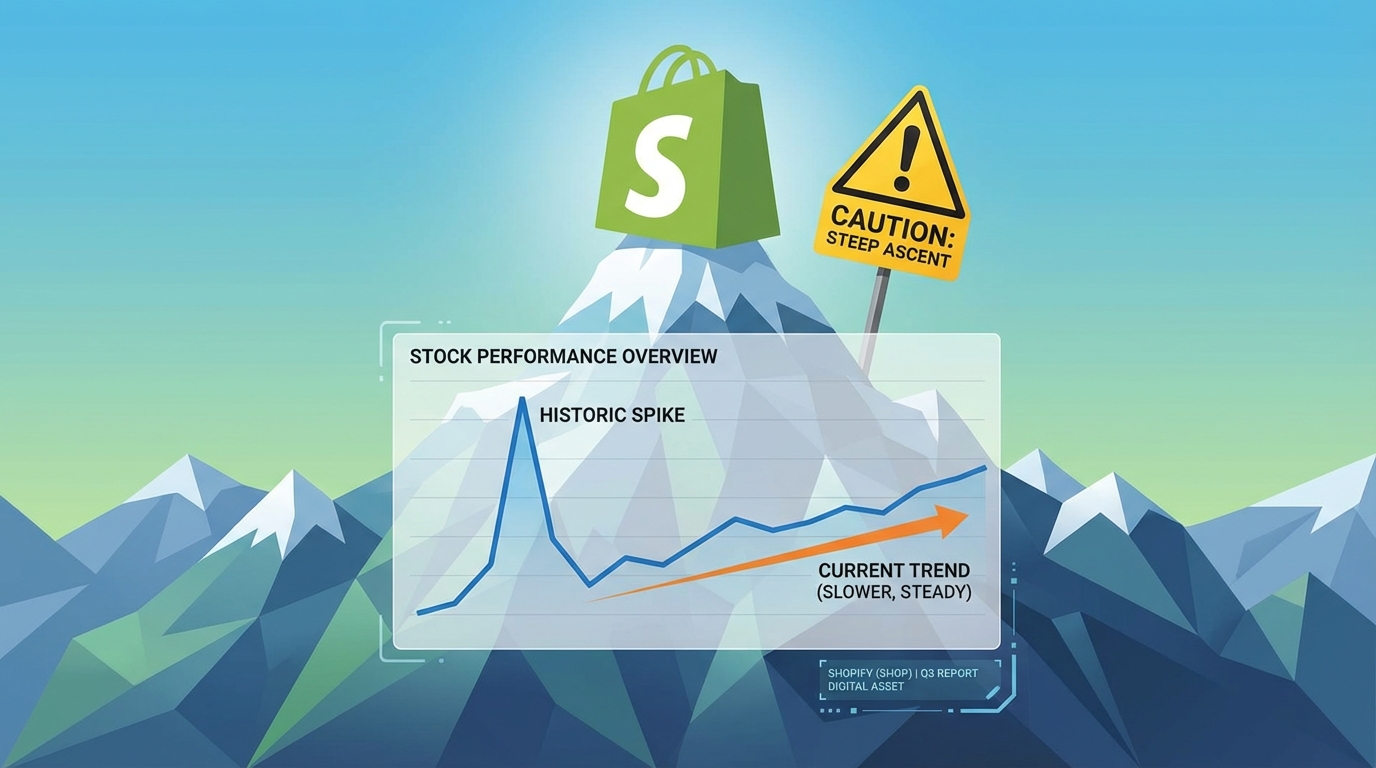
For nearly a decade, Shopify has been the undisputed “Golden Child” of the e-commerce world. If you were an early investor, the story was simple: buy the dip, ride the explosive growth of the direct-to-consumer (DTC) movement, and watch your net worth climb alongside the platform’s skyrocketing Gross Merchandise Volume (GMV). However, as we navigate the complex economic landscape of early 2026, a new consensus is forming among Wall Street’s elite: Shopify stock: the easy money’s been made.
The era of “growth at any cost” has officially transitioned into an era of “disciplined execution.” While Shopify remains a dominant force, the tailwinds that once propelled it to triple-digit gains are now facing the headwinds of market saturation, high valuation multiples, and a global economy grappling with shifting interest rates. In this guide, we will break down the core metrics, practical investment strategies, and potential risks to determine if Shopify is still a “buy” or if the “easy money” era is truly behind us.
The Maturity of an E-commerce Titan
To understand why some analysts believe Shopify stock: the easy money’s been made, we must first look at the platform’s current market position. Shopify is no longer a “scrappy startup.” It is a massive, multi-faceted ecosystem that powers roughly 30% of all e-commerce websites in the United States and over 10% of the global market software space.
The Law of Large Numbers
In the early days, Shopify could easily double its revenue every year. Today, the “Law of Large Numbers” has set in. While the company reported an impressive 32% revenue growth in late 2025, maintaining those levels becomes exponentially harder as the base grows larger. To sustain its premium valuation, Shopify must now find growth in more complex areas like B2B wholesale, international expansion (particularly in Europe and APAC), and high-end enterprise solutions via Shopify Plus.
Valuation vs. Reality
Shopify has always traded at a “growth premium.” As of January 23, 2026, the stock trades at a Price-to-Earnings (P/E) ratio exceeding 100x. While its profitability has improved—marking nine consecutive quarters of double-digit free cash flow margins—this valuation leaves very little room for error. If the company misses a single quarterly target or provides cautious guidance, the “premium” can evaporate in a single trading session.
Navigating the “Late Cycle” Growth
If you are considering a position today, you are no longer an “early adopter”; you are a “late-cycle” growth investor. This requires a much more nuanced framework than the simple “buy and hold” of 2017.
Focus on Free Cash Flow (FCF) Yield
Because the explosive revenue growth is normalizing, the new metric for success is Free Cash Flow. Shopify’s pivot away from its expensive logistics business in 2023 was a “Master Stroke” that allowed it to become a asset-light, high-margin software business once again.
- The FCF Play: Look for the FCF margin to consistently stay above 15–18%. If the company can achieve this while growing revenue at 20%+, the stock can justify its higher multiple over the long term.
The “Agentic AI” Catalyst
The one wild card that could disprove the theory that Shopify stock: the easy money’s been made is Artificial Intelligence. Shopify is currently evolving from a transaction processor into an “intelligent commerce operating system.”
- Sidekick and Automation: The integration of AI tools like Sidekick helps merchants automate descriptions, SEO, and even customer support.
- The Strategy: Monitor the adoption rate of Shopify’s AI features. If AI can significantly reduce “churn” (merchants leaving the platform) and increase the Average Order Value (AOV) for its customers, it creates a new “growth leg” that isn’t dependent on adding new merchants.
Actionable Steps for the Shopify Investor:
- Dollar-Cost Average (DCA): Avoid “lumping” into a position at these levels. Use DCA to build a position over 6–12 months.
- Watch the 52-Week High: Currently near $182. A failure to break this level with high volume may signal a “topping out” phase.
- Monitor B2B Growth: This is Shopify’s “Next Frontier.” If B2B GMV continues to grow at 90%+ year-over-year, the company is successfully tapping into a massive new market.
- the best financial planning tools for long-term growth
Scenarios and Case Insights: The ROI of “Hard Money”
To see the difference between the “easy money” and the “hard money” eras, let’s look at a comparative scenario of portfolio returns over the last decade versus projected returns for 2026–2030.
Scenario: The “Alpha” Comparison
Imagine two investors, one in 2016 and one in 2026, both investing $10,000 into SHOP.
| Metric | The “Easy Money” Era (2016-2021) | The “Hard Money” Era (2026-2030 Est.) |
| Market Condition | Low Rates / Early DTC Boom | High Rates / Mature Market |
| Annual Revenue Growth | 50% – 90% | 20% – 25% |
| Projected 5-Year ROI | ~1,500%+ | ~60% – 90% |
| Investor Risk Profile | High Volatility / High Reward | High Volatility / Moderate Reward |
As the table shows, a 25% annual return is still excellent—far outperforming the S&P 500—but it is a far cry from the life-changing wealth generated in the early days. This is what we mean when we say Shopify stock: the easy money’s been made. You can still make money, but you have to work much harder for it.
Macro Perspective: According to theInternational Monetary Fund (IMF), “operational readiness” and infrastructure efficiency will define the 2026 e-commerce winners. Shopify’s focus on 99.99% uptime and 30% faster checkouts during peak events is exactly where the value lies now.
Common Mistakes and Risks to Avoid
- Chasing the All-Time Highs: Don’t let “FOMO” (Fear Of Missing Out) drive you to buy at the top of a parabolic move. Wait for a healthy correction of 10–15% before entering.
- Ignoring Competitor Innovation: While Shopify is the leader, competitors like WooCommerce and Wix are catching up in terms of feature parity. the best AI crypto projects to watch in 2026
- Underestimating Macro Sensitivity: Shopify is highly sensitive to consumer spending. If inflation remains “sticky” through 2026, the mid-market merchants that fuel Shopify could see their margins—and their ability to pay Shopify—severely impacted.
- Overlooking “Stock-Based Compensation” (SBC): Shopify spends a lot on its people. While the $130M quarterly SBC is manageable, it remains a “drag” on real earnings that investors must account for.
Conclusion – Key Takeaways & Next Steps
The thesis that Shopify stock: the easy money’s been made is not a “Sell” recommendation; it is a “Reality Check.” Shopify remains a world-class company with a massive moat and a visionary leadership team. However, the days of throwing money at the screen and waking up 10x richer are likely over. The stock has matured into a high-quality, high-valuation “Blue Chip” of the tech world.
Success in the 2026 market will come to those who treat Shopify as a core foundational piece of a tech-heavy portfolio, rather than a “get rich quick” speculative play. By focusing on free cash flow, AI integration, and disciplined entry points, you can still build significant wealth with Shopify—it just might take a little more patience.
Are you ready to audit your tech holdings for the 2026 cycle?
Start by reviewing your portfolio’s “Growth-to-Valuation” ratio. Would you like me to create a “Shopify vs. Amazon” comparison report to see which e-commerce giant offers the best risk-adjusted return for your specific goals?