
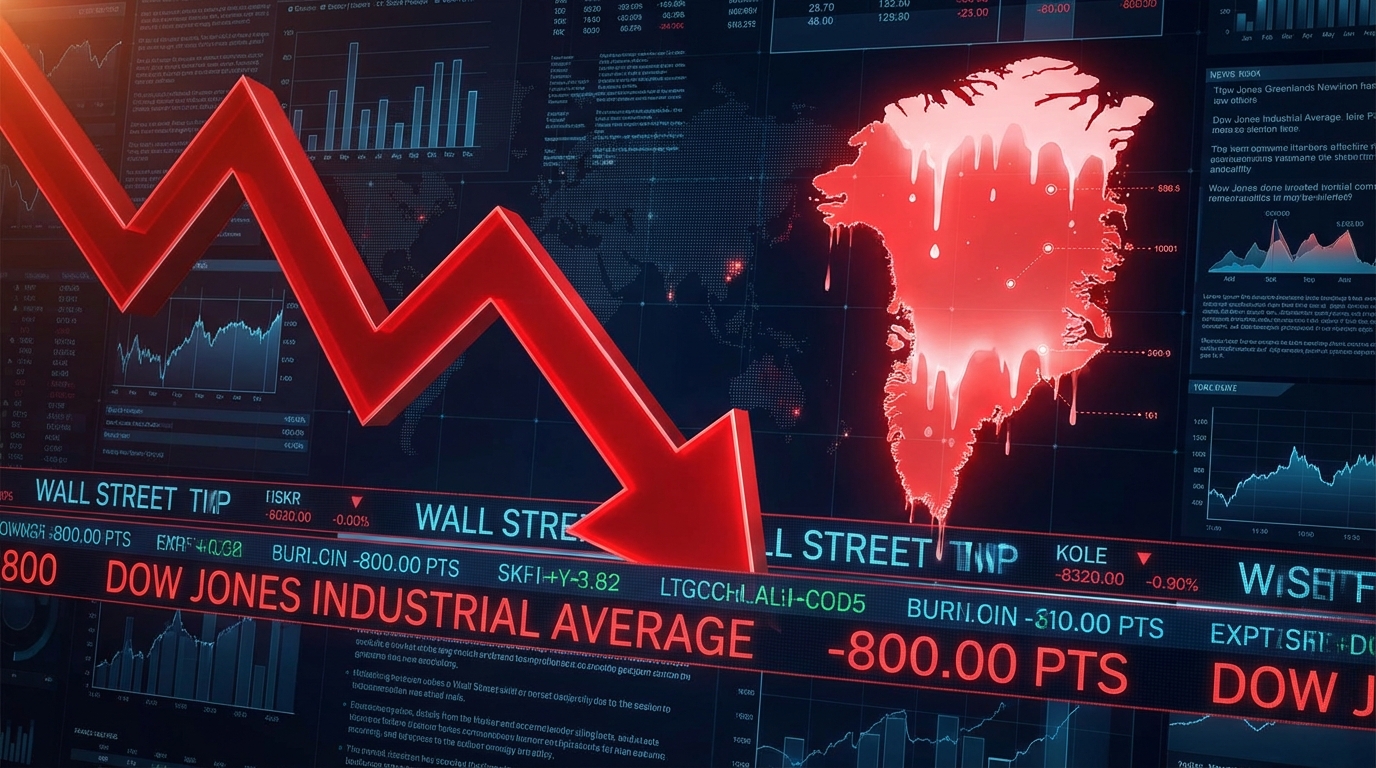
The volatility of the stock market today reached a fever pitch as the Dow Jones Industrial Average plummeted more than 800 points, marking its steepest single-day decline since October.1 This dramatic sell-off was triggered by a sudden escalation in trade tensions, as President Trump issued fresh tariff threats against several European allies over the ongoing bid to acquire Greenland.2 As the S&P 500 and Nasdaq both sank over 2%, investors were left scrambling to assess the macroeconomic fallout of a potential trade war with eight NATO member states.3
For those tracking the stock market today, the message was clear: geopolitical risk is back at the forefront of the 2026 investment landscape.4 While the new year began with a spirit of optimism, the threat of 10% to 25% tariffs on imports from nations like Denmark, Germany, and the UK has introduced a significant “risk premium” into equity valuations.5 In this article, we will break down the core drivers of today’s market rout, analyze the sectors hardest hit, and provide practical strategies for navigating this high-stakes economic environment.
Greenland Tariffs and Market Volatility
To understand why the stock market today reacted so violently, one must look at the intersection of trade policy and international relations. The current crisis centers on President Trump’s desire for the United States to purchase Greenland from Denmark.6 When European leaders pushed back on the proposal, the administration responded with the threat of sweeping import duties.7
The “Sell America” Trade Revived
The sell-off has revived what analysts call the “Sell America” trade—a phenomenon where investors dump U.S. dollar-denominated assets in favor of safe havens like gold and silver.8 On Tuesday, as the Dow shed 870 points, gold surged to a fresh record high above $4,760 an ounce.9 This flight to safety suggests that markets are pricing in prolonged uncertainty and a potential loss of confidence in traditional trade alliances.10
Impact on Global Supply Chains
The stock market today was particularly unkind to sectors reliant on complex, cross-border supply chains.11 Trump’s social media announcement specified that imports from Denmark, Norway, Sweden, France, Germany, the Netherlands, Finland, and Great Britain would face 10% tariffs starting February 1, rising to 25% by June.12 Because combined imports from the European Union exceed those from Mexico and China, the potential for an inflationary shock is massive.13
Practical Strategies for a Volatile Market
Navigating a sudden 800-point Dow drop requires a disciplined framework. While the headlines are alarming, the stock market today also reveals where the “smart money” is hiding.
1. Rotating into Defensive Sectors
Historically, during periods of high geopolitical friction, “Consumer Staples” and “Utilities” tend to outperform. In today’s rout, while tech giants like Nvidia and Apple fell more than 3%, staples like Colgate-Palmolive and Campbell’s Soup actually managed to edge higher.14
- Actionable Step: Audit your portfolio for tech concentration. If you are over-weighted in high-beta AI stocks, consider rebalancing into low-beta defensive sectors to cushion against further tariff shocks.
- Actionable Step: Monitor the CBOE Volatility Index (VIX).15 Today, the VIX jumped above 20, a level that typically indicates heightened concern for the coming weeks.16
2. Utilizing “Safe Haven” Hedges
The stock market today confirmed that precious metals remain the ultimate hedge against geopolitical “black swan” events.
- Strategy: Maintaining a 5% to 10% allocation in physical gold or silver can provide a psychological and financial floor when equities are in a tailspin.
- Strategy: Watch the 10-year Treasury yield. Today, yields jumped to 4.29% as bond prices fell, reflecting fears that European nations might retaliate by selling their U.S. debt holdings.17
Actions to Take Immediately:
- Review your stop-losses: Ensure your “sell triggers” are active but not too tight, as high-volatility days often involve “fake-out” moves.
- Check your margin levels: A 2% drop in the major indices can trigger margin calls for over-leveraged accounts.
- Monitor Davos headlines: With world leaders meeting at the World Economic Forum, any sign of de-escalation could spark a rapid “mean reversion” rally.
Scenarios and Market Insights
To understand the weight of the stock market today, let’s look at a comparative analysis of how different asset classes performed during this 800-point plunge.
Scenario: The “Man-Made Crisis” Impact
If the tariff threats are not walked back by the February 1st deadline, we could see a structural shift in market pricing.
| Asset Class | Today’s Move | Reason for Volatility |
| Dow Jones (Blue Chips) | -1.8% (-870 pts) | Fear of industrial export slowdown to Europe. |
| Nasdaq (Tech) | -2.4% | Supply chain disruptions for semiconductor components. |
| S&P 500 (Benchmark) | -2.1% | Broad-based “risk-off” sentiment across 10 of 11 sectors. |
| Gold (Spot)18 | +3.7%19 | Traditional flight to safety amid treaty uncertainty.20 |
| U.S. Dollar Index | -0.8% | “Sell America” mood due to strained NATO alliances. |
For a retail investor with a $100,000 portfolio, the stock market today resulted in an immediate $2,100 paper loss. However, those who followed a “barbell strategy”—holding both growth tech and defensive gold—likely saw that loss mitigated to under $500. This is the power of diversification in a 2026 economy where “the bark is often worse than the bite,” but the bite is still painful.
Common Mistakes and Risks to Avoid
- Panic-Selling at the Bottom: Major sell-offs like the one in the stock market today often lead to “oversold” conditions. Selling during an 800-point drop often means you miss the eventual “snap-back” rally once diplomacy resumes.
- Underestimating Retaliatory Tariffs: The European Union has already threatened to use its “anti-coercion instrument.”21 This could lead to 200% tariffs on American goods like wine and bourbon, impacting U.S. consumer discretionary stocks.
- Ignoring the Fed’s Dilemma: Higher tariffs are inflationary. If the stock market today is any indication, the Federal Reserve may be forced to hold interest rates higher for longer to combat “imported inflation,” which would put further pressure on stock multiples.
- Forgetting About Small Caps: Interestingly, the Russell 2000 has been outperforming larger indices lately. as they are less exposed to global trade wars.
Conclusion – Key Takeaways & Next Steps
The stock market today provided a jarring reminder that geopolitical headlines can override even the strongest economic fundamentals. While the Dow’s 800-point plunge and the 2% sink in the S&P 500 and Nasdaq are alarming, they are also a signal to return to the basics of risk management. The Greenland tariff threats have created a “man-made crisis” that requires investors to stay nimble, diversified, and focused on long-term value.22
Whether this sell-off is the start of a deeper correction or just a temporary “kerfuffle” depends on the diplomatic talks currently unfolding in Davos. For now, the safest path is to maintain a high-quality, diversified portfolio that can weather the storm of “maximum pressure” trade tactics.
Are you worried about how your portfolio handles trade wars?
Start by auditing your exposure to the “Davos Eight” European countries. Would you like me to create a “Geopolitical Risk Scorecard” to help you identify which of your stocks are most vulnerable to the Greenland tariff threats?




2 Comments