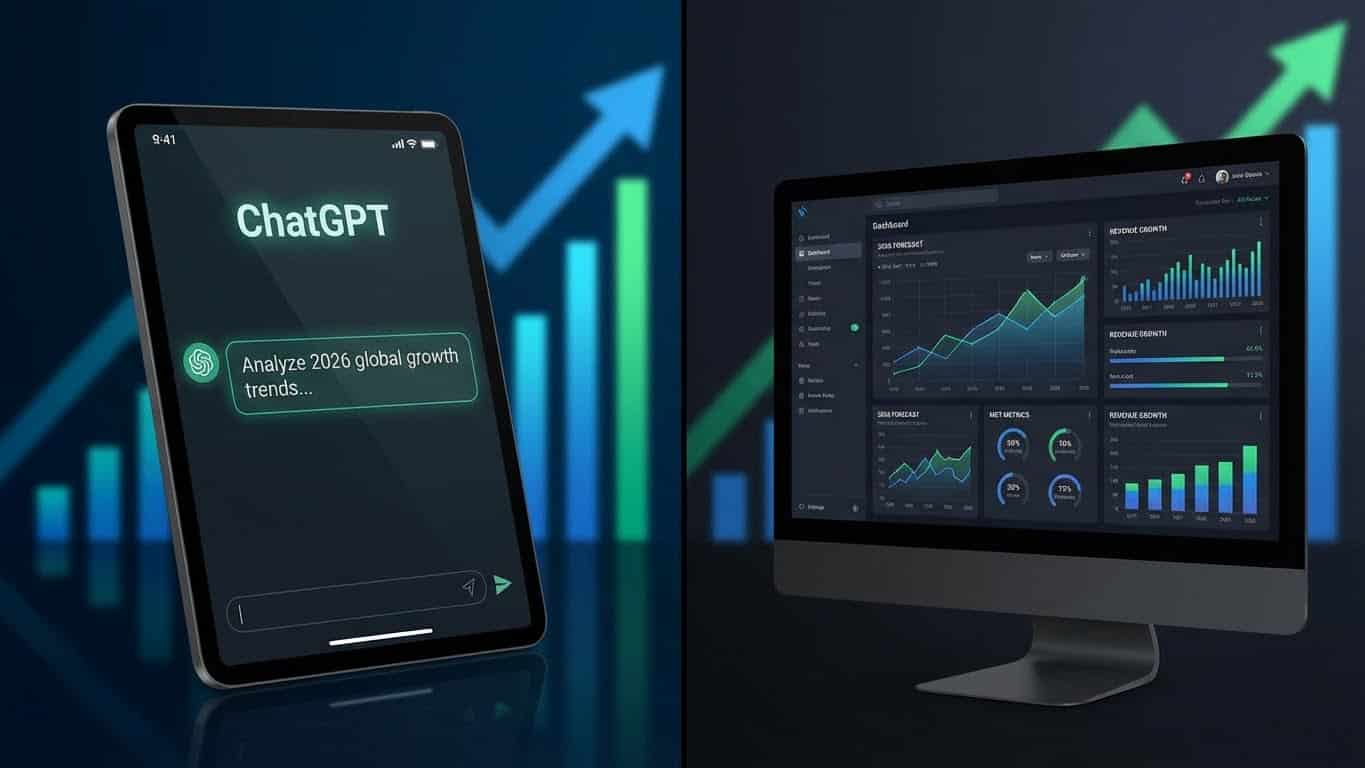
The era of manual spreadsheets and guessing your way through retirement is officially over. As we navigate the high-stakes economic landscape of January 2026, the traditional, static approach to wealth management is being replaced by something far more powerful: agentic intelligence. With the Dow Jones flirting with historic milestones and the U.S. Federal Reserve maintaining a “higher-for-longer” stance at 3.5%, the complexity of modern markets is staggering. Fortunately, ChatGPT can build your financial plan today, transforming from a simple chatbot into a 24/7 personal chief financial officer.
Writing a financial plan in 2026 is no longer about filling out a dry PDF once a year. It is about deploying an autonomous agent that reasons through your unique tax liabilities, inflation-adjusted goals, and risk tolerance in real-time. Whether you are navigating the new deductions of the “One Big Beautiful Bill Act” (OBBBA) or seeking to optimize a high-yield portfolio, the integration of AI is your greatest competitive advantage. This guide provides the exact framework to move from “budgeting blindly” to a precision-engineered financial future.
The Rise of the Agentic Financial Plan
The fundamental shift in 2026 is the transition from generative AI to agentic AI. When we say ChatGPT can build your financial plan, we are no longer referring to a list of generic tips. We are talking about “Agentic Autonomy”—the ability of an AI to plan, reason, and execute multi-step workflows across your entire digital life.
The Power of Multi-Step Reasoning
In 2026, ChatGPT’s latest models use “Chain-of-Thought” reasoning to handle complex financial trade-offs. For example, instead of just telling you to save, the AI can analyze whether you should prioritize a Roth conversion at current 2026 tax brackets or capitalize on the 4% risk-free rates currently available in the “belly” of the yield curve. This level of nuanced decision-making was once reserved for high-fee wealth managers, but it is now accessible through a simple interface.
Contextual Intelligence and Real-Time Grounding
One of the most significant breakthroughs of the last year is the ability to “ground” your AI in real-time market data and personal context. By securely connecting your financial agents to live feeds and your own transaction history (anonymized for privacy), you ensure that your plan is never out of date. If the inflation rate shifts from 2.7% to 3% tomorrow, your agentic plan adjusts your “safe withdrawal rate” and spending targets instantly.
The 2026 Prompting Framework
To stop budgeting blindly, you need to use a sophisticated prompting system. The most successful investors in 2026 use the R.T.C.S. Model (Role, Task, Context, Structure) to ensure the output is professional-grade and ready for implementation.
Phase 1 – The “Role and Reality” Audit
The first step is to establish the AI as your lead analyst. You must provide enough context so it doesn’t hallucinate generic advice.
Prompt Example: “Act as a Senior Financial Planner specializing in the 2026 U.S. economic landscape. I am currently earning [Income] with [Debt] and a goal of [Target]. Before you draft my plan, ask me 10 probing questions about my risk tolerance, tax-loss harvesting history, and dependents to ensure the plan is airtight.”
Phase 2 – Building the “Dynamic Wealth Engine”
Once the context is set, you instruct the AI to build the specific “engines” of your plan. This is where ChatGPT can build your financial plan into something truly actionable.
- The “OBBBA” Optimization: Ask the AI to identify which of your accounts can most benefit from the 2025 “One Big Beautiful Bill Act” tax incentives.
- Automated Expense Triage: Use the AI to analyze your last three months of spending (via a CSV upload) to identify “leakage” in areas like underutilized SaaS subscriptions or high-interest credit card traps.
- The High-Yield Ladder: Instruct the AI to build a “Bond Ladder” or a “CD Strategy” based on current interest rates to ensure you are earning maximum yield on your emergency fund.
Actionable Checklist for Your AI Plan:
- Verify the MAGI: Ensure you ask the AI to calculate your Modified Adjusted Gross Income (MAGI) to see if you qualify for the new 2026 Senior Tax Deductions.
- Stress Test for 3.5% Inflation: Ask the AI to run a “Worst Case” scenario where inflation stays sticky at 3.5% for the next five years.
- Audit Expense Ratios: Have the AI compare your current ETF expense ratios against the 2026 industry averages to find cost-savings.
7 AI Trading Tools That Save You 10 Hours of Trading Daily
Examples, Scenarios, and Case Insights
To illustrate the difference between traditional planning and AI-integrated planning, let’s look at a comparative scenario of an investor in early 2026.
Case Study: The $10,000 Correction Strategy
Imagine a scenario where the “K-shaped” recovery of 2025 leads to a sudden sector rotation in February 2026.
| Task | Traditional “Blind” Budgeting | ChatGPT-Integrated Planning |
| Market Scan | Checks headlines once a day. | Agentic AI scans real-time filings for sentiment shifts. |
| Tax Impact | Guesses the capital gains tax. | AI models the exact tax liability of a potential sale. |
| Rebalancing | Waits for the end of the quarter. | AI flags an immediate “Value Opportunity” in the Dow. |
| Wealth Preservation | Panic sells in volatile sectors. | AI executes a “Trailing Stop-Loss” strategy automatically. |
Real-World Insight: The 2026 Productivity Boost
According to reports from J.P. Morgan Global Research, the “relentless expansion of AI” is the primary driver of corporate earnings in 2026. By using these same tools for your personal finances, you are effectively “front-running” the productivity wave. An investor using ChatGPT to automate their debt-avalanche strategy can save an average of 14 months on their repayment timeline simply by optimizing for interest-rate differentials that a human would miss.
writing a financial plan with ChatGPT
Common Mistakes and Risks to Avoid
- The “PII” Security Gap: Never input your full legal name, social security number, or exact bank account numbers. Use rounded numbers or placeholders (e.g., “Account A” instead of “Chase Savings”).
- Assuming 100% Accuracy: While ChatGPT can build your financial plan, it can still hallucinate specific tax codes. Always verify its output against official World Bank or IMF data.
- Ignoring the “Human-in-the-Loop”: Use AI for the math and the strategy, but always be the one to click “confirm” on any trade or major life change.
- Prompts that are Too Vague: Asking “How do I save money?” will get you generic advice. Ask: “Analyze my 30% debt-to-income ratio and provide a 12-month reduction plan.”
- Forgetting the Macro Context: The 2026 environment is unique. If you don’t mention the current 3.5% Fed interest rate in your prompts, the AI might use outdated 2023 or 2024 assumptions.
Conclusion – Key Takeaways & Next Steps
Budgeting blindly is a relic of the past. Today, ChatGPT can build your financial plan with a level of precision and adaptability that was impossible just two years ago. By leveraging agentic autonomy, multi-step reasoning, and real-time market grounding, you can build a portfolio that thrives despite sticky inflation and market volatility.
Stability in 2026 is no longer about finding the “one right stock”; it is about the efficiency of your information processing. The AI-integrated investor is the one who will survive the 35% probability of a 2026 recession and emerge on the other side with their wealth intact.
Would you like me to help you draft your first “Financial Planner” system instruction based on your specific 2026 wealth goals? Explore our further resources to stay updated on the latest AI-driven wealth strategies.