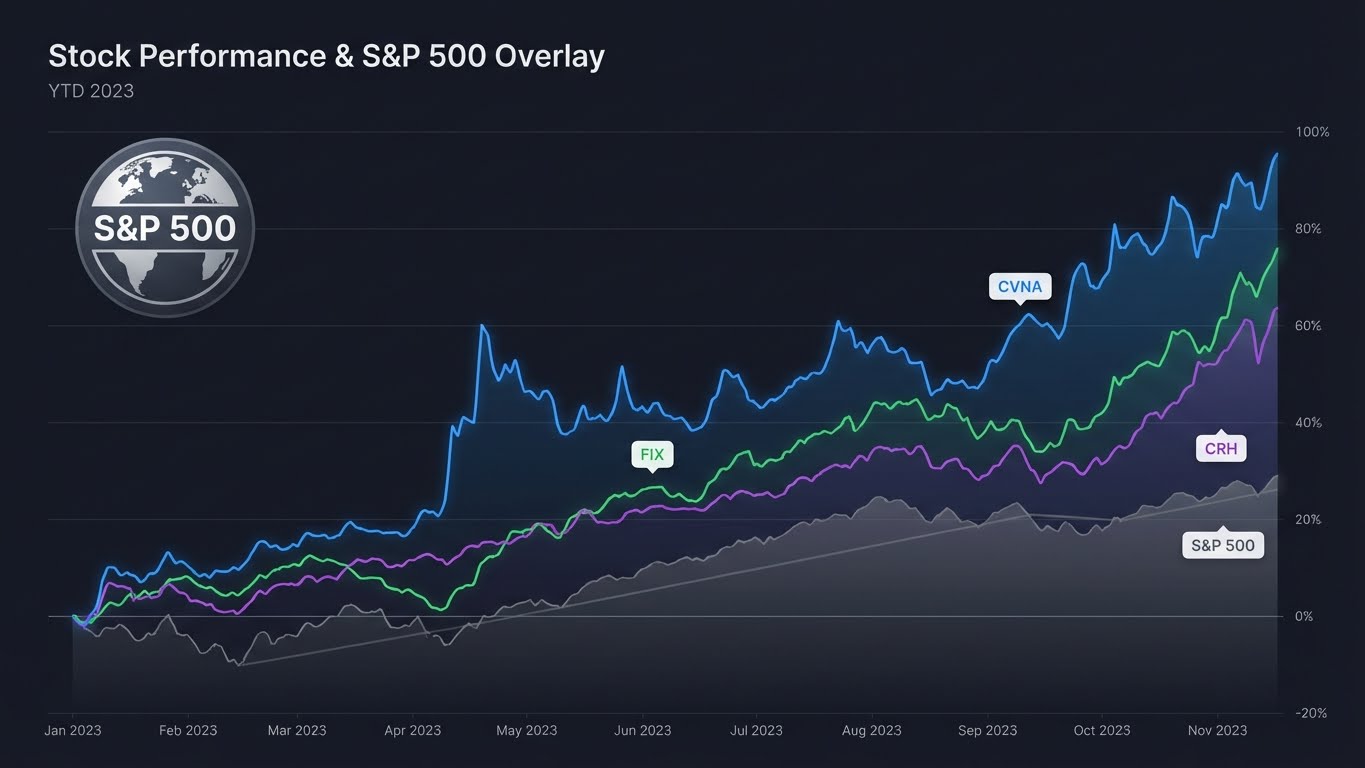
When you see headlines shouting that Carvana Comfort Systems CRH to join S&P 500, it’s easy to feel like you’re about to miss “the big one.” Index inclusion often triggers sharp price moves, heavy trading volume, and a wave of investor FOMO. In December 2025, S&P Dow Jones Indices confirmed that CRH, Carvana (CVNA), and Comfort Systems USA (FIX) will be added to the S&P 500 as part of the index’s quarterly rebalancing, effective before the open on December 22, 2025. News Release Archive+1
In this article, we’ll break down what this move really means, how to think about the rally, and how you can build a disciplined strategy instead of chasing the hype.
Section 1 – Core Concept: What “Carvana Comfort Systems CRH to Join S&P 500” Really Means
S&P 500 inclusion isn’t a press-release trophy. It has real mechanical and psychological effects on a stock.
On the mechanical side, every S&P 500 index fund and ETF must eventually buy shares of the new constituents so they can continue to track the index. Because the S&P 500 is the most-followed large-cap benchmark in the world, inclusion typically brings higher demand and liquidity. S&P Global+1
On the psychological side, investors see S&P 500 membership as a badge of quality: consistent profitability, size, and trading volume are key requirements. Companies like CRH, Carvana, and Comfort Systems USA were selected after meeting these criteria and being approved by the S&P index committee. S&P Global+1
Key Component 1 – Why These Three Names?
According to S&P Dow Jones Indices, CRH (materials), Carvana (consumer discretionary), and Comfort Systems USA (industrials) will join the S&P 500, replacing LKQ and Power Integrations, which move to the S&P SmallCap 600. News Release Archive
Broadly, this tells you three things:
- Size: They’ve reached large-cap territory and meet market-cap thresholds for inclusion. ويكيبيديا
- Profitability: The S&P 500 requires positive GAAP earnings in the most recent quarter and over the last four quarters. ويكيبيديا
- Sector Representation: The committee balances sector weights; adding a materials giant (CRH), a cyclical consumer name (Carvana), and an industrial contractor (Comfort Systems) helps keep the index representative of the wider economy. S&P Global+1
In the immediate aftermath of the announcement, all three stocks spiked in after-hours trading as traders and algorithms positioned ahead of index-fund buying. Investors.com+1
Key Component 2 – The Mechanics Behind “Stocks Are Breaking Out”
When you read that Carvana Comfort Systems CRH to join S&P 500 and that “the stocks are breaking out,” it’s usually driven by three forces:
- Front-running index funds: Active traders buy ahead of passive buying pressure.
- Short covering: Traders who were short the stock rush to cover, amplifying the move.
- Momentum and FOMO: New investors pile in based on the headline, not the fundamentals.
However, academic research and market history show that S&P 500 additions often see a strong pop followed by more muted or even negative short-term performance once the forced-buying window passes. Barron’s
That’s why your edge as an investor often lies in having a process, not reacting to a single news item.
Section 2 – Practical Strategies & Framework for S&P 500 Additions
Step-by-Step Strategy 1 – Fundamental Checklist Before You Buy
Instead of automatically chasing headlines about Carvana Comfort Systems CRH to join S&P 500, run each stock through a basic fundamental checklist:
- Business Quality
- What does the company actually do? Is the business model understandable?
- Does it generate sustainable free cash flow, or is it still highly dependent on capital markets?
- Balance Sheet Strength
- How much debt does the company carry relative to equity and cash flow?
- Could higher interest rates (a key theme in 2025–2026) pressure its ability to refinance?
- Earnings Quality
- Are earnings driven by real operations or one-time items and aggressive adjustments?
- For cyclicals like Carvana and CRH, how sensitive are profits to economic slowdowns?
- Valuation
- After the S&P 500 news spike, are you paying a premium vs. historical averages or peers?
- Remember: “great company” is not the same as “great price.”
- Role in Your Portfolio
- Are you already heavily exposed to consumer cyclicals or construction-related names?
- Can you size the position without breaking your risk limits?
Mastering Market Cycles: How Smart Investors Thrive in Bull and Bear Markets
Step-by-Step Strategy 2 – A Simple Playbook Around Index Rebalances
If you want to trade around index inclusions systematically, you can use this high-level playbook:
- Announcement Phase (Day 0–1)
- Price often gaps up on news that Carvana Comfort Systems CRH to join S&P 500.
- Liquidity spikes; spreads can widen in the first minutes after the headline.
- Index Fund Positioning (Next 3–5 Trading Days)
- Index funds gradually buy to match the new index weights ahead of the effective date. Barron’s+1
- Short-term momentum traders are very active in this window.
- Effective Date and Aftermath
- Price can be volatile into the close before the change, then sometimes fades afterward as speculative demand cools. Barron’s
- Medium-Term Repricing (Next 3–12 Months)
- Fundamentals and macro conditions (growth, inflation, rates) reclaim center stage.
- Stocks that were added for strong earnings and durable growth can outperform; others give back their inclusion pop.
Example Process: Timing Your Entry
- Aggressive trader: Scales in during the run-up, sells part or all near the effective date.
- Long-term investor: Often waits for post-inclusion consolidation rather than buying during peak hype.
- Risk-averse investor: Uses low, pre-defined position sizes and stop-loss levels instead of “all in” bets.
Section 3 – Examples & Scenario Analysis for S&P 500 Newcomers
To make this concrete, imagine three investors reacting to Carvana Comfort Systems CRH to join S&P 500.
Numeric Example: Position Sizing and Drawdowns
Assume each investor is starting with a $50,000 portfolio and is considering a basket of the three new S&P 500 entrants.
| Investor Type | Allocation to New S&P 500 Stocks | Dollar Amount | 20% Drawdown Impact on Portfolio |
|---|---|---|---|
| Conservative | 5% | $2,500 | –1% overall |
| Balanced | 15% | $7,500 | –3% overall |
| Aggressive | 30% | $15,000 | –6% overall |
This simple table shows that position sizing matters more than the exact entry price. Even if the basket drops 20% after the inclusion pop, the conservative investor only sees a 1% portfolio hit, while the aggressive investor takes a 6% hit.
Scenario 1 – Chasing the Breakout
An investor buys immediately after reading that Carvana Comfort Systems CRH to join S&P 500 and that “the stocks are breaking out.”
- If prices climb another 10% into the effective date, they feel like a genius.
- But if, after inclusion, the stocks pull back 15% as speculative flows reverse, the investor is suddenly underwater — even if the long-term fundamentals remain intact.
Key lesson: Your holding period should match your thesis. If you bought for a short-term “index pop,” don’t turn it into a long-term hold just because the trade moved against you.
Scenario 2 – Waiting for the Dust to Settle
Another investor sets alerts and waits 2–4 weeks after the effective date:
- They review updated research, earnings, and macro commentary.
- They compare valuations versus peers and assess whether S&P 500 membership could support higher long-term multiples (e.g., via increased liquidity and institutional ownership).
They may miss part of the spike, but they’re trading less noise and more information.
Scenario 3 – Using a Basket Approach
Instead of betting on a single name, an investor:
- Allocates a fixed amount equally across CRH, Carvana, and Comfort Systems.
- Manages the basket like a “S&P 500 addition mini-ETF” with clear rules:
- Rebalance annually.
- Exit any name if fundamentals deteriorate (e.g., balance sheet stress, earnings collapse).
- Cap the basket at, say, 10% of their total equity exposure.
This approach reduces single-stock risk while still letting you participate in the theme that Carvana Comfort Systems CRH to join S&P 500 could be long-term winners.
Common Mistakes and Key Risks
Before you react to any S&P 500 inclusion headline, keep these pitfalls in mind:
- Confusing index inclusion with guaranteed outperformance
Being added to the S&P 500 is not a promise of future gains. Many additions have lagged the index after their initial pop. - Ignoring valuation after the spike
Paying any price because “it’s going into the S&P 500” can lock you into poor risk-adjusted returns. - Overlooking company-specific risks
- Carvana still carries business-model and leverage risk as an online auto retailer in a cyclical sector.
- CRH is exposed to construction cycles and infrastructure spending trends.
- Comfort Systems’ performance depends heavily on non-residential construction and HVAC demand.
- Forgetting macro conditions
In a world of uncertain growth, shifting inflation, and evolving interest-rate expectations, cyclical stocks can be more volatile than the broader index. - Concentrating too heavily in one theme
Going “all in” on the idea that Carvana Comfort Systems CRH to join S&P 500 will automatically outperform can leave your portfolio under-diversified. - Treating news articles as personal advice
Headlines and even analysis pieces (including this one) are educational, not tailored financial advice. Always consider your time horizon, risk tolerance, and overall plan.
Conclusion – Key Takeaways & Next Steps
The news that Carvana Comfort Systems CRH to join S&P 500 is exciting, and the “stocks are breaking out” narrative can make it tempting to hit the buy button immediately. But smart investors step back and frame the story inside a disciplined process.
Key takeaways:
- S&P 500 inclusion brings forced buying, more liquidity, and prestige, but not guaranteed long-term outperformance.
- The initial spike is often driven by technical flows (index funds, short covering, momentum traders), not new fundamental information.
- Your edge lies in understanding the businesses, valuing them reasonably, sizing positions appropriately, and respecting your own risk tolerance.
If you want to go deeper:
- Build or refine your written investment checklist and run each new S&P 500 addition through it.
- Consider tracking past S&P 500 additions to see how they behaved after inclusion.
- Continue learning about diversification, risk management, and factor exposure so you’re not just trading headlines.
Ultimately, the headline “Carvana Comfort Systems CRH to join S&P 500” should be the start of your analysis, not the end. Let it prompt better questions, not impulsive trades.
This article is for informational and educational purposes only and is not personalized investment advice. Always do your own research or consult a licensed financial professional before making investment decisions.